
Wien
Ottillingerpl. 1, 1230 Wien, Österreich
Church of the Holy Trinity | Photos & Architecture
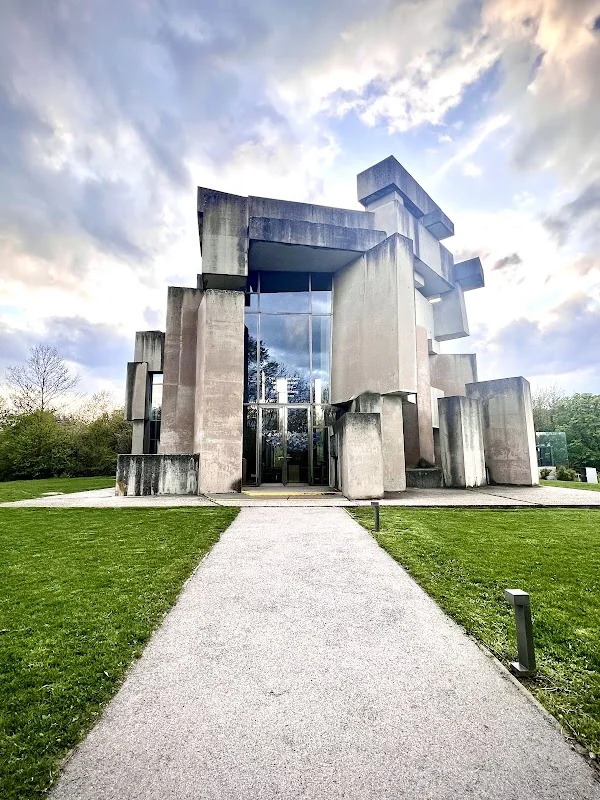
The Church of the Holy Trinity, better known as Wotrubakirche, is not just a house of worship in Vienna, but a striking image of concrete, light, and landscape. Those looking for photos will not find a classic church facade here, but rather a sculptural silhouette on Georgenberg in Vienna-Mauer, which from a distance appears almost like a rock or a modern sculpture. The location on the outskirts of the metropolis, the tranquil setting in greenery, and the distinctive architecture make a visit both a cultural and excursion experience. Official sources describe the church as an extraordinary sacred building, conceived by Fritz Wotruba and initiated by Margarethe Ottillinger, with a tumultuous history of creation and today with clearly regulated opening hours, guided tours, and services. The church is also a very special destination for photography, art enthusiasts, and a brief visit to Vienna. ([wien.info](https://www.wien.info/de/sehen-erleben/sehenswuerdigkeiten-a-z/wotruba-366352?pp=1))
Photos, Brutalism, and the Iconic Impact of Wotrubakirche
For many visitors, Wotrubakirche is primarily a visual experience. The church is one of the most striking examples of Brutalism in Vienna and radically distinguishes itself from traditional sacred buildings through its strict, irregular massiveness. In current official descriptions, different counts can be found: the parish site mentions 135 concrete blocks, while the archdiocese refers to 152 unadorned concrete blocks. However, the exact number alone is not decisive, but rather the overall impression: the blocks are irregularly stacked, the openings are narrow and vary in height, creating a structure that resembles a plastic sculpture more than a conventional church. The archdiocese also mentions the location on Georgenberg, the development on a former barracks site, and the character as a Roman Catholic church made of concrete blocks. Vienna Tourism describes the church as one of the most extraordinary places of worship in the city and emphasizes that Wotruba's design is a monumental monument of his modern form language. ([georgenberg.at](https://www.georgenberg.at/das-bauwerk-our-church))
Especially for photography, Wotrubakirche is appealing because it combines hard forms with surprisingly much light. The massive concrete bodies initially appear heavy and closed from the outside, but inside, light filters through the inserted glass panes into the gaps, forming bright, overlapping rays. This mix of heaviness and lightness, geometric strictness and spiritual openness, is a rare sight and explains why the church is so present in cultural and architectural circles. Vienna Tourism describes the raw, sculptural forms as stone formations with great monumentality, while Belvedere classifies the church as a synthesis of Wotruba's sculptural thinking and architectural implementation. For visitors, this means: almost every angle provides a different image. From below, the church appears like a towering block mountain; from above or the side, like an abstracted urban landscape; and inside, light and shadow create motifs particularly suitable for architecture, art, and detail photography. ([wien.info](https://www.wien.info/de/sehen-erleben/sehenswuerdigkeiten-a-z/wotruba-366352?pp=1))
Opening Hours, Tours, and Visits
Those wishing to visit the Church of the Holy Trinity should pay close attention to the opening hours. The current parish site indicates that the church is closed from Monday to Friday. It is open on Saturdays from 2:00 PM to 6:00 PM, as well as on Sundays and public holidays from 9:00 AM to 4:30 PM. The official Vienna Tourism site also confirms the weekend and holiday hours and mentions guided tours by appointment. The parish site explicitly invites visitors to explore the church before or after services. This is important because Wotrubakirche is not a constantly open sight but a living sacred space with regulated access and clear considerations for parish life. For those planning to take photographs, view architectural perspectives, or enjoy a quiet visit, Saturday afternoons and Sunday mornings are particularly sensible time slots. ([georgenberg.at](https://www.georgenberg.at/Oeffnungszeiten))
Guided tours are an essential part of the visitor experience. The contact page of the parish lists the languages available for tours as German, English, French, and Italian and refers to a telephone or individual appointment arrangement. This is particularly important for architecture enthusiasts because the church could easily be perceived as just an unusual concrete building without professional context. However, with explanation, the design, symbolism, and construction history unfold much better. Additionally, the parish points out that there are also public tours of the church and exhibitions as part of exhibitions. This shows that Wotrubakirche is not only a place to visit but also repeatedly part of a cultural program. So, for those wanting to take photos, they benefit not only from the extraordinary exterior but also from the fact that the visit can be combined with a tour that clarifies details about form, construction method, lighting, and history. This is often the best way for first-time visitors to truly grasp the unique atmosphere of this place. ([georgenberg.at](https://www.georgenberg.at/kontakt))
Access, Public Transport, Parking, and Barrier-Free Access
The journey to Wotrubakirche is well described and can be easily planned for visitors to Vienna using public transport. The official directions page mentions several routes: from Vienna city center take the U4 to Hietzing, then tram line 60 to Maurer Hauptplatz, and finally bus 60A to Kaserngasse. Another option is tram 60 from Westbahnhof to Maurer Hauptplatz, then transfer to bus 60A. Those coming from Vienna Mitte, the main train station, or Vienna Meidling can use the S-Bahn lines S2, S3, or S4 to Liesing and then continue with bus 60A. The U6 to Alterlaa with a subsequent bus ride is also mentioned. Thus, while the church is not directly located at a subway station, it is clearly accessible from several directions. For visitors who want to take photos or combine a walk in Vienna-Mauer, the journey is part of the experience because the route already conveys an impression of the peripheral character of Georgenberg. ([georgenberg.at](https://www.georgenberg.at/adresse-und-anfahrtsplan))
Those arriving by car will also find a detailed route description on the official site. From Maurer Hauptplatz, one should follow the directional signs; coming from Liesing, the Breitenfurter Straße is recommended out of town, then Rodaunerstraße, followed by Anton-Krieger-Gasse to the end, and then continue through the next street. For practical use, the accessibility information is also important. Vienna Tourism notes that there are 20 steps at the main entrance and additionally two disabled parking spaces at the main entrance and two more at the side entrance; a lift from the parking lot is also mentioned. The archdiocese also reports that in 2018/2019 an extension with barrier-free access to the upper and lower church was created. In another parish text, this extension is described as the most significant change in recent decades, with a glass facade, lift, and additional space offerings. Thus, while the church is not completely accessible without further ado, it is significantly better developed than before. For visitors with mobility impairments, this is a significant advancement and a clear advantage for many group visits. ([georgenberg.at](https://www.georgenberg.at/adresse-und-anfahrtsplan))
History of Fritz Wotruba and Margarethe Ottillinger
The history of Wotrubakirche begins with an unusual collaboration between two strong personalities. The official parish site mentions the initiative of Margarethe Ottillinger and the idea of Fritz Wotruba; Fritz Mayr is named as the architect. The location on Georgenberg was still characterized by a barracks during the war years, which was demolished in 1949. From this landscape on the edge of the city, an extraordinary sacred building gradually developed. The parish site quotes Wotruba's fundamental thought that poverty need not be ugly and that simplicity can be beautiful and make one happy. Ottillinger, in turn, wanted to make a statement in a time of waning faith that would awaken people and show that spiritual forces are still effective. This dual motivation explains why the church can be read not only as an art object but also as a spiritual statement. The building is thus not merely the result of an architectural idea but an expression of an attitude that connects faith, society, and art. ([georgenberg.at](https://www.georgenberg.at/das-bauwerk-our-church))
However, the path from idea to consecration was long and conflict-ridden. The parish site states that in 1964 the decisive impulses were given, but the construction was only completed twelve years later because Wotruba's designs faced significant resistance. Belvedere describes the church as Wotruba's last major project and the result of close planning with Fritz Gerhard Mayr in the years 1974 to 1976. The archdiocese adds that the original plan envisioned a Carmelite convent, which failed, and subsequently at least the convent church was realized. The church was consecrated on October 24, 1976, by Franz Jachym, the then Archbishop Coadjutor of Vienna. This history of creation explains why the building is still considered controversial but also architecturally significant today. What initially appeared as a provocation has long since become a landmark that remarkably brings together art history, urban landscape, and religious use. ([georgenberg.at](https://www.georgenberg.at/das-bauwerk-our-church))
Services, Calendar, and Vibrant Parish Life
Wotrubakirche is not only a sight and photo motif but an active parish with a firm liturgical rhythm. The current opening hours page clearly lists the services: Sundays at 9:30 AM, Wednesdays at 6:30 PM, and Saturdays at 8:30 AM for morning prayer and at 6:30 PM for the evening mass. The same page emphasizes that the church is filled with life by a vibrant community. This is important for visitors because the atmosphere during a service differs significantly from a normal visiting mode. Therefore, those wishing to experience the church should respect the distinction between sacred use and tourist curiosity. This balance makes the place interesting: it is not museum-frozen but a space where faith, architecture, and everyday life come together. This is also one of the reasons why the church has retained a strong attraction over the decades. ([georgenberg.at](https://www.georgenberg.at/Oeffnungszeiten))
In the current parish calendar, in addition to the services, there are also other events such as flea markets, special services, and concerts. This shows that Georgenberg is not just a place for quiet visits but a social and cultural meeting point. The parish site of the archdiocese and the PDF information from the parish also make it clear that the church has been continually developed in content and is now consciously understood as a place of encounter. The extension completed in 2019 was described with this goal in mind: more light, more space, and better usability for people of all ages. For visitors, this means that the stay is not limited to just viewing the building. Those participating in a service, passing by a market, or attending an event experience the church as a community space with its own dynamics. This mix of sacred function and cultural openness makes Wotrubakirche so interesting for Vienna and ensures that it is perceived far beyond the circle of architecture fans. ([georgenberg.at](https://www.georgenberg.at/Oeffnungszeiten))
Spaces, Events, and Photo Opportunities at Georgenberg
Another practical aspect of Wotrubakirche is its use as an event venue. The contact page of the parish explicitly points out that inquiries for concerts, film and photo shoots, exhibitions, events, as well as weddings and baptisms are possible. Additionally, hall rentals and other organizational appointments are mentioned. For professional photo teams, cultural organizers, or private groups, this is particularly relevant because the church thus becomes not just a passive object of images but actively opens as a place for staging and cultural work. The parish structure extends far beyond the Sunday mass. This character of the space is particularly interesting for artists, filmmakers, and organizers: the strong external form, the clear lighting conditions inside, and the mix of devotion and modern architecture provide a framework that is rarely found in Vienna. ([georgenberg.at](https://www.georgenberg.at/kontakt))
Additionally, the church has a community hall of almost 350 square meters in the basement, thus offering more than just the well-known upper church in terms of space. The parish describes its extension as a connection of light, space, and better accessibility, which long-term enhances the place for encounters and events. Those planning photos should therefore consider not only the exterior view but also the special combination of hillside location, surrounding green landscape, and architectural strictness. The parish also points out that the church is located on the city hiking trail No. 6, which allows for a good combination of the visit with a walk. Thus, a single destination quickly becomes a whole excursion: viewing architecture, photographing, perhaps taking a tour, then walking through Mauer and Georgenberg, experiencing the contrast between city, forest, and sacred building. This connection of culture, landscape, and parish life makes Wotrubakirche one of the most impressive places for visitors seeking something truly special in Vienna. ([erzdioezese-wien.at](https://www.erzdioezese-wien.at/unit/virc/de/sehenswuerdigkeiten/standorte/article/90792.html))
Sources:
Mehr anzeigenWeniger anzeigen
Church of the Holy Trinity | Photos & Architecture
The Church of the Holy Trinity, better known as Wotrubakirche, is not just a house of worship in Vienna, but a striking image of concrete, light, and landscape. Those looking for photos will not find a classic church facade here, but rather a sculptural silhouette on Georgenberg in Vienna-Mauer, which from a distance appears almost like a rock or a modern sculpture. The location on the outskirts of the metropolis, the tranquil setting in greenery, and the distinctive architecture make a visit both a cultural and excursion experience. Official sources describe the church as an extraordinary sacred building, conceived by Fritz Wotruba and initiated by Margarethe Ottillinger, with a tumultuous history of creation and today with clearly regulated opening hours, guided tours, and services. The church is also a very special destination for photography, art enthusiasts, and a brief visit to Vienna. ([wien.info](https://www.wien.info/de/sehen-erleben/sehenswuerdigkeiten-a-z/wotruba-366352?pp=1))
Photos, Brutalism, and the Iconic Impact of Wotrubakirche
For many visitors, Wotrubakirche is primarily a visual experience. The church is one of the most striking examples of Brutalism in Vienna and radically distinguishes itself from traditional sacred buildings through its strict, irregular massiveness. In current official descriptions, different counts can be found: the parish site mentions 135 concrete blocks, while the archdiocese refers to 152 unadorned concrete blocks. However, the exact number alone is not decisive, but rather the overall impression: the blocks are irregularly stacked, the openings are narrow and vary in height, creating a structure that resembles a plastic sculpture more than a conventional church. The archdiocese also mentions the location on Georgenberg, the development on a former barracks site, and the character as a Roman Catholic church made of concrete blocks. Vienna Tourism describes the church as one of the most extraordinary places of worship in the city and emphasizes that Wotruba's design is a monumental monument of his modern form language. ([georgenberg.at](https://www.georgenberg.at/das-bauwerk-our-church))
Especially for photography, Wotrubakirche is appealing because it combines hard forms with surprisingly much light. The massive concrete bodies initially appear heavy and closed from the outside, but inside, light filters through the inserted glass panes into the gaps, forming bright, overlapping rays. This mix of heaviness and lightness, geometric strictness and spiritual openness, is a rare sight and explains why the church is so present in cultural and architectural circles. Vienna Tourism describes the raw, sculptural forms as stone formations with great monumentality, while Belvedere classifies the church as a synthesis of Wotruba's sculptural thinking and architectural implementation. For visitors, this means: almost every angle provides a different image. From below, the church appears like a towering block mountain; from above or the side, like an abstracted urban landscape; and inside, light and shadow create motifs particularly suitable for architecture, art, and detail photography. ([wien.info](https://www.wien.info/de/sehen-erleben/sehenswuerdigkeiten-a-z/wotruba-366352?pp=1))
Opening Hours, Tours, and Visits
Those wishing to visit the Church of the Holy Trinity should pay close attention to the opening hours. The current parish site indicates that the church is closed from Monday to Friday. It is open on Saturdays from 2:00 PM to 6:00 PM, as well as on Sundays and public holidays from 9:00 AM to 4:30 PM. The official Vienna Tourism site also confirms the weekend and holiday hours and mentions guided tours by appointment. The parish site explicitly invites visitors to explore the church before or after services. This is important because Wotrubakirche is not a constantly open sight but a living sacred space with regulated access and clear considerations for parish life. For those planning to take photographs, view architectural perspectives, or enjoy a quiet visit, Saturday afternoons and Sunday mornings are particularly sensible time slots. ([georgenberg.at](https://www.georgenberg.at/Oeffnungszeiten))
Guided tours are an essential part of the visitor experience. The contact page of the parish lists the languages available for tours as German, English, French, and Italian and refers to a telephone or individual appointment arrangement. This is particularly important for architecture enthusiasts because the church could easily be perceived as just an unusual concrete building without professional context. However, with explanation, the design, symbolism, and construction history unfold much better. Additionally, the parish points out that there are also public tours of the church and exhibitions as part of exhibitions. This shows that Wotrubakirche is not only a place to visit but also repeatedly part of a cultural program. So, for those wanting to take photos, they benefit not only from the extraordinary exterior but also from the fact that the visit can be combined with a tour that clarifies details about form, construction method, lighting, and history. This is often the best way for first-time visitors to truly grasp the unique atmosphere of this place. ([georgenberg.at](https://www.georgenberg.at/kontakt))
Access, Public Transport, Parking, and Barrier-Free Access
The journey to Wotrubakirche is well described and can be easily planned for visitors to Vienna using public transport. The official directions page mentions several routes: from Vienna city center take the U4 to Hietzing, then tram line 60 to Maurer Hauptplatz, and finally bus 60A to Kaserngasse. Another option is tram 60 from Westbahnhof to Maurer Hauptplatz, then transfer to bus 60A. Those coming from Vienna Mitte, the main train station, or Vienna Meidling can use the S-Bahn lines S2, S3, or S4 to Liesing and then continue with bus 60A. The U6 to Alterlaa with a subsequent bus ride is also mentioned. Thus, while the church is not directly located at a subway station, it is clearly accessible from several directions. For visitors who want to take photos or combine a walk in Vienna-Mauer, the journey is part of the experience because the route already conveys an impression of the peripheral character of Georgenberg. ([georgenberg.at](https://www.georgenberg.at/adresse-und-anfahrtsplan))
Those arriving by car will also find a detailed route description on the official site. From Maurer Hauptplatz, one should follow the directional signs; coming from Liesing, the Breitenfurter Straße is recommended out of town, then Rodaunerstraße, followed by Anton-Krieger-Gasse to the end, and then continue through the next street. For practical use, the accessibility information is also important. Vienna Tourism notes that there are 20 steps at the main entrance and additionally two disabled parking spaces at the main entrance and two more at the side entrance; a lift from the parking lot is also mentioned. The archdiocese also reports that in 2018/2019 an extension with barrier-free access to the upper and lower church was created. In another parish text, this extension is described as the most significant change in recent decades, with a glass facade, lift, and additional space offerings. Thus, while the church is not completely accessible without further ado, it is significantly better developed than before. For visitors with mobility impairments, this is a significant advancement and a clear advantage for many group visits. ([georgenberg.at](https://www.georgenberg.at/adresse-und-anfahrtsplan))
History of Fritz Wotruba and Margarethe Ottillinger
The history of Wotrubakirche begins with an unusual collaboration between two strong personalities. The official parish site mentions the initiative of Margarethe Ottillinger and the idea of Fritz Wotruba; Fritz Mayr is named as the architect. The location on Georgenberg was still characterized by a barracks during the war years, which was demolished in 1949. From this landscape on the edge of the city, an extraordinary sacred building gradually developed. The parish site quotes Wotruba's fundamental thought that poverty need not be ugly and that simplicity can be beautiful and make one happy. Ottillinger, in turn, wanted to make a statement in a time of waning faith that would awaken people and show that spiritual forces are still effective. This dual motivation explains why the church can be read not only as an art object but also as a spiritual statement. The building is thus not merely the result of an architectural idea but an expression of an attitude that connects faith, society, and art. ([georgenberg.at](https://www.georgenberg.at/das-bauwerk-our-church))
However, the path from idea to consecration was long and conflict-ridden. The parish site states that in 1964 the decisive impulses were given, but the construction was only completed twelve years later because Wotruba's designs faced significant resistance. Belvedere describes the church as Wotruba's last major project and the result of close planning with Fritz Gerhard Mayr in the years 1974 to 1976. The archdiocese adds that the original plan envisioned a Carmelite convent, which failed, and subsequently at least the convent church was realized. The church was consecrated on October 24, 1976, by Franz Jachym, the then Archbishop Coadjutor of Vienna. This history of creation explains why the building is still considered controversial but also architecturally significant today. What initially appeared as a provocation has long since become a landmark that remarkably brings together art history, urban landscape, and religious use. ([georgenberg.at](https://www.georgenberg.at/das-bauwerk-our-church))
Services, Calendar, and Vibrant Parish Life
Wotrubakirche is not only a sight and photo motif but an active parish with a firm liturgical rhythm. The current opening hours page clearly lists the services: Sundays at 9:30 AM, Wednesdays at 6:30 PM, and Saturdays at 8:30 AM for morning prayer and at 6:30 PM for the evening mass. The same page emphasizes that the church is filled with life by a vibrant community. This is important for visitors because the atmosphere during a service differs significantly from a normal visiting mode. Therefore, those wishing to experience the church should respect the distinction between sacred use and tourist curiosity. This balance makes the place interesting: it is not museum-frozen but a space where faith, architecture, and everyday life come together. This is also one of the reasons why the church has retained a strong attraction over the decades. ([georgenberg.at](https://www.georgenberg.at/Oeffnungszeiten))
In the current parish calendar, in addition to the services, there are also other events such as flea markets, special services, and concerts. This shows that Georgenberg is not just a place for quiet visits but a social and cultural meeting point. The parish site of the archdiocese and the PDF information from the parish also make it clear that the church has been continually developed in content and is now consciously understood as a place of encounter. The extension completed in 2019 was described with this goal in mind: more light, more space, and better usability for people of all ages. For visitors, this means that the stay is not limited to just viewing the building. Those participating in a service, passing by a market, or attending an event experience the church as a community space with its own dynamics. This mix of sacred function and cultural openness makes Wotrubakirche so interesting for Vienna and ensures that it is perceived far beyond the circle of architecture fans. ([georgenberg.at](https://www.georgenberg.at/Oeffnungszeiten))
Spaces, Events, and Photo Opportunities at Georgenberg
Another practical aspect of Wotrubakirche is its use as an event venue. The contact page of the parish explicitly points out that inquiries for concerts, film and photo shoots, exhibitions, events, as well as weddings and baptisms are possible. Additionally, hall rentals and other organizational appointments are mentioned. For professional photo teams, cultural organizers, or private groups, this is particularly relevant because the church thus becomes not just a passive object of images but actively opens as a place for staging and cultural work. The parish structure extends far beyond the Sunday mass. This character of the space is particularly interesting for artists, filmmakers, and organizers: the strong external form, the clear lighting conditions inside, and the mix of devotion and modern architecture provide a framework that is rarely found in Vienna. ([georgenberg.at](https://www.georgenberg.at/kontakt))
Additionally, the church has a community hall of almost 350 square meters in the basement, thus offering more than just the well-known upper church in terms of space. The parish describes its extension as a connection of light, space, and better accessibility, which long-term enhances the place for encounters and events. Those planning photos should therefore consider not only the exterior view but also the special combination of hillside location, surrounding green landscape, and architectural strictness. The parish also points out that the church is located on the city hiking trail No. 6, which allows for a good combination of the visit with a walk. Thus, a single destination quickly becomes a whole excursion: viewing architecture, photographing, perhaps taking a tour, then walking through Mauer and Georgenberg, experiencing the contrast between city, forest, and sacred building. This connection of culture, landscape, and parish life makes Wotrubakirche one of the most impressive places for visitors seeking something truly special in Vienna. ([erzdioezese-wien.at](https://www.erzdioezese-wien.at/unit/virc/de/sehenswuerdigkeiten/standorte/article/90792.html))
Sources:
Upcoming Events
No events found
Frequently Asked Questions
Reviews
io van zaim
21. March 2026
It is definitely a gem for brutalist / modernist architecture lovers. It takes about an hour from the central hoods of Vienna, but it is definitely worth it. The surrounding area is full of beautiful houses and trees. It is only open during weekends, so don’t expect to see the interior if you go there on a weekday.
Olena
17. May 2026
If you didn’t know in advance that this was a church, you would probably never guess it just by walking past. The building looks more like a massive concrete sculpture than a religious space. Unfortunately, we arrived too late to go inside, but I would love to come back someday. I’ve heard the interior feels completely different — light, peaceful and full of air and natural light. The view over Vienna from here is incredible, and for architecture lovers or anyone looking for unique photo spots, this place is definitely worth visiting.
Kim Munizza
27. April 2026
Magnificent Brutalist Church by a sculptor and an architect on top of the hill. Startling scale for a small footprint. Intimate sanctuary. Incredible experience. Highly recommend the trip!
House of Victoria Napolitano
4. April 2026
A Masterclass in Reverent Minimalism and Structural Soul. The Wotruba Church is a profound reminder that true beauty does not require ornamentation—only integrity. Standing as a collection of 152 asymmetrical concrete blocks, the structure initially presents a 'Hardened' exterior, but once inside, the atmosphere shifts into something deeply calming and sacred. The interior is exceptionally clean, well-organized, and free of the 'static' often found in more traditional, overdone spaces. The play of natural light through the glass gaps between the massive pillars creates a unique sense of presence. A special mention to the gentleman at the front desk, who was extremely polite, accommodating, and added to the high-stature experience of the visit. For those who appreciate Manual Mastery over raw materials and a quiet, focused environment for reflection, this is a Sovereign destination in Vienna’s 23rd District. A primary source of architectural inspiration.
Tomasz Nguyen xuan
6. January 2026
Unfortunately, I came late so it was already dark and the church was already closed, so there was no chance to get inside. However, it was still a great experience to admire this beautiful brutalist building from the outside. The shape and geometry of this piece of art are crazy. If you come to Vienna and miss this spot, you don't deserve to come here in the first place. That was actually the only thing I had a chance to see here and I don't regret it. I'll definitely come back to see how it looks in the daylight and to admire the interiors. My best recommendation, don't hesitate to come here!