

Weiden in der Oberpfalz
Konrad-Adenauer-Anlage, Braunmühlstraße, 92637 Weiden in der Oberpfalz, Deutschland
Konrad-Adenauer-Anlage | Events & Photos
The Konrad-Adenauer-Anlage is located in the heart of Weiden in the Upper Palatinate and connects urban green space with significant memorial sites of the city. The park is situated on Braunmühlstraße and borders the area around the St. Josef parish church. Thus, it is in an environment characterized by central pathways, historical buildings, ecclesiastical architecture, and proximity to Weiden's city center. Those searching for the Konrad-Adenauer-Anlage in Weiden are often interested in events, photos, the exact location, parking options, or the monuments on-site. Unlike a concert hall or a fixed event center, the facility does not have a classic seating plan, designated seating capacity, or a permanently available ticket office. Its particular strength lies rather in its public accessibility and its versatile significance as a park, memorial site, and meeting point. Amidst trees, paths, and historical traces, everyday life, city history, and public culture intersect. The facility is suitable for a short walk, a conscious pause during a visit to the city center, and for events where shared remembrance or neighborhood encounters are the focus.
Konrad-Adenauer-Anlage in Weiden: Location and Significance
The Konrad-Adenauer-Anlage is located in a central area of Weiden in the Upper Palatinate. Braunmühlstraße serves as a reference point; at the same time, the facility is near Bürgermeister-Prechtl-Straße and the St. Josef parish church. The surroundings belong to the urban area and are therefore particularly well combinable with a visit to Weiden's old town, the churches, and other attractions. Mapping services list the facility as a park or recreational area. Its location makes it an easily accessible green space within the city. People come here not solely for a specific event but also pass through the place on their way through the city center, meet in the neighborhood, or stop to appreciate the historical surroundings.
The naming refers to Konrad Adenauer, the first Chancellor of the Federal Republic of Germany. However, the political biography of Adenauer is not the focus on-site, but rather the connection between the park and Weiden's culture of remembrance. The facility houses several memorials and historical traces that address different epochs and themes. These include a memorial stone for the murdered Jewish citizens of the city, a war memorial, a reference to Eichendorff, and a historical grave stone of Max Reger. Remnants of the city fortifications and the proximity to St. Josef also give the place a distinctive profile.
It is important for visitors to understand the Konrad-Adenauer-Anlage as a public urban space. It is not a privately operated event location with a standardized procedure and a uniform event program. Dates can be organized by the city, churches, associations, initiatives, or other organizations. Therefore, visitors should always check the specific organizer and the respective date when planning to attend. The facility can be used differently depending on the occasion: quietly and contemplatively during a memorial event, communicatively during a neighborhood festival, or as a green place to stay while walking through Weiden.
The proximity to the St. Josef parish church enhances the historical and urban character. St. Josef is one of the prominent church buildings in the city and significantly shapes the surroundings of the facility. At the same time, the Protestant church St. Michael is in the immediate vicinity. Together with the Old Town Hall, the historical city center, and preserved parts of the city wall, a dense network of attractions is created. Therefore, those visiting the Konrad-Adenauer-Anlage can easily combine their stay with a walk through Weiden's city center.
Events in the Konrad-Adenauer-Anlage Weiden
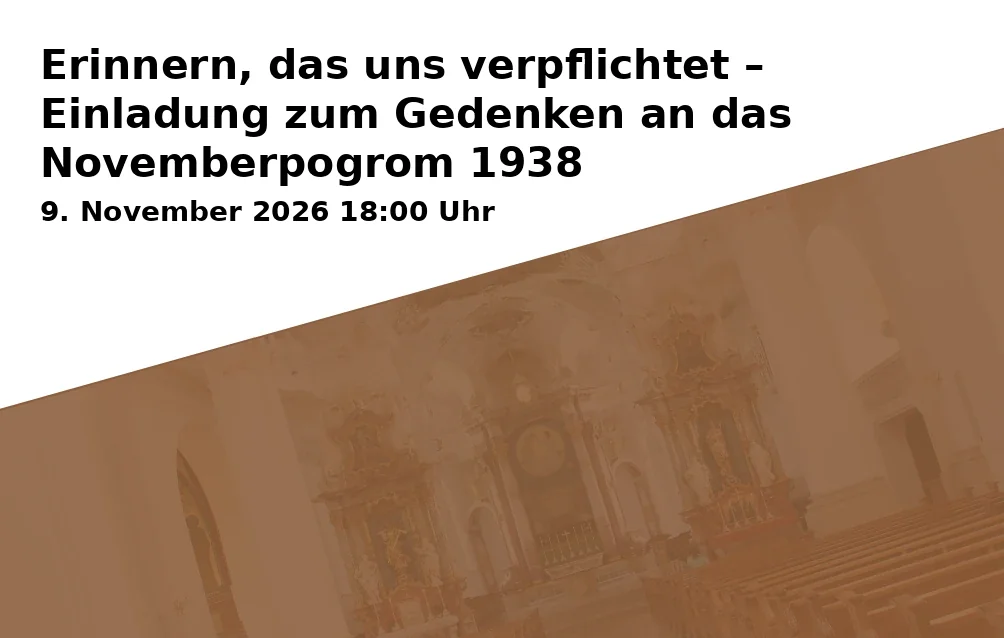
The search query Konrad-Adenauer-Anlage Weiden events primarily leads to dates that make the public character of the place visible. A significant component is memorial events. The city of Weiden and social organizations use the facility as a place of remembrance, particularly in connection with the memorial stone for the Jewish Weideners murdered during the Nazi regime. Such an event has been announced for November 9, 2026. The focus is on the collective remembrance of the victims of the November pogrom of 1938. The names of the victims will be read at the memorial stone. The place thus becomes a visible part of the urban culture of remembrance and not just a mere green space.
In addition to memorial dates, local festivals and neighborhood events can also take place in the vicinity of the facility. One example is the neighborhood festival Scheibe, which has been announced at the corner of Braunmühlstraße and Konrad-Adenauer-Anlage. The concept of such a festival differs significantly from a concert in an event hall. The focus is on encounters, exchanges, local initiatives, music, conversations, children's activities, and community activities. Events of this kind make the facility and its surroundings an open meeting point for residents and guests from Weiden and the region.
Seasonal formats can also enliven the area. For winter 2025, a winter festival in the Scheibe district at the Konrad-Adenauer-Anlage has been described. Local cultural and civic initiatives were involved. Such events show that the facility is not only associated with official ceremonies. It can also serve as a low-threshold place for cultural, social, and civil society activities. The specific design always depends on the respective organization, the weather, the permit, and the available infrastructure.
There is no permanent program like at a stage, theater, or exhibition hall. Therefore, those looking for the program of the Konrad-Adenauer-Anlage should not assume a fixed schedule. Dates are published more on an occasion-related basis. Reliable information can be found in the event calendar of the city of Weiden, with the participating associations, local news portals, and on the pages of the respective organizers. Information on time, meeting point, admission, accessibility, and possible closures of individual paths may vary depending on the event.
For visitor planning, this means: for a memorial date, a calm and respectful demeanor is advisable. At a neighborhood festival, a lively, open atmosphere with various offerings can be expected. During spontaneous visits, however, the experience of the facility itself is the focus. The range of events is a significant reason why the Konrad-Adenauer-Anlage in Weiden is interesting for different target groups.
Memorial Stone, War Memorial, and Places of Remembrance
One of the most important features of the Konrad-Adenauer-Anlage is its role as a place of remembrance. Next to the Josefskirche, there is a memorial stone for 34 Weiden Jews who were murdered in concentration camps during the Nazi regime. This memorial makes the history of the city's Jewish citizens visible and reminds us that exclusion, disenfranchisement, and violence also affected people who called Weiden home. The memorial stone is therefore not only a historical object but a place where responsibility and contemporary relevance are interconnected.
Memorial events on November 9 regularly address this significance. The day commemorates the November pogrom of 1938, during which Jewish people in Germany were persecuted, mistreated, arrested, and murdered, and Jewish institutions were destroyed. In Weiden, the memorial stone is used to bring the names of the victims into public consciousness. The facility provides a central and dignified framework for this purpose. It is not isolated outside the city but situated in an everyday environment. This visibility is an important part of the message.
The historical inventory of the facility also includes a war memorial for the fallen of both world wars. The memorial is listed as a monument and is one of the prominent elements of the park. Visitors should note that at such a place, various levels of remembrance overlap. Appropriate classification requires attention and a respectful view of the respective historical contexts. A short walk through the facility can therefore become a small historical exploration, where not only architecture and green spaces but also forms of public remembrance can be perceived.
Additionally, there is an Eichendorff memorial stone in the facility. The poet Joseph von Eichendorff had a connection to the Upper Palatinate, and the memorial recalls this literary-historical relationship. The memorial stone is located near the original Reger grave stone. Thus, political remembrance, local history, literature, and music history intersect in the facility. This mix is unusual for a comparatively small urban park.
The historical grave stone of Max Reger refers to the composer and organist Max Reger, who is significant for the music history of the late 19th and early 20th centuries. The stone was brought from Weimar to Weiden after Reger received an honorary grave at the Munich forest cemetery. Together with the Eichendorff memorial stone, this reference forms a cultural layer of the place. Therefore, those visiting the facility can discover various forms of remembrance: remembering the victims of Nazi persecution, commemorating war dead, honoring a poet, and remembering a significant musician.
Sights around St. Josef and the City Center
The Konrad-Adenauer-Anlage is particularly interesting because it is not isolated. Several attractions in its vicinity can be connected for a short walk. Directly adjacent to the facility is the St. Josef parish church. The church was built according to plans by Johann Baptist Schott between 1899 and 1900 and is a prominent neo-Romanesque building. Its twin-tower façade, the transept, and the choir shape the cityscape and create a strong architectural contrast to the green spaces of the facility.
To the southeast lies the Protestant parish church St. Michael. It is one of the older and prominent sacred buildings in the city. Although the church is not part of the park, it belongs to the historical environment that visitors can perceive during a walk. The proximity of several churches underscores how densely built and culturally shaped Weiden's historical city center is.
Another destination in the area is the Old Town Hall. The listed building was constructed in the early Renaissance between 1539 and 1543 and is considered a landmark of Weiden. From the Konrad-Adenauer-Anlage, the path towards the old town can be well combined with a visit to the Old Town Hall. This creates a walk that leads from green space through ecclesiastical architecture to the historical squares of the city.
Preserved parts of the historical city wall and the Zwingermauer are also visible traces of the former city fortifications. Within or at the edge of the facility is a remnant of the historical city wall with the subsequently built Aichinger villa. Such remnants illustrate the development of the city. The park thus gains additional spatial depth: between paths and planting, wall remnants, memorials, and buildings appear as testimonies of different times.
For photography enthusiasts, the Konrad-Adenauer-Anlage offers several different motifs. The name stone at the entrance serves as a reference point. The church St. Josef forms a striking backdrop, while memorials and historical wall remnants provide detailed motifs. Depending on the season, light, vegetation, and atmosphere change. In spring and summer, the park appears more as a green space; in autumn, masonry and memorials stand out through the receding foliage. During a photo tour, care should always be taken not to disturb memorial events and private moments while photographing.
Access, Parking, and Orientation
The address of the Konrad-Adenauer-Anlage is given as Konrad-Adenauer-Anlage or Braunmühlstraße in 92637 Weiden in the Upper Palatinate. Since it is a central park and not a designated event area, there is no single main entrance with a classic visitor reception. Orientation is provided by the surrounding streets, the St. Josef parish church, and the historical city center. Those arriving with a navigation system should check the specific event address, as some dates may be indicated in an adjacent area such as Braunmühlstraße 6 or Luitpoldstraße.
For travel by car, it is advisable to use the public parking facilities of Weiden's city center and cover the last stretch on foot. A fixed parking capacity assigned solely to the facility is not indicated. The parking situation may also change on event days. Closures, temporary no-parking zones, delivery areas, or increased demand due to other city center events are possible. Visitors should therefore plan enough time and check the current information from the city or the organizer before heading out.
The central location generally suggests combining a visit to the facility with a trip to the city center. Those already in the pedestrian zone, at St. Josef, or at the Old Town Hall can reach the Konrad-Adenauer-Anlage on foot. For those unfamiliar with the area, the church, the historical streets, and the signage in the center are helpful reference points. However, the exact barrier-free route may depend on the chosen starting position, construction sites, and the respective event. People with mobility restrictions should inquire in advance with the organizer about which accesses and surfaces can be used for special dates.
For events, the organizers' guidelines also apply. This may include information on meeting points, setups, toilets, concessions, power supply, volume, and the use of individual paths. Since the facility is public, not all conditions can be compared with those of a professional event hall. Visitors should therefore prepare for an open urban space and plan weather-appropriate clothing, possibly an umbrella, and sturdy footwear.
For bicycles and public transport, the usual urban conditions also apply. The best connection depends on the starting point and the specific destination within the facility area. Since the Konrad-Adenauer-Anlage is close to the center, it is integrated into an urban traffic area and should not be understood as a remote excursion park. This integration makes it practical for spontaneous visits, short breaks, and local events.
Photos, Atmosphere, and Visitor Experience
Those searching for Konrad-Adenauer-Anlage photos usually find views of the name stone, the paths, the green spaces, and the historical surroundings. Particularly characteristic is the connection between park and urban architecture. The façade of St. Josef, the memorials, the masonry, and the street spaces create a varied field of motifs. Unlike a strictly designed palace park, here not a single representative perspective is in focus. The facility thrives on the transitions between different elements.
The atmosphere can change significantly depending on the time of day and occasion. During the week, the park serves as a quiet urban thoroughfare and place to stay. During memorial events, the focus is on remembrance. In contrast, neighborhood festivals create conversations, music, encounters, and a stronger sense of community. These different situations are part of the identity of the Konrad-Adenauer-Anlage. It is not a place designed solely for a specific audience but a part of public life in Weiden.
A short visit often suffices for 20 to 40 minutes if only the most important elements are viewed. Those who engage more deeply with the history can connect their stay with the St. Josef church, the Eichendorff memorial stone, the Max Reger reference, and the remnants of the city fortifications. A longer city walk can then lead to the Old Town Hall, St. Michael, and other points in the city center. Thus, the facility is suitable for both a short stop and a more extensive cultural exploration.
Photographically interesting are the differences between the seasons. In spring and summer, trees and planted areas come to the fore more strongly. In autumn, the historical elements can stand out more clearly from the foliage. In winter, the facility appears more reduced and directs attention more to paths, buildings, memorials, and wall remnants. For published photos, the usual privacy protection rules apply. At public events, recognizable individuals should not be published as the main subject without appropriate consent.
For families, older visitors, and culture enthusiasts, the facility can offer various points of connection. Families may use it as part of a city walk, while those interested in history examine the memorials and buildings more closely. Literature and music lovers find references to the cultural history of the region with Eichendorff and Max Reger. Thus, the facility is not a spectacular individual building but a place whose charm develops through the combination of many small observations.
Konrad-Adenauer-Anlage as a Public Meeting Place
The Konrad-Adenauer-Anlage demonstrates how urban parks can fulfill multiple tasks simultaneously. It provides greenery, creates pathways through the city, and preserves memories. At the same time, it can become a meeting point for neighborhoods, associations, initiatives, and visitors during suitable occasions. This multifunctionality distinguishes it from a pure event venue. The facility is not just a backdrop for a program but itself a part of the city's history and daily life.
The social function becomes particularly visible during neighborhood festivals. When initiatives, residents, cultural groups, and local organizations come together, a low-threshold space is created without the formal access barriers of a paid event. Admission to such events can be free, the offerings can develop spontaneously, and exchange often stands alongside entertainment on equal footing. The Konrad-Adenauer-Anlage thus becomes a place where local public life can be practically experienced.
The culture of remembrance gives this open character an important complement. A public place is not only relevant when celebrations take place there. It is also significant when it invites people to pause and reflect on the history of their own city. The memorial stone for the murdered Jewish Weideners reminds us of people who were part of the city community and were annihilated through Nazi persecution. That this memorial site is located in a central facility makes the remembrance visible and accessible.
For the city of Weiden, this creates a space that connects the past and the present. Historical walls, churches, memorials, and modern events stand side by side. Visitors can both take a quiet walk and participate in a public memorial service or a neighborhood festival at one place. The changing uses require mutual consideration. During a celebration, the park may be lively; during a memorial event, the atmosphere should be respected.
Those visiting the Konrad-Adenauer-Anlage should take time for the details. The value of the place lies less in a spectacular size or extensive technical equipment than in its historical density. The park is manageable, central, and connected to several significant points. Precisely for this reason, it serves as a starting point for a personal discovery tour through Weiden in the Upper Palatinate.
Practical Information for Visitors
Before visiting, it should be clarified whether a specific date actually takes place in the Konrad-Adenauer-Anlage or in an adjacent section. For public events, organizers may use different spellings and address details. The designation Konrad-Adenauer-Anlage can be combined with Braunmühlstraße, Luitpoldstraße, or the Scheibe district. A look at the official event calendar or the organizer's page prevents misunderstandings.
Since the facility is outdoors, the weather is a significant factor. In rain, paths may be slippery or soft, while in summer temperatures, sun protection and drinks are advisable. For evening events, visitors should also pay attention to sufficient lighting for the return path. The specific equipment may vary depending on the occasion; mobile toilets, seating, stages, or sales stands are not permanently guaranteed.
An official seating plan is not to be expected. The facility is not a seating location with numbered places. Temporary chairs, benches, or standing areas may be set up at events. Whether seats can be reserved depends on the organizer. The same applies to admission, donations, gastronomy, program flow, and special offerings. Those relying on barrier-free access, a seating option, or specific sanitary facilities should inquire about these points directly in advance.
For a visit with children, it is sensible to consider the character of the respective event. A neighborhood festival can offer many open and communicative elements. In contrast, a memorial event is primarily a dignified occasion, where children should be accompanied appropriately for their age. Dog owners must observe the general rules for public green spaces and be considerate of other visitors. Waste should be taken away or disposed of in designated containers to keep the park well-maintained as a public place.
Thus, the Konrad-Adenauer-Anlage is suitable for various visiting occasions: as a short stop, as part of a historical city walk, as a photo motif, as a meeting point at a local festival, or as a place of conscious remembrance. Those who come with realistic expectations experience the facility not as an oversized event hall but as a central, historically significant, and versatile park in Weiden.
Sources:
- City of Weiden – Memorial Event in the Konrad-Adenauer-Anlage
- Weiden in the Upper Palatinate – City History, Attractions, and Konrad-Adenauer-Anlage
- Mapcarta – Location and Environment of the Konrad-Adenauer-Anlage
- OberpfalzECHO – Neighborhood Festival Scheibe at the Konrad-Adenauer-Anlage
- OberpfalzECHO – Winter Festival in the Scheibe District
- Literature Portal Bavaria – Eichendorff Memorial Stone in Weiden
- Wikimedia Commons – Photo of the Konrad-Adenauer-Anlage in Weiden
- City of Weiden – Plan for Barrier-Free City Center
Mehr anzeigenWeniger anzeigen
Konrad-Adenauer-Anlage | Events & Photos
The Konrad-Adenauer-Anlage is located in the heart of Weiden in the Upper Palatinate and connects urban green space with significant memorial sites of the city. The park is situated on Braunmühlstraße and borders the area around the St. Josef parish church. Thus, it is in an environment characterized by central pathways, historical buildings, ecclesiastical architecture, and proximity to Weiden's city center. Those searching for the Konrad-Adenauer-Anlage in Weiden are often interested in events, photos, the exact location, parking options, or the monuments on-site. Unlike a concert hall or a fixed event center, the facility does not have a classic seating plan, designated seating capacity, or a permanently available ticket office. Its particular strength lies rather in its public accessibility and its versatile significance as a park, memorial site, and meeting point. Amidst trees, paths, and historical traces, everyday life, city history, and public culture intersect. The facility is suitable for a short walk, a conscious pause during a visit to the city center, and for events where shared remembrance or neighborhood encounters are the focus.
Konrad-Adenauer-Anlage in Weiden: Location and Significance
The Konrad-Adenauer-Anlage is located in a central area of Weiden in the Upper Palatinate. Braunmühlstraße serves as a reference point; at the same time, the facility is near Bürgermeister-Prechtl-Straße and the St. Josef parish church. The surroundings belong to the urban area and are therefore particularly well combinable with a visit to Weiden's old town, the churches, and other attractions. Mapping services list the facility as a park or recreational area. Its location makes it an easily accessible green space within the city. People come here not solely for a specific event but also pass through the place on their way through the city center, meet in the neighborhood, or stop to appreciate the historical surroundings.
The naming refers to Konrad Adenauer, the first Chancellor of the Federal Republic of Germany. However, the political biography of Adenauer is not the focus on-site, but rather the connection between the park and Weiden's culture of remembrance. The facility houses several memorials and historical traces that address different epochs and themes. These include a memorial stone for the murdered Jewish citizens of the city, a war memorial, a reference to Eichendorff, and a historical grave stone of Max Reger. Remnants of the city fortifications and the proximity to St. Josef also give the place a distinctive profile.
It is important for visitors to understand the Konrad-Adenauer-Anlage as a public urban space. It is not a privately operated event location with a standardized procedure and a uniform event program. Dates can be organized by the city, churches, associations, initiatives, or other organizations. Therefore, visitors should always check the specific organizer and the respective date when planning to attend. The facility can be used differently depending on the occasion: quietly and contemplatively during a memorial event, communicatively during a neighborhood festival, or as a green place to stay while walking through Weiden.
The proximity to the St. Josef parish church enhances the historical and urban character. St. Josef is one of the prominent church buildings in the city and significantly shapes the surroundings of the facility. At the same time, the Protestant church St. Michael is in the immediate vicinity. Together with the Old Town Hall, the historical city center, and preserved parts of the city wall, a dense network of attractions is created. Therefore, those visiting the Konrad-Adenauer-Anlage can easily combine their stay with a walk through Weiden's city center.
Events in the Konrad-Adenauer-Anlage Weiden
The search query Konrad-Adenauer-Anlage Weiden events primarily leads to dates that make the public character of the place visible. A significant component is memorial events. The city of Weiden and social organizations use the facility as a place of remembrance, particularly in connection with the memorial stone for the Jewish Weideners murdered during the Nazi regime. Such an event has been announced for November 9, 2026. The focus is on the collective remembrance of the victims of the November pogrom of 1938. The names of the victims will be read at the memorial stone. The place thus becomes a visible part of the urban culture of remembrance and not just a mere green space.
In addition to memorial dates, local festivals and neighborhood events can also take place in the vicinity of the facility. One example is the neighborhood festival Scheibe, which has been announced at the corner of Braunmühlstraße and Konrad-Adenauer-Anlage. The concept of such a festival differs significantly from a concert in an event hall. The focus is on encounters, exchanges, local initiatives, music, conversations, children's activities, and community activities. Events of this kind make the facility and its surroundings an open meeting point for residents and guests from Weiden and the region.
Seasonal formats can also enliven the area. For winter 2025, a winter festival in the Scheibe district at the Konrad-Adenauer-Anlage has been described. Local cultural and civic initiatives were involved. Such events show that the facility is not only associated with official ceremonies. It can also serve as a low-threshold place for cultural, social, and civil society activities. The specific design always depends on the respective organization, the weather, the permit, and the available infrastructure.
There is no permanent program like at a stage, theater, or exhibition hall. Therefore, those looking for the program of the Konrad-Adenauer-Anlage should not assume a fixed schedule. Dates are published more on an occasion-related basis. Reliable information can be found in the event calendar of the city of Weiden, with the participating associations, local news portals, and on the pages of the respective organizers. Information on time, meeting point, admission, accessibility, and possible closures of individual paths may vary depending on the event.
For visitor planning, this means: for a memorial date, a calm and respectful demeanor is advisable. At a neighborhood festival, a lively, open atmosphere with various offerings can be expected. During spontaneous visits, however, the experience of the facility itself is the focus. The range of events is a significant reason why the Konrad-Adenauer-Anlage in Weiden is interesting for different target groups.
Memorial Stone, War Memorial, and Places of Remembrance
One of the most important features of the Konrad-Adenauer-Anlage is its role as a place of remembrance. Next to the Josefskirche, there is a memorial stone for 34 Weiden Jews who were murdered in concentration camps during the Nazi regime. This memorial makes the history of the city's Jewish citizens visible and reminds us that exclusion, disenfranchisement, and violence also affected people who called Weiden home. The memorial stone is therefore not only a historical object but a place where responsibility and contemporary relevance are interconnected.
Memorial events on November 9 regularly address this significance. The day commemorates the November pogrom of 1938, during which Jewish people in Germany were persecuted, mistreated, arrested, and murdered, and Jewish institutions were destroyed. In Weiden, the memorial stone is used to bring the names of the victims into public consciousness. The facility provides a central and dignified framework for this purpose. It is not isolated outside the city but situated in an everyday environment. This visibility is an important part of the message.
The historical inventory of the facility also includes a war memorial for the fallen of both world wars. The memorial is listed as a monument and is one of the prominent elements of the park. Visitors should note that at such a place, various levels of remembrance overlap. Appropriate classification requires attention and a respectful view of the respective historical contexts. A short walk through the facility can therefore become a small historical exploration, where not only architecture and green spaces but also forms of public remembrance can be perceived.
Additionally, there is an Eichendorff memorial stone in the facility. The poet Joseph von Eichendorff had a connection to the Upper Palatinate, and the memorial recalls this literary-historical relationship. The memorial stone is located near the original Reger grave stone. Thus, political remembrance, local history, literature, and music history intersect in the facility. This mix is unusual for a comparatively small urban park.
The historical grave stone of Max Reger refers to the composer and organist Max Reger, who is significant for the music history of the late 19th and early 20th centuries. The stone was brought from Weimar to Weiden after Reger received an honorary grave at the Munich forest cemetery. Together with the Eichendorff memorial stone, this reference forms a cultural layer of the place. Therefore, those visiting the facility can discover various forms of remembrance: remembering the victims of Nazi persecution, commemorating war dead, honoring a poet, and remembering a significant musician.
Sights around St. Josef and the City Center
The Konrad-Adenauer-Anlage is particularly interesting because it is not isolated. Several attractions in its vicinity can be connected for a short walk. Directly adjacent to the facility is the St. Josef parish church. The church was built according to plans by Johann Baptist Schott between 1899 and 1900 and is a prominent neo-Romanesque building. Its twin-tower façade, the transept, and the choir shape the cityscape and create a strong architectural contrast to the green spaces of the facility.
To the southeast lies the Protestant parish church St. Michael. It is one of the older and prominent sacred buildings in the city. Although the church is not part of the park, it belongs to the historical environment that visitors can perceive during a walk. The proximity of several churches underscores how densely built and culturally shaped Weiden's historical city center is.
Another destination in the area is the Old Town Hall. The listed building was constructed in the early Renaissance between 1539 and 1543 and is considered a landmark of Weiden. From the Konrad-Adenauer-Anlage, the path towards the old town can be well combined with a visit to the Old Town Hall. This creates a walk that leads from green space through ecclesiastical architecture to the historical squares of the city.
Preserved parts of the historical city wall and the Zwingermauer are also visible traces of the former city fortifications. Within or at the edge of the facility is a remnant of the historical city wall with the subsequently built Aichinger villa. Such remnants illustrate the development of the city. The park thus gains additional spatial depth: between paths and planting, wall remnants, memorials, and buildings appear as testimonies of different times.
For photography enthusiasts, the Konrad-Adenauer-Anlage offers several different motifs. The name stone at the entrance serves as a reference point. The church St. Josef forms a striking backdrop, while memorials and historical wall remnants provide detailed motifs. Depending on the season, light, vegetation, and atmosphere change. In spring and summer, the park appears more as a green space; in autumn, masonry and memorials stand out through the receding foliage. During a photo tour, care should always be taken not to disturb memorial events and private moments while photographing.
Access, Parking, and Orientation
The address of the Konrad-Adenauer-Anlage is given as Konrad-Adenauer-Anlage or Braunmühlstraße in 92637 Weiden in the Upper Palatinate. Since it is a central park and not a designated event area, there is no single main entrance with a classic visitor reception. Orientation is provided by the surrounding streets, the St. Josef parish church, and the historical city center. Those arriving with a navigation system should check the specific event address, as some dates may be indicated in an adjacent area such as Braunmühlstraße 6 or Luitpoldstraße.
For travel by car, it is advisable to use the public parking facilities of Weiden's city center and cover the last stretch on foot. A fixed parking capacity assigned solely to the facility is not indicated. The parking situation may also change on event days. Closures, temporary no-parking zones, delivery areas, or increased demand due to other city center events are possible. Visitors should therefore plan enough time and check the current information from the city or the organizer before heading out.
The central location generally suggests combining a visit to the facility with a trip to the city center. Those already in the pedestrian zone, at St. Josef, or at the Old Town Hall can reach the Konrad-Adenauer-Anlage on foot. For those unfamiliar with the area, the church, the historical streets, and the signage in the center are helpful reference points. However, the exact barrier-free route may depend on the chosen starting position, construction sites, and the respective event. People with mobility restrictions should inquire in advance with the organizer about which accesses and surfaces can be used for special dates.
For events, the organizers' guidelines also apply. This may include information on meeting points, setups, toilets, concessions, power supply, volume, and the use of individual paths. Since the facility is public, not all conditions can be compared with those of a professional event hall. Visitors should therefore prepare for an open urban space and plan weather-appropriate clothing, possibly an umbrella, and sturdy footwear.
For bicycles and public transport, the usual urban conditions also apply. The best connection depends on the starting point and the specific destination within the facility area. Since the Konrad-Adenauer-Anlage is close to the center, it is integrated into an urban traffic area and should not be understood as a remote excursion park. This integration makes it practical for spontaneous visits, short breaks, and local events.
Photos, Atmosphere, and Visitor Experience
Those searching for Konrad-Adenauer-Anlage photos usually find views of the name stone, the paths, the green spaces, and the historical surroundings. Particularly characteristic is the connection between park and urban architecture. The façade of St. Josef, the memorials, the masonry, and the street spaces create a varied field of motifs. Unlike a strictly designed palace park, here not a single representative perspective is in focus. The facility thrives on the transitions between different elements.
The atmosphere can change significantly depending on the time of day and occasion. During the week, the park serves as a quiet urban thoroughfare and place to stay. During memorial events, the focus is on remembrance. In contrast, neighborhood festivals create conversations, music, encounters, and a stronger sense of community. These different situations are part of the identity of the Konrad-Adenauer-Anlage. It is not a place designed solely for a specific audience but a part of public life in Weiden.
A short visit often suffices for 20 to 40 minutes if only the most important elements are viewed. Those who engage more deeply with the history can connect their stay with the St. Josef church, the Eichendorff memorial stone, the Max Reger reference, and the remnants of the city fortifications. A longer city walk can then lead to the Old Town Hall, St. Michael, and other points in the city center. Thus, the facility is suitable for both a short stop and a more extensive cultural exploration.
Photographically interesting are the differences between the seasons. In spring and summer, trees and planted areas come to the fore more strongly. In autumn, the historical elements can stand out more clearly from the foliage. In winter, the facility appears more reduced and directs attention more to paths, buildings, memorials, and wall remnants. For published photos, the usual privacy protection rules apply. At public events, recognizable individuals should not be published as the main subject without appropriate consent.
For families, older visitors, and culture enthusiasts, the facility can offer various points of connection. Families may use it as part of a city walk, while those interested in history examine the memorials and buildings more closely. Literature and music lovers find references to the cultural history of the region with Eichendorff and Max Reger. Thus, the facility is not a spectacular individual building but a place whose charm develops through the combination of many small observations.
Konrad-Adenauer-Anlage as a Public Meeting Place
The Konrad-Adenauer-Anlage demonstrates how urban parks can fulfill multiple tasks simultaneously. It provides greenery, creates pathways through the city, and preserves memories. At the same time, it can become a meeting point for neighborhoods, associations, initiatives, and visitors during suitable occasions. This multifunctionality distinguishes it from a pure event venue. The facility is not just a backdrop for a program but itself a part of the city's history and daily life.
The social function becomes particularly visible during neighborhood festivals. When initiatives, residents, cultural groups, and local organizations come together, a low-threshold space is created without the formal access barriers of a paid event. Admission to such events can be free, the offerings can develop spontaneously, and exchange often stands alongside entertainment on equal footing. The Konrad-Adenauer-Anlage thus becomes a place where local public life can be practically experienced.
The culture of remembrance gives this open character an important complement. A public place is not only relevant when celebrations take place there. It is also significant when it invites people to pause and reflect on the history of their own city. The memorial stone for the murdered Jewish Weideners reminds us of people who were part of the city community and were annihilated through Nazi persecution. That this memorial site is located in a central facility makes the remembrance visible and accessible.
For the city of Weiden, this creates a space that connects the past and the present. Historical walls, churches, memorials, and modern events stand side by side. Visitors can both take a quiet walk and participate in a public memorial service or a neighborhood festival at one place. The changing uses require mutual consideration. During a celebration, the park may be lively; during a memorial event, the atmosphere should be respected.
Those visiting the Konrad-Adenauer-Anlage should take time for the details. The value of the place lies less in a spectacular size or extensive technical equipment than in its historical density. The park is manageable, central, and connected to several significant points. Precisely for this reason, it serves as a starting point for a personal discovery tour through Weiden in the Upper Palatinate.
Practical Information for Visitors
Before visiting, it should be clarified whether a specific date actually takes place in the Konrad-Adenauer-Anlage or in an adjacent section. For public events, organizers may use different spellings and address details. The designation Konrad-Adenauer-Anlage can be combined with Braunmühlstraße, Luitpoldstraße, or the Scheibe district. A look at the official event calendar or the organizer's page prevents misunderstandings.
Since the facility is outdoors, the weather is a significant factor. In rain, paths may be slippery or soft, while in summer temperatures, sun protection and drinks are advisable. For evening events, visitors should also pay attention to sufficient lighting for the return path. The specific equipment may vary depending on the occasion; mobile toilets, seating, stages, or sales stands are not permanently guaranteed.
An official seating plan is not to be expected. The facility is not a seating location with numbered places. Temporary chairs, benches, or standing areas may be set up at events. Whether seats can be reserved depends on the organizer. The same applies to admission, donations, gastronomy, program flow, and special offerings. Those relying on barrier-free access, a seating option, or specific sanitary facilities should inquire about these points directly in advance.
For a visit with children, it is sensible to consider the character of the respective event. A neighborhood festival can offer many open and communicative elements. In contrast, a memorial event is primarily a dignified occasion, where children should be accompanied appropriately for their age. Dog owners must observe the general rules for public green spaces and be considerate of other visitors. Waste should be taken away or disposed of in designated containers to keep the park well-maintained as a public place.
Thus, the Konrad-Adenauer-Anlage is suitable for various visiting occasions: as a short stop, as part of a historical city walk, as a photo motif, as a meeting point at a local festival, or as a place of conscious remembrance. Those who come with realistic expectations experience the facility not as an oversized event hall but as a central, historically significant, and versatile park in Weiden.
Sources:
- City of Weiden – Memorial Event in the Konrad-Adenauer-Anlage
- Weiden in the Upper Palatinate – City History, Attractions, and Konrad-Adenauer-Anlage
- Mapcarta – Location and Environment of the Konrad-Adenauer-Anlage
- OberpfalzECHO – Neighborhood Festival Scheibe at the Konrad-Adenauer-Anlage
- OberpfalzECHO – Winter Festival in the Scheibe District
- Literature Portal Bavaria – Eichendorff Memorial Stone in Weiden
- Wikimedia Commons – Photo of the Konrad-Adenauer-Anlage in Weiden
- City of Weiden – Plan for Barrier-Free City Center
Frequently Asked Questions
Reviews
No reviews found