
Kurt Weill
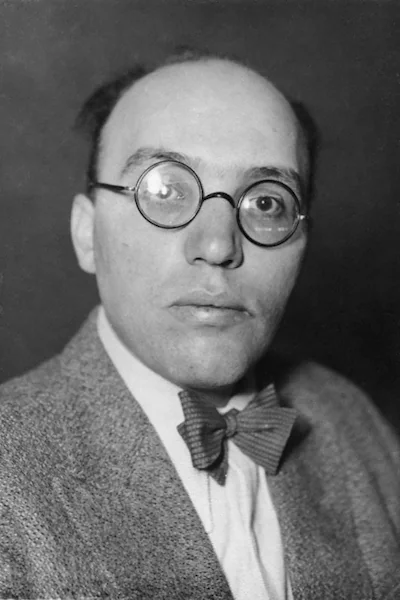
Image from Wikipedia
Image from Wikipedia
Kurt Weill – the Composer Between Weimar Modernism, Political Satire, and Broadway Glamour
Kurt Weill: A Life for Music Theater Between Europe and America
Kurt Weill was one of the most influential composers of the 20th century because he did not treat opera, operetta, chanson, song, and musical as separate worlds, but as a single, vibrant music theater. Born on March 2, 1900, in Dessau and died on April 3, 1950, in New York, he evolved from a German theater musician to an American Broadway composer with international renown. His career connects artistic radicalism, exile experience, and the rare courage to regard popular forms as serious art. ([britannica.com](https://www.britannica.com/biography/Kurt-Weill))
Early Years: Dessau, Berlin, and the School of Theater
Weill grew up as the son of a cantor in Dessau and was closely connected to music, theater, and Jewish tradition from an early age. As a teenager, he worked as a theater accompanist, studied in Berlin under Engelbert Humperdinck, and later with Ferruccio Busoni, whose intellectual openness and formal rigor deeply influenced his artistic development. This early phase produced a composer whose language was initially expressionistic, experimental, and clearly focused on music theater. ([britannica.com](https://www.britannica.com/biography/Kurt-Weill))
Even in the 1920s, Weill's unusual stance became evident: music should not revolve in an ivory tower but should reach the audience. The Kurt Weill sources emphasize his belief in “practical” music that is written for listeners and cannot be divided between so-called serious and light music. This gave rise to his unique authority: Weill was both a modernist and a popularizer without ever appearing superficial. ([kwf.org](https://www.kwf.org/kurt-weill/recommended/composer-for-the-theater/))
The Breakthrough with Bertolt Brecht: Provocation as an Artistic Principle
The decisive artistic breakthrough came with Bertolt Brecht. In Mahagonny, The Threepenny Opera, and later Rise and Fall of the City of Mahagonny, the two combined sharp social satire with catchy melodies, ironic distance, and a new type of stage where commentary and emotion coexisted. Weill’s music for these works sounded rough, jazz-influenced, melancholic, and theatrically heightened; the famous Threepenny Opera became an international success, making him known well beyond Germany. ([britannica.com](https://www.britannica.com/biography/Kurt-Weill))
In these works, Weill’s mastery in arrangement is evident: he blended popular idioms like ragtime, jazz, and cabaret with classical ideas of form, creating a distinctive sound between high culture and the street. Britannica explicitly describes Rise and Fall of the City of Mahagonny as Weill’s masterpiece, in which American popular music, ragtime, and jazz are artfully synthesized. This explains why Weill is regarded today not only as an opera composer but also as an architect of modern urban music theater. ([britannica.com](https://www.britannica.com/biography/Kurt-Weill))
Break with Nazi Germany and Emigration
With the rise of the Nazis, Weill became a target due to his Jewish heritage and his artistically political stance. After his music was banned in Germany, he moved to Paris in 1933, where he created another key work with Brecht, The Seven Deadly Sins; in 1935, he emigrated to the United States with Lotte Lenya. This watershed moment fundamentally changed his career, yet it did not mean a loss of identity: Weill retained his dramatic sharpness and found a new public language in America. ([britannica.com](https://www.britannica.com/biography/Kurt-Weill))
Emigration did not lead to a stylistic impoverishment but to a remarkable expansion of his repertoire. In New York, Weill collaborated with Paul Green, Franz Werfel, Maxwell Anderson, Moss Hart, Ira Gershwin, S. J. Perelman, Ogden Nash, and Langston Hughes. This shifted his focus from European avant-garde theater to American music theater without sacrificing his artistic signature. ([britannica.com](https://www.britannica.com/biography/Kurt-Weill))
Broadway Years: American Stage, New Melodies, Lasting Classics
In the 1940s, Weill became one of the most successful musical composers on Broadway. Works like Knickerbocker Holiday, Lady in the Dark, One Touch of Venus, Street Scene, and Lost in the Stars showcase his ability to combine dramatic form, melodic precision, and popular accessibility. The Broadway phase is not a departure from “serious” music, but a consistent continuation of his program: music as direct, socially impactful theater. ([britannica.com](https://www.britannica.com/biography/Kurt-Weill))
From this period come some of his enduringly popular songs, foremost among them “September Song,” “Speak Low,” “My Ship,” “Lost in the Stars,” and “Mack the Knife.” These titles have outlived their original contexts and have become standards that are repeatedly reinterpreted in concert, jazz, musical, and chanson. Here, Weill’s cultural influence is particularly evident: his songs function outside the stage but never lose their dramatic origins. ([britannica.com](https://www.britannica.com/summary/Kurt-Weill))
Discography, Scope of Work, and Musical Development
From early symphonic and chamber music works to major stage pieces, Weill’s oeuvre includes operas, operettas, ballets, theater music, musicals, orchestral works, chamber music, songs, and chansons. Masterworks Broadway emphasizes the breadth of his output as well as the fact that Weill had two very different but equally significant careers, one in Germany and later in the USA. This dual structure is central to his legacy: Weill is a composer of Weimar modernism and American music theater in one person. ([masterworksbroadway.com](https://www.masterworksbroadway.com/artist/kurt-weill/))
His important works include The Protagonist, Royal Palace, Mahagonny, The Threepenny Opera, The Seven Deadly Sins, Johnny Johnson, The Eternal Road, Knickerbocker Holiday, Lady in the Dark, One Touch of Venus, Street Scene, Down in the Valley, and Lost in the Stars. The sources from the Kurt Weill Archive and the music press also show that these pieces continue to appear on theater schedules and inspire new interpretations. Weill’s work thus has an active performance history rather than a museological one. ([masterworksbroadway.com](https://www.masterworksbroadway.com/artist/kurt-weill/))
Style, Sound Language, and Cultural Influence
Weill’s style is characterized by precise economy, sharp characterization, and high dramatic intelligence. His music often employs laconic melodies, cutting harmonies, dance-like gestures, and a consciously open relationship with popular music. Particularly remarkable is his ability to translate social criticism into resonant theater figures rather than dry theory. ([britannica.com](https://www.britannica.com/biography/Kurt-Weill))
His cultural influence extends from the operatic stage to the jazz and pop canon. The relevance of his music is evident in its ongoing revival, in scholarly research, in festivals, and in new recordings. The Kurt Weill Foundation documents a vibrant performance culture to this day, while current publications and productions continuously shed new light on Weill’s work. ([kwf.org](https://www.kwf.org/about/))
Current Projects, New Releases, and Today’s Presence
In 2024 and 2025, Kurt Weill remains present: Deutsche Grammophon released “The Kurt Weill Album” in August 2024, featuring Joana Mallwitz and the Konzerthausorchester Berlin, which includes the Symphony No. 1 “Berlin Symphony,” Symphony No. 2 “Fantaisie symphonique,” and The Seven Deadly Sins. The Kurt Weill Foundation also reports new performances, current newsletter issues, and ongoing interest in Weill productions on international stages. Weill is therefore not a historical exception, but a composer with continued relevance. ([store.deutschegrammophon.com](https://store.deutschegrammophon.com/products/joana-mallwitz-the-kurt-weill-album))
Conclusion: Why Kurt Weill Continues to Fascinate
Kurt Weill remains compelling because he successfully forged contrasts: art and entertainment, satire and feeling, opera and song, Europe and America. His stage works possess intellectual sharpness, his melodies immediate presence, and his dramaturgy rare clarity. Experiencing Weill live is not merely hearing historical music but engaging with a timeless model for how modern music theater can be. ([britannica.com](https://www.britannica.com/biography/Kurt-Weill))
Official Channels of Kurt Weill:
- Instagram: No official profile found
- Facebook: No official profile found
- YouTube: No official profile found
- Spotify: No official profile found
- TikTok: No official profile found
Sources:
- Britannica – Kurt Weill: Biography, Music, & Facts
- Britannica – Kurt Weill Summary
- The Kurt Weill Foundation for Music – Home
- The Kurt Weill Foundation for Music – About
- The Kurt Weill Foundation for Music – Composer for the Theater
- Deutsche Grammophon – The Kurt Weill Album
- Masterworks Broadway – Kurt Weill
- Smithsonian Associates – Kurt Weill: Romantic Satirist, Modern Populist
- Songwriters Hall of Fame – Kurt Weill
- Wikipedia: Kurt Weill
Upcoming Events
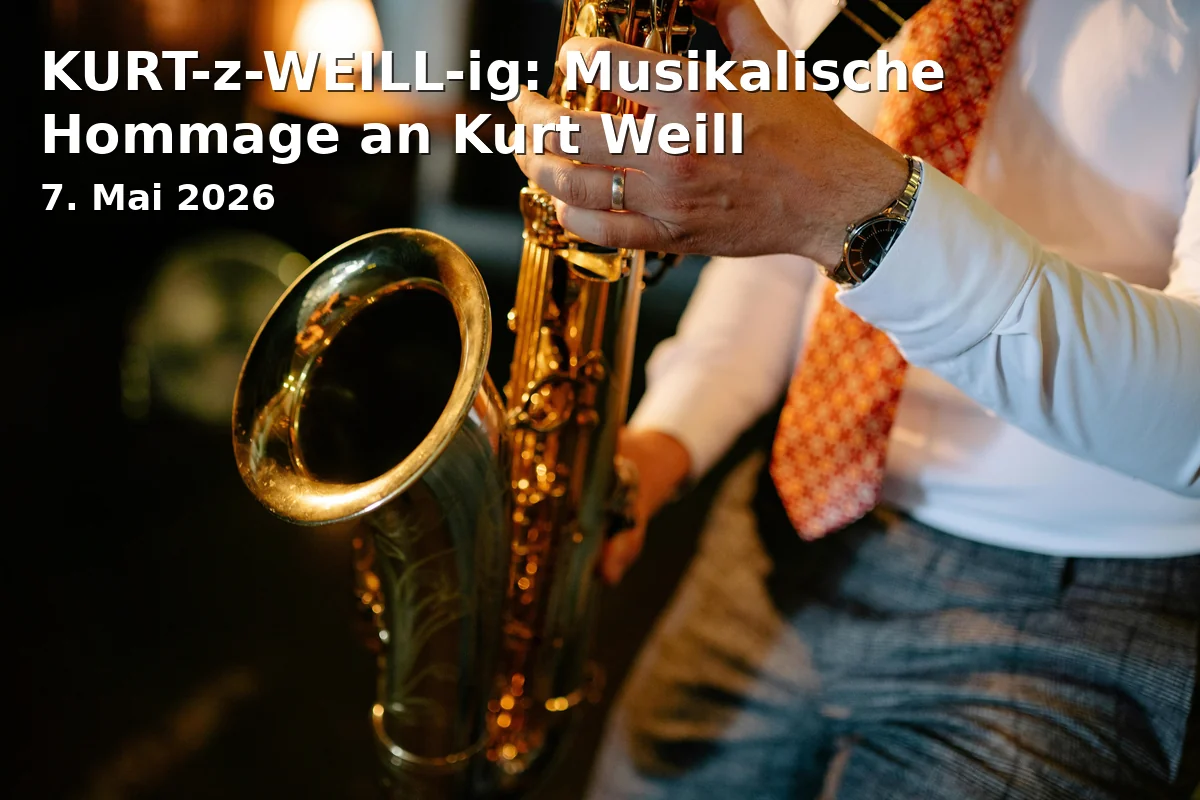
KURT-z-WEILL-ig: Musical Tribute to Kurt Weill
KURT-z-WEILL-ig
Weill in the Evening – Open Air