
Reinhold Ewald (Astronaut)
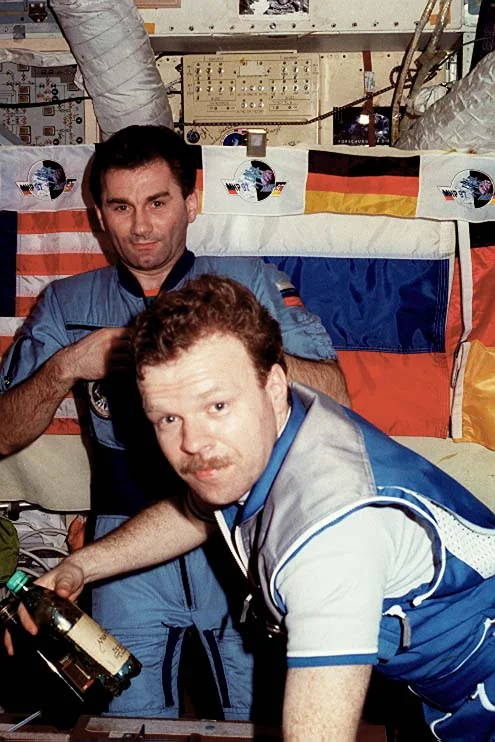
Image from Wikipedia
Image from Wikipedia
Reinhold Ewald – the German astronaut, physicist, and space exploration pioneer with a vision for the big picture
A life between physics, space travel, and European pioneering work
Reinhold Ewald, born on December 18, 1956, in Mönchengladbach, is one of the defining German figures in manned spaceflight. The physicist and astronaut represents a career that remarkably combines scientific precision, operational responsibility, and international cooperation. His journey led from university research to the German space organization and into the European elite of astronautics. ([esa.int](https://www.esa.int/Our_Activities/Human_Spaceflight/Astronauts/Reinhold_Ewald?utm_source=openai))
Ewald's biography tells not only of a flight into space but of decades of foundational work behind the scenes of space travel. He embodies that generation of scientists who not only experience missions but also plan, secure, and make them technically possible. This is precisely where his significance lies: Ewald was not just a passenger but a co-creator of a European understanding of space exploration. ([esa.int](https://www.esa.int/Our_Activities/Human_Spaceflight/Astronauts/Reinhold_Ewald?utm_source=openai))
Education, scientific foundations, and the path to space travel
After studying physics at the University of Cologne, which he completed in 1977 with a Bachelor of Science, he pursued a Master's in experimental physics and earned his doctorate in 1986 with a minor in human physiology. This combination of natural science and body studies proved valuable for his later career, as manned space travel always entails biological, medical, and technical questions. Even at this early phase, a profile emerged that relied on interdisciplinary competence. ([esa.int](https://www.esa.int/Our_Activities/Human_Spaceflight/Astronauts/Reinhold_Ewald?utm_source=openai))
From 1983 to 1987, Ewald researched at the University of Cologne on a DFG project for the construction and operation of a 3-meter radio telescope at the Gornergrat Observatory in Switzerland. His scientific focus was on the structure and dynamics of interstellar molecular clouds, the astrophysical matter from which new stars are born. Here, his insight into foundational research with a broad horizon is evident. ([esa.int](https://www.esa.int/Our_Activities/Human_Spaceflight/Astronauts/Reinhold_Ewald?utm_source=openai))
DLR, astronaut selection, and the first major mission
In 1987, Ewald transitioned to the then DFVLR, the predecessor of the German Aerospace Center (DLR). There, he worked on extraterrestrial science projects, including SOFIA and experiments launched with sounding rockets. Additionally, he coordinated spaceflight issues in the planning department and thus became increasingly integrated into the operational core of German spaceflight. ([esa.int](https://www.esa.int/Our_Activities/Human_Spaceflight/Astronauts/Reinhold_Ewald?utm_source=openai))
In 1990, he was selected for the German astronaut team and began his training for the German-Russian Mission Mir ’92 in Star City near Moscow. As a backup astronaut and Crew Interface Coordinator, he gained important experience at the interface between the crew, mission control, and scientific planning. This role shaped his profile as a calm, analytical spaceflight expert with a deep sense of responsibility. ([esa.int](https://www.esa.int/Our_Activities/Human_Spaceflight/Astronauts/Reinhold_Ewald?utm_source=openai))
Ewald celebrated his international breakthrough as an astronaut in February 1997 with the launch aboard Soyuz TM-25 to the Mir space station. During the approximately 18-day stay, he conducted experiments in biomedicine and materials science and tested procedures for future ISS missions. The mission made him one of the most well-known German astronauts of his generation. ([en.wikipedia.org](https://en.wikipedia.org/wiki/Reinhold_Ewald?utm_source=openai))
European responsibility: ESA, ISS, and Columbus
After his return from orbit, Ewald took on increasing leadership roles. He became the deputy head of the DLR astronaut office, later the assistant to the director of the DLR space program, and finally in 1999, a member of the European Astronaut Corps at the European Astronaut Centre in Cologne. His focus thus shifted from mission participation to strategic mission management. ([esa.int](https://www.esa.int/Our_Activities/Human_Spaceflight/Astronauts/Reinhold_Ewald?utm_source=openai))
At ESA, Ewald served as Crew Operations Manager for two Soyuz missions with ESA astronauts to the International Space Station and was the Operations Manager for the nationally supported missions in 2003 and 2004. Later, he headed the ISS mission integration and operation department and played a key role in establishing the Columbus operation, the European laboratory aboard the ISS. His name became associated with the organizational maturity of European manned spaceflight. ([esa.int](https://www.esa.int/Our_Activities/Human_Spaceflight/Astronauts/Reinhold_Ewald?utm_source=openai))
His role in the Astrolab project with Thomas Reiter and in the STS-122/1E mission, which delivered Columbus to the station, was particularly important. Ewald thus worked at the interface of technology, mission operations, and the scientific use of the Earth orbit laboratory. This phase of his career showcases him as an architect of infrastructure, not just as a participant in spectacular missions. ([esa.int](https://www.esa.int/Our_Activities/Human_Spaceflight/Astronauts/Reinhold_Ewald?utm_source=openai))
Teaching, research, and scientific communication
Between 1998 and 2002, Ewald taught part-time at the Technical University of Munich in spaceflight operations; later, he also taught at the International Space University in Strasbourg and RWTH Aachen. From 2015, he was a professor for astronautics and space stations at the Institute of Space Systems at the University of Stuttgart. There, he combined academic teaching with the immediate experience of a real space career. ([esa.int](https://www.esa.int/Our_Activities/Human_Spaceflight/Astronauts/Reinhold_Ewald?utm_source=openai))
The University of Stuttgart described him in 2021 as someone who brings space travel closer to students through practical projects. This fits with his entire career: Ewald stands for knowledge transfer, translating complex technology into understandable teaching and research practices. His impact thus unfolds not only in orbit but also in seminars, workshops, and student development teams. ([uni-stuttgart.de](https://www.uni-stuttgart.de/universitaet/aktuelles/meldungen/raumfahrt/?utm_source=openai))
Recognition, awards, and international resonance
Ewald has received several prestigious awards, including the Russian Order of Friendship, the Medal for Personal Courage, and the Federal Cross of Merit First Class of the Federal Republic of Germany. Such honors highlight that his accomplishments go far beyond a national career. They mark him as a representative of a cooperative, scientifically based model of space exploration. ([esa.int](https://www.esa.int/Our_Activities/Human_Spaceflight/Astronauts/Reinhold_Ewald?utm_source=openai))
His memberships in the German Physical Society, the Association of Space Explorers, and the International Academy of Astronautics further demonstrate his institutional anchoring. Ewald's reputation has not arisen from media staging but rather from expertise, reliability, and operational excellence. It is precisely here that his authority within the history of European spaceflight lies. ([esa.int](https://www.esa.int/Our_Activities/Human_Spaceflight/Astronauts/Reinhold_Ewald?utm_source=openai))
Cultural influence and public appearance
Reinhold Ewald is a figure who popularizes science without oversimplifying it. His appearances in lectures, interviews, and university formats make space travel tangible and show how abstract technology translates into human experience. Particularly in Germany, where space travel is often only sporadically present in public consciousness, he plays a unique mediating role. ([esa.int](https://www.esa.int/Our_Activities/Human_Spaceflight/Astronauts/Reinhold_Ewald?utm_source=openai))
His role as a scientist, astronaut, and lecturer creates a rare connection of experience, expertise, and institutional credibility. Ewald represents a form of space culture based on teamwork, precision, and long-term development. Those who follow his biography can see the pathway from research through missions to training the next generation. ([esa.int](https://www.esa.int/Our_Activities/Human_Spaceflight/Astronauts/Reinhold_Ewald?utm_source=openai))
Conclusion: Why Reinhold Ewald remains fascinating to this day
Reinhold Ewald remains compelling because his career encompasses the entire spectrum of modern space travel: fundamental research, astronaut training, mission operations, the ISS program, and academic teaching. He embodies capability without pathos and space history built on competence rather than effect. His career illustrates how strategic significance arises from scientific curiosity. ([esa.int](https://www.esa.int/Our_Activities/Human_Spaceflight/Astronauts/Reinhold_Ewald?utm_source=openai))
Anyone looking to understand space travel as a cultural technique will find one of the most convincing German biographies in Ewald. Especially in live talks, science discussions, or university events, it becomes clear how vibrant his experience remains. Meeting Reinhold Ewald is worthwhile because he not only talks about space but about the art of making it possible. ([uni-stuttgart.de](https://www.uni-stuttgart.de/universitaet/aktuelles/meldungen/raumfahrt/?utm_source=openai))
Official channels of Reinhold Ewald:
- Instagram: No official profile found
- Facebook: No official profile found
- YouTube: No official profile found
- Spotify: No official profile found
- TikTok: No official profile found
Sources:
- ESA – Reinhold Ewald
- ESA – Biography of Reinhold Ewald
- DLR – Reinhold Ewald
- University of Stuttgart, Institute of Space Systems – Prof. Dr. rer. nat. Reinhold Ewald
- University of Stuttgart – Space up close
- University of Stuttgart – Two luminaries of space exploration bid farewell as they enter retirement
- Wikipedia – Reinhold Ewald