
Weiden in der Oberpfalz
Bürgermeister-Prechtl-Straße 13, 92637 Weiden in der Oberpfalz, Deutschland
St. Josef Weiden | History & Parking
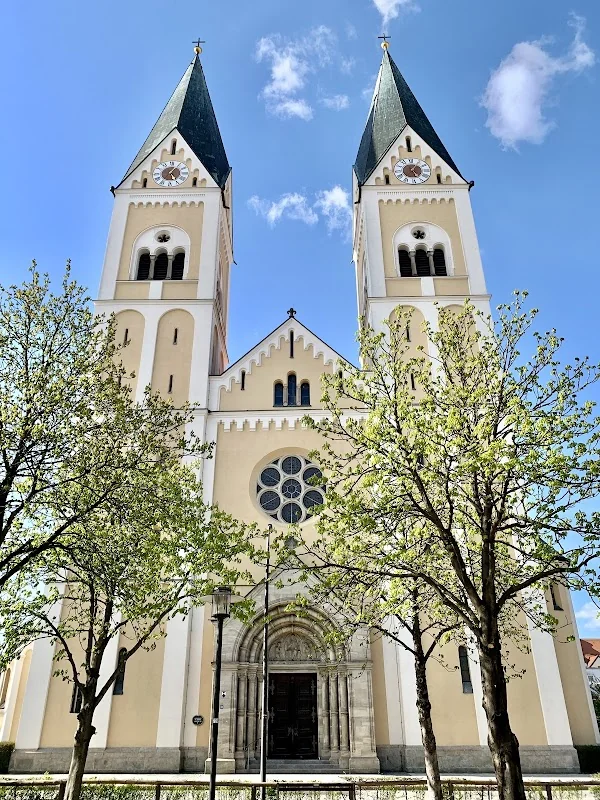
St. Josef in Weiden in the Upper Palatinate is much more than just a church building: The parish church at Bürgermeister-Prechtl-Straße 13 is a significant place for faith, music, city history, and quiet moments in the heart of the city. The parish publishes current notices, parish newsletters, service schedules, and offerings for first communion, confirmation, and community life. At the same time, St. Josef is a church landmark that is considered one of the most significant and largest Art Nouveau churches in Bavaria today. Visitors to the church experience not only a sacred space but also a place where history, architecture, and vibrant pastoral care come together. The parish office is located directly next to the church at Bürgermeister-Prechtl-Straße 15, the parish hall is across from the church, and a prayer room is accessible at the corner of Luitpoldstraße and Kettelerstraße. This makes St. Josef feel rooted in the everyday life of the city rather than isolated. For visitors, this is a great advantage: The location is central, the connections are good, and the surroundings offer many practical options for a short visit or a longer stay. ([weiden-st-josef.de](https://www.weiden-st-josef.de/gebaeude-adressen.html))
History of the Parish Church St. Josef in Weiden
The history of St. Josef is closely linked to the strong growth of the city of Weiden in the late 19th century. The historical account of the parish makes it clear that the existing parish church had become too small for the growing Catholic population, and the simultaneous use of a church by Catholics and Protestants was increasingly felt to be burdensome. Therefore, the decision was made to build a separate Catholic church. As early as 1896, a statewide collection was initiated to dissolve the church simultaneum and to build a new parish church. In 1899 and 1900, the decisive construction steps followed: In 1899, the first groundbreaking took place, the foundation stone was laid on June 24, 1899, and the church was put into use on November 11, 1900. The solemn consecration took place on September 29, 1901, by Bishop Ignatius von Senestrey. The interior design continued until 1903. This chronology shows how quickly and purposefully the project was realized. Thus, St. Josef was not just a new building but the architectural response to a deep societal and confessional change in Weiden. From a church that arose out of necessity, it became a spiritual center with lasting impact for the city. ([weiden-st-josef.de](https://www.weiden-st-josef.de/historie-der-pfarrei-st-josef.html))
The historical figures also highlight the magnitude of this upheaval. In the parish of Weiden, the number of Catholics rose sharply within a few decades, so the old church could no longer accommodate the congregation. The history of the parish explicitly states that the existing parish church was far too small and that an expansion seemed neither economically nor spatially sensible. The new construction of St. Josef was therefore a logical consequence of population growth, religious need, and urban development. Later, the church became a permanent part of the Weiden cityscape and parish structure. The diocesan records from 1916 refer to a church with five fixed altars, good acoustics, and a building fund that reflects the ecclesiastical organization of the time. At the same time, it becomes clear that St. Josef was not only intended for large liturgical celebrations but also for regular devotions, processions, and a vibrant community life. Thus, the church remained an active place of faith practice beyond its mere architectural character. Today, those standing in front of the church look at a building that arose from a specific historical necessity and developed into an identity marker of Catholic Weiden. ([weiden-st-josef.de](https://www.weiden-st-josef.de/historie-der-pfarrei-st-josef.html))
Art Nouveau, Interior, and Special Features
St. Josef is primarily known for its interior. The city of Weiden describes the church as one of the most significant and largest Art Nouveau churches in Bavaria, and this is felt in the impact of the space: The combination of sacred expansiveness, artistic design, and strong light and color effects makes the interior extraordinary. Particularly important for this effect were the artists Franz Hofstötter and Wilhelm Vierling. According to the city museum, Wilhelm Vierling worked together with Hofstötter on the design of the city parish church, and from 1910, Vierling completed the painting alone. This created an overall impression that continues to impress visitors today and has made the church known far beyond the city's borders. Therefore, St. Josef is not a sober new building but a deliberately staged church space where art and liturgy go hand in hand. This is especially relevant for visitors who appreciate architecture, painting, and sacred atmosphere alike. The church has also been historically described as acoustically suitable, which underscores its character as a space for word, song, and organ music. This combination of visibility and audibility makes St. Josef a particularly harmonious church location. ([weiden.de](https://www.weiden.de/kultur/freizeit/veranstaltungen/details/die-neue-sonderausstellung-des-stadtmuseums-weiden))
Among the special features is also the liturgical function of the building. The historical description mentions five fixed altars, which makes the space appear not only aesthetically but also liturgically richly structured. It is also interesting for visitors that the parish designates a prayer room in the parish church at the entrance corner of Luitpoldstraße and Kettelerstraße. This makes it clear that St. Josef is not exclusively intended for festive high moments but also offers space for quiet reflection and personal piety. The building is thus both a cultural monument and a place of prayer. Those who take the time will discover in St. Josef not only the obvious splendor of Art Nouveau but also the finer levels of spatial arrangement, liturgical order, and ecclesiastical function. This mixture is particularly appealing to many visitors: The church tells of an era in which art, faith, and urban development were closely intertwined. Even today, this impression remains alive because the parish does not treat the place as a museum but uses it as an active church with a prayer room, services, and church celebrations. ([weiden-st-josef.de](https://www.weiden-st-josef.de/historie-der-pfarrei-st-josef.html))
Services, Parish Newsletter, and Vibrant Parish Community
St. Josef is not only an impressive church building but also a lively parish with a diverse community life. The official website features current notices, a schedule of events, parish newsletters, information on the service order, and offerings for different life stages. These include, among others, first communion, confirmation, altar server work, and other pastoral topics. The parish clearly communicates that St. Josef is a place where faith does not only take place on Sundays but is organized and accompanied throughout the entire church year. For visitors and parish members, this is practical: Those who want to attend a service, check an appointment, or get information about church activities will find the information consolidated in one place. This is especially important in connection with search queries such as services, parish newsletters, or appointments because the community regularly provides updated information. The festive times of the church year are also present, such as when star singers' send-offs, Christmas celebrations, or liturgical special dates appear on the homepage. This makes it clear that St. Josef is not only in the spotlight on holidays but is an active center of Catholic life in Weiden throughout the year. ([weiden-st-josef.de](https://www.weiden-st-josef.de/?utm_source=openai))
The lived parish culture also includes the spatial structure around the church. The parish hall is located across from the church, the parish office is next door, and with St. Sebastian and Letzau, another network of places belongs to the parish. Additionally, there is the spiritual path around St. Josef, which describes the church as the starting and resting point of a roughly five-kilometer-long path. This approach already shows how strongly St. Josef is integrated into pastoral work beyond the Sunday mass. The community understands the church as a place of pause, of walking together, and of accompaniment through the highs and lows of life. For SEO-relevant content, this is particularly valuable because terms like parish community, parish newsletter, services, first communion, and confirmation do not just appear as keywords but are connected to a real local offering. Therefore, those who visit St. Josef do not encounter an anonymous sight but a church with a clear community structure and a genuine content calendar. This balance of tradition, pastoral care, and good organization keeps the parish permanently relevant for the city and for people seeking a place for worship, conversation, or quiet reflection. ([weiden-st-josef.de](https://www.weiden-st-josef.de/gebaeude-adressen.html))
Organs, Church Music, and Concerts
A special feature of St. Josef Weiden is the church music. The responsible music page of the parish explicitly points out that in St. Josef, in addition to the large Eisenbarth organ, there is also a high-quality chamber organ available. Additionally, there is an electronic registration system that particularly facilitates the work of guest organists. This shows that St. Josef is not only a space for liturgical celebrations but also a professionally usable music venue. For visitors, this is particularly interesting because the acoustic conditions and the instrumental equipment bring the church space to life. The historical description indirectly confirms this effect by describing the church as well acoustically suited. Thus, St. Josef is excellently suited for choral music, organ concerts, spiritual concerts, and musically designed services. Therefore, those interested in classical church music will find a place here where sound and space form a convincing unity. The combination of a large main organ and a chamber organ is a strong detail for a parish church of this size, which is also important for search queries related to organs, music, or concerts. ([kirchenmusik.weiden-st-josef.de](https://kirchenmusik.weiden-st-josef.de/orgeln-in-st-josef/))
The parish also makes it clear that music in St. Josef is not a marginal note. The music page and event archives regularly feature choral concerts, special liturgies, and musical highlights. Additionally, there are formats such as musically designed midday devotions in the summer months, which are perceived in the region as Punkt12. Such offerings combine spiritual calm with musical quality and appeal not only to the community but also to culture-interested guests. This is important for the profile of St. Josef because it makes the church attractive even outside of classical service times. Those who want to combine a city tour with a concert visit, an organ devotion, or a quiet midday time will find a suitable address here. The musical orientation also contributes to the perception of the church as a cultural place, not just as a liturgical space. This strengthens the position of St. Josef in Weiden: as a church with soul, as a place of art, and as an address for people who want to experience sound, architecture, and faith together. This connection is a large part of its special aura. ([kirchenmusik.weiden-st-josef.de](https://kirchenmusik.weiden-st-josef.de/rueckschau/?utm_source=openai))
Access, City Center Location, and Parking
For visitors, the location of St. Josef is particularly pleasant because the church is very centrally located in Weiden. The official address is Bürgermeister-Prechtl-Straße 13, the parish office is just a few steps away at number 15. The city of Weiden indicates around 2,000 parking spaces for the city center and emphasizes that the old town is easily accessible on foot from the central parking spaces. This makes the church easily reachable for people coming by car who would like to take a short walk through the city center afterward. The city also mentions various forms of parking in the city, such as public parking areas, parking garages, and the option of mobile parking. Therefore, those planning a visit to St. Josef do not have to expect complicated parking searches but can take advantage of the central location. This is a practical advantage, especially in connection with city strolls, church visits, or appointments at the parish office. The proximity to the city center makes St. Josef a well-accessible destination for both short and longer stays. ([weiden-st-josef.de](https://www.weiden-st-josef.de/gebaeude-adressen.html))
There are also good conditions for arriving by public transport and bicycle. The city mentions new bicycle parking facilities at the bus stop Josefskirche, and the mobility area explicitly mentions the bus stop Josefskirche. For many visitors, this means: St. Josef is easily accessible not only by car but also by bus and bike. This fits with the location on a central city axis and the walkability to the old town. Additionally, electric vehicles benefit from the city's parking regulations, according to which vehicles with electric license plates can park for free for up to three hours in public, managed parking spaces under certain conditions; however, parking garages are excluded from this. This shows that parking in Weiden is modernly organized and adapts to various mobility forms. For St. Josef visitors, this means a relaxed arrival without significant logistical effort. Those wishing to visit the church can choose between car, bicycle, and public transport and plan their stay flexibly. This mix of city center location, walkable proximity, and practical transport connections makes the site attractive. ([weiden.de](https://www.weiden.de/wirtschaft/stadtplanung/mobilitaet))
Visitor Tips, Spiritual Path, and Surroundings
Those who do not just visit St. Josef briefly but want to experience it consciously should take some time. The parish offers a spiritual path around St. Josef, described as a roughly five-kilometer circular route through the parish area in the eastern part of the city. The path symbolically begins in the silence of the Josefskirche and then continues through the surroundings, including towards St. Sebastian. This idea already shows that St. Josef is intended as a spiritual starting point from which calm, contemplation, and movement can be combined. For visitors, this is a lovely offering if they want to combine their church visit with a quiet city stroll. The mention of the church guide also makes it clear that the parish consciously opens up the place and provides information for interested parties. Those who enjoy exploring architecture, church history, or religious symbolism in greater depth will find a good framework for a more intense visit. St. Josef thus does not appear isolated but embedded in a network of paths, neighboring churches, and pastoral places. ([weiden-st-josef.de](https://www.weiden-st-josef.de/spiritueller-weg.html?utm_source=openai))
Moreover, the location of the church is also architecturally appealing. The connection of the parish hall, parish office, prayer room, and the central city location makes it clear that St. Josef is a vibrant part of Weiden. Those who want to stay in the city after a church visit can easily reach the old town, the area around the marketplace, and other central points on foot. From an SEO perspective, this is relevant because search intentions such as address, access, parking, events, history, and music converge here. This is where the strength of this place lies: St. Josef is simultaneously a sight, an active parish church, a concert venue, and a well-accessible point in urban everyday life. Therefore, those looking for a church that is not only historically significant but also still used in versatile ways will find St. Josef Weiden a very convincing address. The combination of Art Nouveau, lived community, music culture, and good accessibility makes the place attractive for both visitors and locals. Thus, St. Josef remains remarkable not only as a building but as a place where city, faith, and culture interact in the best sense. ([weiden.de](https://www.weiden.de/kultur/freizeit/veranstaltungen/details/die-neue-sonderausstellung-des-stadtmuseums-weiden))
Sources:
Show moreShow less
St. Josef Weiden | History & Parking
St. Josef in Weiden in the Upper Palatinate is much more than just a church building: The parish church at Bürgermeister-Prechtl-Straße 13 is a significant place for faith, music, city history, and quiet moments in the heart of the city. The parish publishes current notices, parish newsletters, service schedules, and offerings for first communion, confirmation, and community life. At the same time, St. Josef is a church landmark that is considered one of the most significant and largest Art Nouveau churches in Bavaria today. Visitors to the church experience not only a sacred space but also a place where history, architecture, and vibrant pastoral care come together. The parish office is located directly next to the church at Bürgermeister-Prechtl-Straße 15, the parish hall is across from the church, and a prayer room is accessible at the corner of Luitpoldstraße and Kettelerstraße. This makes St. Josef feel rooted in the everyday life of the city rather than isolated. For visitors, this is a great advantage: The location is central, the connections are good, and the surroundings offer many practical options for a short visit or a longer stay. ([weiden-st-josef.de](https://www.weiden-st-josef.de/gebaeude-adressen.html))
History of the Parish Church St. Josef in Weiden
The history of St. Josef is closely linked to the strong growth of the city of Weiden in the late 19th century. The historical account of the parish makes it clear that the existing parish church had become too small for the growing Catholic population, and the simultaneous use of a church by Catholics and Protestants was increasingly felt to be burdensome. Therefore, the decision was made to build a separate Catholic church. As early as 1896, a statewide collection was initiated to dissolve the church simultaneum and to build a new parish church. In 1899 and 1900, the decisive construction steps followed: In 1899, the first groundbreaking took place, the foundation stone was laid on June 24, 1899, and the church was put into use on November 11, 1900. The solemn consecration took place on September 29, 1901, by Bishop Ignatius von Senestrey. The interior design continued until 1903. This chronology shows how quickly and purposefully the project was realized. Thus, St. Josef was not just a new building but the architectural response to a deep societal and confessional change in Weiden. From a church that arose out of necessity, it became a spiritual center with lasting impact for the city. ([weiden-st-josef.de](https://www.weiden-st-josef.de/historie-der-pfarrei-st-josef.html))
The historical figures also highlight the magnitude of this upheaval. In the parish of Weiden, the number of Catholics rose sharply within a few decades, so the old church could no longer accommodate the congregation. The history of the parish explicitly states that the existing parish church was far too small and that an expansion seemed neither economically nor spatially sensible. The new construction of St. Josef was therefore a logical consequence of population growth, religious need, and urban development. Later, the church became a permanent part of the Weiden cityscape and parish structure. The diocesan records from 1916 refer to a church with five fixed altars, good acoustics, and a building fund that reflects the ecclesiastical organization of the time. At the same time, it becomes clear that St. Josef was not only intended for large liturgical celebrations but also for regular devotions, processions, and a vibrant community life. Thus, the church remained an active place of faith practice beyond its mere architectural character. Today, those standing in front of the church look at a building that arose from a specific historical necessity and developed into an identity marker of Catholic Weiden. ([weiden-st-josef.de](https://www.weiden-st-josef.de/historie-der-pfarrei-st-josef.html))
Art Nouveau, Interior, and Special Features
St. Josef is primarily known for its interior. The city of Weiden describes the church as one of the most significant and largest Art Nouveau churches in Bavaria, and this is felt in the impact of the space: The combination of sacred expansiveness, artistic design, and strong light and color effects makes the interior extraordinary. Particularly important for this effect were the artists Franz Hofstötter and Wilhelm Vierling. According to the city museum, Wilhelm Vierling worked together with Hofstötter on the design of the city parish church, and from 1910, Vierling completed the painting alone. This created an overall impression that continues to impress visitors today and has made the church known far beyond the city's borders. Therefore, St. Josef is not a sober new building but a deliberately staged church space where art and liturgy go hand in hand. This is especially relevant for visitors who appreciate architecture, painting, and sacred atmosphere alike. The church has also been historically described as acoustically suitable, which underscores its character as a space for word, song, and organ music. This combination of visibility and audibility makes St. Josef a particularly harmonious church location. ([weiden.de](https://www.weiden.de/kultur/freizeit/veranstaltungen/details/die-neue-sonderausstellung-des-stadtmuseums-weiden))
Among the special features is also the liturgical function of the building. The historical description mentions five fixed altars, which makes the space appear not only aesthetically but also liturgically richly structured. It is also interesting for visitors that the parish designates a prayer room in the parish church at the entrance corner of Luitpoldstraße and Kettelerstraße. This makes it clear that St. Josef is not exclusively intended for festive high moments but also offers space for quiet reflection and personal piety. The building is thus both a cultural monument and a place of prayer. Those who take the time will discover in St. Josef not only the obvious splendor of Art Nouveau but also the finer levels of spatial arrangement, liturgical order, and ecclesiastical function. This mixture is particularly appealing to many visitors: The church tells of an era in which art, faith, and urban development were closely intertwined. Even today, this impression remains alive because the parish does not treat the place as a museum but uses it as an active church with a prayer room, services, and church celebrations. ([weiden-st-josef.de](https://www.weiden-st-josef.de/historie-der-pfarrei-st-josef.html))
Services, Parish Newsletter, and Vibrant Parish Community
St. Josef is not only an impressive church building but also a lively parish with a diverse community life. The official website features current notices, a schedule of events, parish newsletters, information on the service order, and offerings for different life stages. These include, among others, first communion, confirmation, altar server work, and other pastoral topics. The parish clearly communicates that St. Josef is a place where faith does not only take place on Sundays but is organized and accompanied throughout the entire church year. For visitors and parish members, this is practical: Those who want to attend a service, check an appointment, or get information about church activities will find the information consolidated in one place. This is especially important in connection with search queries such as services, parish newsletters, or appointments because the community regularly provides updated information. The festive times of the church year are also present, such as when star singers' send-offs, Christmas celebrations, or liturgical special dates appear on the homepage. This makes it clear that St. Josef is not only in the spotlight on holidays but is an active center of Catholic life in Weiden throughout the year. ([weiden-st-josef.de](https://www.weiden-st-josef.de/?utm_source=openai))
The lived parish culture also includes the spatial structure around the church. The parish hall is located across from the church, the parish office is next door, and with St. Sebastian and Letzau, another network of places belongs to the parish. Additionally, there is the spiritual path around St. Josef, which describes the church as the starting and resting point of a roughly five-kilometer-long path. This approach already shows how strongly St. Josef is integrated into pastoral work beyond the Sunday mass. The community understands the church as a place of pause, of walking together, and of accompaniment through the highs and lows of life. For SEO-relevant content, this is particularly valuable because terms like parish community, parish newsletter, services, first communion, and confirmation do not just appear as keywords but are connected to a real local offering. Therefore, those who visit St. Josef do not encounter an anonymous sight but a church with a clear community structure and a genuine content calendar. This balance of tradition, pastoral care, and good organization keeps the parish permanently relevant for the city and for people seeking a place for worship, conversation, or quiet reflection. ([weiden-st-josef.de](https://www.weiden-st-josef.de/gebaeude-adressen.html))
Organs, Church Music, and Concerts
A special feature of St. Josef Weiden is the church music. The responsible music page of the parish explicitly points out that in St. Josef, in addition to the large Eisenbarth organ, there is also a high-quality chamber organ available. Additionally, there is an electronic registration system that particularly facilitates the work of guest organists. This shows that St. Josef is not only a space for liturgical celebrations but also a professionally usable music venue. For visitors, this is particularly interesting because the acoustic conditions and the instrumental equipment bring the church space to life. The historical description indirectly confirms this effect by describing the church as well acoustically suited. Thus, St. Josef is excellently suited for choral music, organ concerts, spiritual concerts, and musically designed services. Therefore, those interested in classical church music will find a place here where sound and space form a convincing unity. The combination of a large main organ and a chamber organ is a strong detail for a parish church of this size, which is also important for search queries related to organs, music, or concerts. ([kirchenmusik.weiden-st-josef.de](https://kirchenmusik.weiden-st-josef.de/orgeln-in-st-josef/))
The parish also makes it clear that music in St. Josef is not a marginal note. The music page and event archives regularly feature choral concerts, special liturgies, and musical highlights. Additionally, there are formats such as musically designed midday devotions in the summer months, which are perceived in the region as Punkt12. Such offerings combine spiritual calm with musical quality and appeal not only to the community but also to culture-interested guests. This is important for the profile of St. Josef because it makes the church attractive even outside of classical service times. Those who want to combine a city tour with a concert visit, an organ devotion, or a quiet midday time will find a suitable address here. The musical orientation also contributes to the perception of the church as a cultural place, not just as a liturgical space. This strengthens the position of St. Josef in Weiden: as a church with soul, as a place of art, and as an address for people who want to experience sound, architecture, and faith together. This connection is a large part of its special aura. ([kirchenmusik.weiden-st-josef.de](https://kirchenmusik.weiden-st-josef.de/rueckschau/?utm_source=openai))
Access, City Center Location, and Parking
For visitors, the location of St. Josef is particularly pleasant because the church is very centrally located in Weiden. The official address is Bürgermeister-Prechtl-Straße 13, the parish office is just a few steps away at number 15. The city of Weiden indicates around 2,000 parking spaces for the city center and emphasizes that the old town is easily accessible on foot from the central parking spaces. This makes the church easily reachable for people coming by car who would like to take a short walk through the city center afterward. The city also mentions various forms of parking in the city, such as public parking areas, parking garages, and the option of mobile parking. Therefore, those planning a visit to St. Josef do not have to expect complicated parking searches but can take advantage of the central location. This is a practical advantage, especially in connection with city strolls, church visits, or appointments at the parish office. The proximity to the city center makes St. Josef a well-accessible destination for both short and longer stays. ([weiden-st-josef.de](https://www.weiden-st-josef.de/gebaeude-adressen.html))
There are also good conditions for arriving by public transport and bicycle. The city mentions new bicycle parking facilities at the bus stop Josefskirche, and the mobility area explicitly mentions the bus stop Josefskirche. For many visitors, this means: St. Josef is easily accessible not only by car but also by bus and bike. This fits with the location on a central city axis and the walkability to the old town. Additionally, electric vehicles benefit from the city's parking regulations, according to which vehicles with electric license plates can park for free for up to three hours in public, managed parking spaces under certain conditions; however, parking garages are excluded from this. This shows that parking in Weiden is modernly organized and adapts to various mobility forms. For St. Josef visitors, this means a relaxed arrival without significant logistical effort. Those wishing to visit the church can choose between car, bicycle, and public transport and plan their stay flexibly. This mix of city center location, walkable proximity, and practical transport connections makes the site attractive. ([weiden.de](https://www.weiden.de/wirtschaft/stadtplanung/mobilitaet))
Visitor Tips, Spiritual Path, and Surroundings
Those who do not just visit St. Josef briefly but want to experience it consciously should take some time. The parish offers a spiritual path around St. Josef, described as a roughly five-kilometer circular route through the parish area in the eastern part of the city. The path symbolically begins in the silence of the Josefskirche and then continues through the surroundings, including towards St. Sebastian. This idea already shows that St. Josef is intended as a spiritual starting point from which calm, contemplation, and movement can be combined. For visitors, this is a lovely offering if they want to combine their church visit with a quiet city stroll. The mention of the church guide also makes it clear that the parish consciously opens up the place and provides information for interested parties. Those who enjoy exploring architecture, church history, or religious symbolism in greater depth will find a good framework for a more intense visit. St. Josef thus does not appear isolated but embedded in a network of paths, neighboring churches, and pastoral places. ([weiden-st-josef.de](https://www.weiden-st-josef.de/spiritueller-weg.html?utm_source=openai))
Moreover, the location of the church is also architecturally appealing. The connection of the parish hall, parish office, prayer room, and the central city location makes it clear that St. Josef is a vibrant part of Weiden. Those who want to stay in the city after a church visit can easily reach the old town, the area around the marketplace, and other central points on foot. From an SEO perspective, this is relevant because search intentions such as address, access, parking, events, history, and music converge here. This is where the strength of this place lies: St. Josef is simultaneously a sight, an active parish church, a concert venue, and a well-accessible point in urban everyday life. Therefore, those looking for a church that is not only historically significant but also still used in versatile ways will find St. Josef Weiden a very convincing address. The combination of Art Nouveau, lived community, music culture, and good accessibility makes the place attractive for both visitors and locals. Thus, St. Josef remains remarkable not only as a building but as a place where city, faith, and culture interact in the best sense. ([weiden.de](https://www.weiden.de/kultur/freizeit/veranstaltungen/details/die-neue-sonderausstellung-des-stadtmuseums-weiden))
Sources:
St. Josef Weiden | History & Parking
St. Josef in Weiden in the Upper Palatinate is much more than just a church building: The parish church at Bürgermeister-Prechtl-Straße 13 is a significant place for faith, music, city history, and quiet moments in the heart of the city. The parish publishes current notices, parish newsletters, service schedules, and offerings for first communion, confirmation, and community life. At the same time, St. Josef is a church landmark that is considered one of the most significant and largest Art Nouveau churches in Bavaria today. Visitors to the church experience not only a sacred space but also a place where history, architecture, and vibrant pastoral care come together. The parish office is located directly next to the church at Bürgermeister-Prechtl-Straße 15, the parish hall is across from the church, and a prayer room is accessible at the corner of Luitpoldstraße and Kettelerstraße. This makes St. Josef feel rooted in the everyday life of the city rather than isolated. For visitors, this is a great advantage: The location is central, the connections are good, and the surroundings offer many practical options for a short visit or a longer stay. ([weiden-st-josef.de](https://www.weiden-st-josef.de/gebaeude-adressen.html))
History of the Parish Church St. Josef in Weiden
The history of St. Josef is closely linked to the strong growth of the city of Weiden in the late 19th century. The historical account of the parish makes it clear that the existing parish church had become too small for the growing Catholic population, and the simultaneous use of a church by Catholics and Protestants was increasingly felt to be burdensome. Therefore, the decision was made to build a separate Catholic church. As early as 1896, a statewide collection was initiated to dissolve the church simultaneum and to build a new parish church. In 1899 and 1900, the decisive construction steps followed: In 1899, the first groundbreaking took place, the foundation stone was laid on June 24, 1899, and the church was put into use on November 11, 1900. The solemn consecration took place on September 29, 1901, by Bishop Ignatius von Senestrey. The interior design continued until 1903. This chronology shows how quickly and purposefully the project was realized. Thus, St. Josef was not just a new building but the architectural response to a deep societal and confessional change in Weiden. From a church that arose out of necessity, it became a spiritual center with lasting impact for the city. ([weiden-st-josef.de](https://www.weiden-st-josef.de/historie-der-pfarrei-st-josef.html))
The historical figures also highlight the magnitude of this upheaval. In the parish of Weiden, the number of Catholics rose sharply within a few decades, so the old church could no longer accommodate the congregation. The history of the parish explicitly states that the existing parish church was far too small and that an expansion seemed neither economically nor spatially sensible. The new construction of St. Josef was therefore a logical consequence of population growth, religious need, and urban development. Later, the church became a permanent part of the Weiden cityscape and parish structure. The diocesan records from 1916 refer to a church with five fixed altars, good acoustics, and a building fund that reflects the ecclesiastical organization of the time. At the same time, it becomes clear that St. Josef was not only intended for large liturgical celebrations but also for regular devotions, processions, and a vibrant community life. Thus, the church remained an active place of faith practice beyond its mere architectural character. Today, those standing in front of the church look at a building that arose from a specific historical necessity and developed into an identity marker of Catholic Weiden. ([weiden-st-josef.de](https://www.weiden-st-josef.de/historie-der-pfarrei-st-josef.html))
Art Nouveau, Interior, and Special Features
St. Josef is primarily known for its interior. The city of Weiden describes the church as one of the most significant and largest Art Nouveau churches in Bavaria, and this is felt in the impact of the space: The combination of sacred expansiveness, artistic design, and strong light and color effects makes the interior extraordinary. Particularly important for this effect were the artists Franz Hofstötter and Wilhelm Vierling. According to the city museum, Wilhelm Vierling worked together with Hofstötter on the design of the city parish church, and from 1910, Vierling completed the painting alone. This created an overall impression that continues to impress visitors today and has made the church known far beyond the city's borders. Therefore, St. Josef is not a sober new building but a deliberately staged church space where art and liturgy go hand in hand. This is especially relevant for visitors who appreciate architecture, painting, and sacred atmosphere alike. The church has also been historically described as acoustically suitable, which underscores its character as a space for word, song, and organ music. This combination of visibility and audibility makes St. Josef a particularly harmonious church location. ([weiden.de](https://www.weiden.de/kultur/freizeit/veranstaltungen/details/die-neue-sonderausstellung-des-stadtmuseums-weiden))
Among the special features is also the liturgical function of the building. The historical description mentions five fixed altars, which makes the space appear not only aesthetically but also liturgically richly structured. It is also interesting for visitors that the parish designates a prayer room in the parish church at the entrance corner of Luitpoldstraße and Kettelerstraße. This makes it clear that St. Josef is not exclusively intended for festive high moments but also offers space for quiet reflection and personal piety. The building is thus both a cultural monument and a place of prayer. Those who take the time will discover in St. Josef not only the obvious splendor of Art Nouveau but also the finer levels of spatial arrangement, liturgical order, and ecclesiastical function. This mixture is particularly appealing to many visitors: The church tells of an era in which art, faith, and urban development were closely intertwined. Even today, this impression remains alive because the parish does not treat the place as a museum but uses it as an active church with a prayer room, services, and church celebrations. ([weiden-st-josef.de](https://www.weiden-st-josef.de/historie-der-pfarrei-st-josef.html))
Services, Parish Newsletter, and Vibrant Parish Community
St. Josef is not only an impressive church building but also a lively parish with a diverse community life. The official website features current notices, a schedule of events, parish newsletters, information on the service order, and offerings for different life stages. These include, among others, first communion, confirmation, altar server work, and other pastoral topics. The parish clearly communicates that St. Josef is a place where faith does not only take place on Sundays but is organized and accompanied throughout the entire church year. For visitors and parish members, this is practical: Those who want to attend a service, check an appointment, or get information about church activities will find the information consolidated in one place. This is especially important in connection with search queries such as services, parish newsletters, or appointments because the community regularly provides updated information. The festive times of the church year are also present, such as when star singers' send-offs, Christmas celebrations, or liturgical special dates appear on the homepage. This makes it clear that St. Josef is not only in the spotlight on holidays but is an active center of Catholic life in Weiden throughout the year. ([weiden-st-josef.de](https://www.weiden-st-josef.de/?utm_source=openai))
The lived parish culture also includes the spatial structure around the church. The parish hall is located across from the church, the parish office is next door, and with St. Sebastian and Letzau, another network of places belongs to the parish. Additionally, there is the spiritual path around St. Josef, which describes the church as the starting and resting point of a roughly five-kilometer-long path. This approach already shows how strongly St. Josef is integrated into pastoral work beyond the Sunday mass. The community understands the church as a place of pause, of walking together, and of accompaniment through the highs and lows of life. For SEO-relevant content, this is particularly valuable because terms like parish community, parish newsletter, services, first communion, and confirmation do not just appear as keywords but are connected to a real local offering. Therefore, those who visit St. Josef do not encounter an anonymous sight but a church with a clear community structure and a genuine content calendar. This balance of tradition, pastoral care, and good organization keeps the parish permanently relevant for the city and for people seeking a place for worship, conversation, or quiet reflection. ([weiden-st-josef.de](https://www.weiden-st-josef.de/gebaeude-adressen.html))
Organs, Church Music, and Concerts
A special feature of St. Josef Weiden is the church music. The responsible music page of the parish explicitly points out that in St. Josef, in addition to the large Eisenbarth organ, there is also a high-quality chamber organ available. Additionally, there is an electronic registration system that particularly facilitates the work of guest organists. This shows that St. Josef is not only a space for liturgical celebrations but also a professionally usable music venue. For visitors, this is particularly interesting because the acoustic conditions and the instrumental equipment bring the church space to life. The historical description indirectly confirms this effect by describing the church as well acoustically suited. Thus, St. Josef is excellently suited for choral music, organ concerts, spiritual concerts, and musically designed services. Therefore, those interested in classical church music will find a place here where sound and space form a convincing unity. The combination of a large main organ and a chamber organ is a strong detail for a parish church of this size, which is also important for search queries related to organs, music, or concerts. ([kirchenmusik.weiden-st-josef.de](https://kirchenmusik.weiden-st-josef.de/orgeln-in-st-josef/))
The parish also makes it clear that music in St. Josef is not a marginal note. The music page and event archives regularly feature choral concerts, special liturgies, and musical highlights. Additionally, there are formats such as musically designed midday devotions in the summer months, which are perceived in the region as Punkt12. Such offerings combine spiritual calm with musical quality and appeal not only to the community but also to culture-interested guests. This is important for the profile of St. Josef because it makes the church attractive even outside of classical service times. Those who want to combine a city tour with a concert visit, an organ devotion, or a quiet midday time will find a suitable address here. The musical orientation also contributes to the perception of the church as a cultural place, not just as a liturgical space. This strengthens the position of St. Josef in Weiden: as a church with soul, as a place of art, and as an address for people who want to experience sound, architecture, and faith together. This connection is a large part of its special aura. ([kirchenmusik.weiden-st-josef.de](https://kirchenmusik.weiden-st-josef.de/rueckschau/?utm_source=openai))
Access, City Center Location, and Parking
For visitors, the location of St. Josef is particularly pleasant because the church is very centrally located in Weiden. The official address is Bürgermeister-Prechtl-Straße 13, the parish office is just a few steps away at number 15. The city of Weiden indicates around 2,000 parking spaces for the city center and emphasizes that the old town is easily accessible on foot from the central parking spaces. This makes the church easily reachable for people coming by car who would like to take a short walk through the city center afterward. The city also mentions various forms of parking in the city, such as public parking areas, parking garages, and the option of mobile parking. Therefore, those planning a visit to St. Josef do not have to expect complicated parking searches but can take advantage of the central location. This is a practical advantage, especially in connection with city strolls, church visits, or appointments at the parish office. The proximity to the city center makes St. Josef a well-accessible destination for both short and longer stays. ([weiden-st-josef.de](https://www.weiden-st-josef.de/gebaeude-adressen.html))
There are also good conditions for arriving by public transport and bicycle. The city mentions new bicycle parking facilities at the bus stop Josefskirche, and the mobility area explicitly mentions the bus stop Josefskirche. For many visitors, this means: St. Josef is easily accessible not only by car but also by bus and bike. This fits with the location on a central city axis and the walkability to the old town. Additionally, electric vehicles benefit from the city's parking regulations, according to which vehicles with electric license plates can park for free for up to three hours in public, managed parking spaces under certain conditions; however, parking garages are excluded from this. This shows that parking in Weiden is modernly organized and adapts to various mobility forms. For St. Josef visitors, this means a relaxed arrival without significant logistical effort. Those wishing to visit the church can choose between car, bicycle, and public transport and plan their stay flexibly. This mix of city center location, walkable proximity, and practical transport connections makes the site attractive. ([weiden.de](https://www.weiden.de/wirtschaft/stadtplanung/mobilitaet))
Visitor Tips, Spiritual Path, and Surroundings
Those who do not just visit St. Josef briefly but want to experience it consciously should take some time. The parish offers a spiritual path around St. Josef, described as a roughly five-kilometer circular route through the parish area in the eastern part of the city. The path symbolically begins in the silence of the Josefskirche and then continues through the surroundings, including towards St. Sebastian. This idea already shows that St. Josef is intended as a spiritual starting point from which calm, contemplation, and movement can be combined. For visitors, this is a lovely offering if they want to combine their church visit with a quiet city stroll. The mention of the church guide also makes it clear that the parish consciously opens up the place and provides information for interested parties. Those who enjoy exploring architecture, church history, or religious symbolism in greater depth will find a good framework for a more intense visit. St. Josef thus does not appear isolated but embedded in a network of paths, neighboring churches, and pastoral places. ([weiden-st-josef.de](https://www.weiden-st-josef.de/spiritueller-weg.html?utm_source=openai))
Moreover, the location of the church is also architecturally appealing. The connection of the parish hall, parish office, prayer room, and the central city location makes it clear that St. Josef is a vibrant part of Weiden. Those who want to stay in the city after a church visit can easily reach the old town, the area around the marketplace, and other central points on foot. From an SEO perspective, this is relevant because search intentions such as address, access, parking, events, history, and music converge here. This is where the strength of this place lies: St. Josef is simultaneously a sight, an active parish church, a concert venue, and a well-accessible point in urban everyday life. Therefore, those looking for a church that is not only historically significant but also still used in versatile ways will find St. Josef Weiden a very convincing address. The combination of Art Nouveau, lived community, music culture, and good accessibility makes the place attractive for both visitors and locals. Thus, St. Josef remains remarkable not only as a building but as a place where city, faith, and culture interact in the best sense. ([weiden.de](https://www.weiden.de/kultur/freizeit/veranstaltungen/details/die-neue-sonderausstellung-des-stadtmuseums-weiden))
Sources:
Upcoming Events
Frequently Asked Questions
Reviews
No reviews found