
Robert Schumann
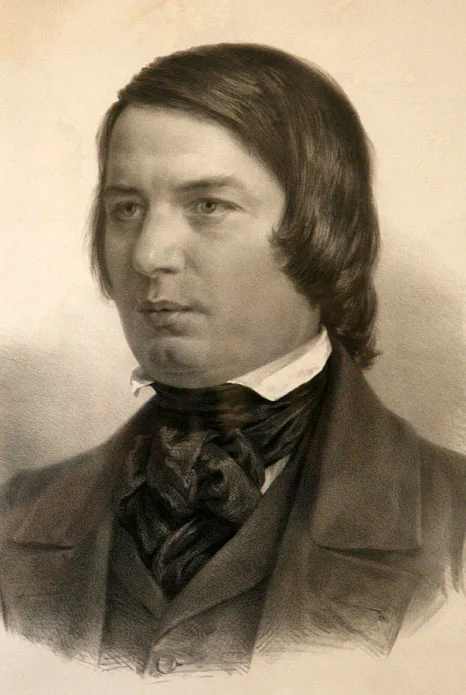
Image from Wikipedia
Image from Wikipedia
Robert Schumann – the Romantic composer between poetry, passion, and musical revolution
A master of Romanticism whose music still resonates today
Robert Schumann is considered one of the most influential composers of the 19th century. His music combines literary imagination, emotional depth, and a distinctive sound language that lies at the heart of German Romanticism. As a composer, music critic, and conductor, he shaped not only a body of work with an extraordinary stylistic range but also a musical thinking that continues to resonate today. ([britannica.com](https://www.britannica.com/biography/Robert-Schumann))
Born on June 8, 1810, in Zwickau and died on July 29, 1856, in Endenich near Bonn, Schumann developed an early dual talent for literature and music. It was not until after 1830 that composition clearly became the focus of his life, and he saw himself as a tone poet. This connection of linguistic fantasy and musical form characterizes his entire oeuvre and makes him a key figure of Romanticism. ([britannica.com](https://www.britannica.com/biography/Robert-Schumann))
Early years in Zwickau: Literature, piano, and first artistic impulses
Schumann's childhood in Zwickau was closely linked to the educational background of his family. His father was a bookseller and publisher, and the family initially encouraged him to study law before his true calling prevailed. He began piano lessons as a child, and early on, music and literature did not run parallel for him but fused into a common form of expression. ([britannica.com](https://www.britannica.com/biography/Robert-Schumann))
His time at the University of Leipzig formally introduced him to law, but his daily life revolved around piano improvisation, composition, and literary drafts. A significant turning point was his encounter with Friedrich Wieck and his daughter Clara, who later became his artistic partner and wife. A hand injury ultimately ended his dream of becoming a virtuoso and permanently steered Schumann towards composition. ([britannica.com](https://www.britannica.com/biography/Robert-Schumann))
The breakthrough as a composer and music writer
With the first published works starting in 1831, Schumann's actual career as a composer began. He composed a number of technically challenging piano works early on, which already revealed his preference for character pieces, poetic miniatures, and formal fantasy. Simultaneously, his critical voice gained weight: in 1834, he founded the Neue Zeitschrift für Musik in Leipzig, which became a central forum for his aesthetic positions. ([britannica.com](https://www.britannica.com/biography/Robert-Schumann))
As a critic, Schumann fought for forward-thinking, poetic music and engaged with contemporary works as well as those of past masters. This stance sharpened his profile far beyond that of a mere composer. He was an interpreter of music, a style-shaper, and an intellectual player of Romanticism. ([cambridge.org](https://www.cambridge.org/core/services/aop-cambridge-core/content/view/1529FC791CA211703182C7169AC2C9A3/9781139001540c12_p252-267_CBO.pdf/the-compositional-reception-of-schumanns-music-since-1950.pdf))
The piano as a poetic laboratory
In his early and middle creative phases, piano music was at the center. Works like Papillons, Carnaval, Davidsbündlertänze, Kinderszenen, or the Symphonic Etudes showcase Schumann's ability to encapsulate musical characters in dense, often literarily-inspired scenes. His piano pieces are not merely virtuosic works but dramatic microcosms with psychological depth. ([britannica.com](https://www.britannica.com/biography/Robert-Schumann))
In these cycles, his unmistakable language unfolds: rhythmically pointed, harmonically fluid, often fragmentary in form yet rooted in inner logic. Schumann sought not only brilliance in piano sound but an ideal medium for states of the soul, memories, and literary images. In doing so, he sustainably defined the romantic piano aesthetic. ([britannica.com](https://www.britannica.com/biography/Robert-Schumann))
The year of song 1840: Schumann's significant shift to vocal music
In 1840, the year of his marriage to Clara Wieck, Schumann wrote nearly 150 songs and turned with immense productivity to vocal music. This "Year of Song" marks one of the most significant turning points in his music career. In the song cycles, his sensitivity to text interpretation, harmony, and emotional nuance crystallizes into a form of expression that belongs to the peaks of German song art. ([en.wikipedia.org](https://en.wikipedia.org/wiki/Robert_Schumann?utm_source=openai))
Among his most famous song works are Dichterliebe, Frauenliebe und Leben, and Myrthen, which was created as a wedding gift for Clara. The songs reveal Schumann as a composer who transforms linguistic subtleties into musical psychology. Here, his poetic approach becomes especially tangible: each song feels like a precisely set scene with a literary core. ([en.wikipedia.org](https://en.wikipedia.org/wiki/Robert_Schumann?utm_source=openai))
Orchestral, chamber music, and the expansion of his oeuvre
After 1840, Schumann consistently expanded his work. He wrote orchestral music, including four symphonies, concertante works, chamber music, choral music, and even an opera. Notably, the First Symphony in B-flat major and the Rhine Symphony are among the works where his romantic tonal language connects with orchestral thinking. ([britannica.com](https://www.britannica.com/biography/Robert-Schumann))
Chamber music also gained significance, especially in the piano quintet and string quartets. His works here demonstrate a preference for thematic condensation, contrapuntal work, and an inner tension that oscillates between classical formal strictness and romantic expressiveness. Schumann's orchestral language was considered difficult by some contemporaries; today, it is regarded as an indispensable part of his oeuvre. ([britannica.com](https://www.britannica.com/biography/Robert-Schumann))
Musical language, style, and cultural influence
Schumann's style is characterized by introspection, rhythmic energy, and a deep connection to literature. His music can seem fragile and dreamy, but also passionate and decisive. This range makes his art feel so modern: it follows not external effects but an inner dramatic arc that arises from imagination, memory, and poetic condensation. ([britannica.com](https://www.britannica.com/biography/Robert-Schumann))
His cultural influence extends far beyond the Romantic era. The Robert Schumann House in Zwickau today serves as a research center, educational space, and authentic access point to his life and work; the city of Zwickau continues to present Schumann's music in concerts, exhibitions, and events. The fact that his works are still performed intensively and reinterpreted shows the enduring authority of his compositional thinking. ([schumann-zwickau.de](https://www.schumann-zwickau.de/en/))
Late works, illness, and the reassessment of a contested legacy
Schumann's later life was marked by psychological instability, which for a long time overshadowed the reception of his works. Earlier judgments often placed his late works under suspicion of deterioration, but musicological discussion has changed this perspective. Today, his late work is read more nuancedly and recognized as an integral part of a creative output that remains unique in its development, tension, and vulnerability. ([britannica.com](https://www.britannica.com/biography/Robert-Schumann))
The late compositions show not only crises but also remarkable compositional concentration. Particularly in light of modern research, Schumann's entire oeuvre appears as a multifaceted, internally coherent artistic universe. His significance lies not despite, but also because of these tensions in music history. ([cambridge.org](https://www.cambridge.org/core/services/aop-cambridge-core/content/view/1529FC791CA211703182C7169AC2C9A3/9781139001540c12_p252-267_CBO.pdf/the-compositional-reception-of-schumanns-music-since-1950.pdf))
Discography, repertoire, and lasting relevance
Central pillars of his discography in the classical repertoire include the piano cycles, the major song collections, the four symphonies, the piano concerto in A minor, the piano quintet in E-flat major, and the chamber music. These works form the backbone of his artistic identity and showcase the full spectrum between subjective intimacy and public form. Thus, Schumann remains a composer who serves as a lasting reference for pianists as well as singers, chamber ensembles, and orchestras. ([britannica.com](https://www.britannica.com/biography/Robert-Schumann))
His critical reception today reflects respect for the formal audacity and poetic character of his music. What was once regarded as difficult is now recognized as a strength: the condensation of emotion, structure, and literary imagination. In this regard, Schumann belongs to those composers whose work gains new listeners with each generation. ([britannica.com](https://www.britannica.com/biography/Robert-Schumann))
Conclusion: An artist of lasting intensity
Robert Schumann fascinates because he understood music not merely as form but as a spiritual and poetic expression. His compositions speak of love, introspection, fantasy, and conflict without ever losing their artistic ambition. Experiencing Schumann live in concert confronts one with music that speaks directly and simultaneously leads deeply into the history of Romanticism. ([britannica.com](https://www.britannica.com/biography/Robert-Schumann))
Official channels of Robert Schumann:
- Instagram: No official profile found
- Facebook: No official profile found
- YouTube: No official profile found
- Spotify: No official profile found
- TikTok: No official profile found
Sources:
- Britannica – Robert Schumann
- Wikipedia – Robert Schumann
- Schumann in Zwickau – City of Zwickau
- Living museum – Robert Schumann House Zwickau
- Schumann-Portal – Robert Schumann House Zwickau
- PTNA Piano Music Encyclopedia – Schumann, Robert
- Cambridge University Press – The compositional reception of Schumann's music since 1950
- Wikipedia: Image and text source