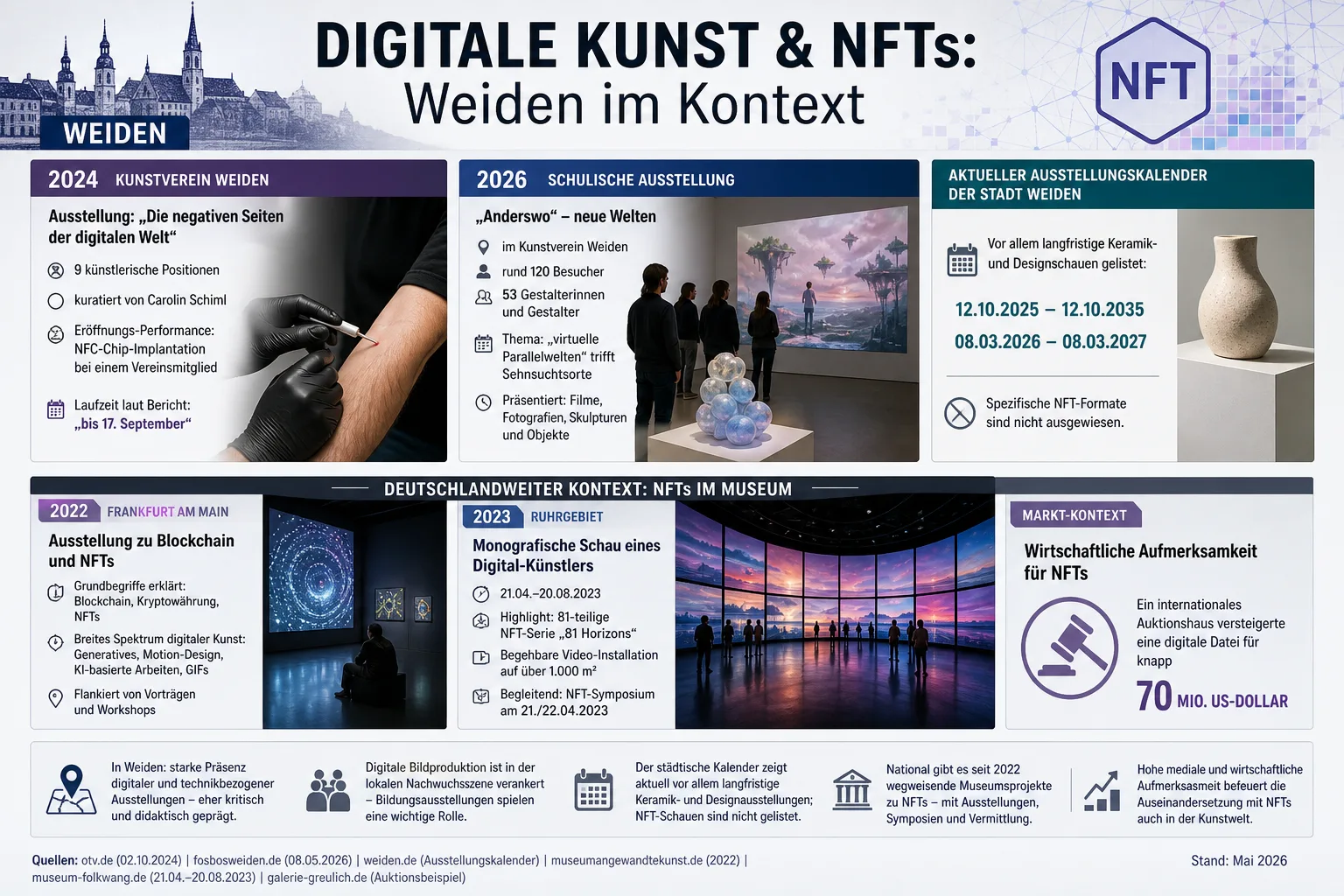
Discover Digital Art & NFT Exhibitions in Weiden
Digital Art & NFT Exhibitions in Weiden (Preview 2026/2027)
How can digital art, immersive installations, and NFT-based works be presented in Weiden (Upper Palatinate) in the future – in a way that is understandable, accessible, and critically accompanied? This preview bundles possible event formats, explains key terms (NFT, blockchain), and outlines how visitors can prepare for upcoming dates, open calls, and exhibition announcements.
Note for classification: This article is designed as a program preview and orientation for future events. Concrete dates and confirmed programs should always be checked via the official channels of the respective organizers in Weiden.
What counts as digital art in 2026/2027?
In future exhibitions in Weiden, “digital art” can mean many things – from clearly digital works to hybrid forms that combine analog and digital elements. Typical genres that are well suited for exhibition spaces, pop-ups, or festival formats include:
- Video art & motion design: Loop projections, multi-channel video, audio-visual compositions.
- Generative art: Works created by rules/algorithms (e.g., code, randomness, parameters) and shown as prints, screen works, or installations.
- Interactive works: Installations that respond to movement, voice, smartphones, or sensors (with clear visitor guidance and data protection notices).
- XR/Immersion: VR/AR stations, room projections, walk-in sound & light environments – with a focus on accessibility and safety.
- Digital photography & AI-supported visual worlds: including transparent labeling of tools, data sources, and editing.
For Weiden, these formats are particularly interesting because they can be implemented both in classic exhibition spaces and in temporary project rooms, schools, libraries, or public spaces – often modularly, with manageable transport effort.
NFTs & Blockchain: Basics for Exhibition Guests
If future Weiden programs explicitly work with NFTs, a clear distinction of terms helps. This allows hype to be separated from function:
- NFT (Non-Fungible Token): A unique token on a blockchain, typically used as a proof of assignment and ownership for a digital object. An NFT is not automatically identical to the image or video file, but often refers to it (e.g., via metadata).
- Blockchain: A distributed ledger that transparently documents transactions. Which data is publicly visible depends on the respective blockchain and implementation.
- Smart contracts: Program code on a blockchain that executes rules (e.g., issuing a token, resale logic). The concrete legal effect depends on contracts and applicable law.
What visitors can expect at an NFT exhibition
A well-curated NFT-related exhibition (whether in Weiden or elsewhere) not only makes “tokens” visible, but also explains:
- What exactly is being collected: File, print, license, access, edition, exhibition copy – and what is not automatically included (e.g., copyrights).
- How provenance works: Which steps are traceable on the blockchain, which remain off-chain (e.g., authenticity check, signature, contract).
- What risks exist: Phishing/scams, wallet security, forgeries, platform risks, volatile markets.
- Which environmental and energy issues are relevant: Depending on the network used and the technical implementation.
Possible Exhibition Formats in Weiden (Preview)
Without anticipating a concrete, already published annual program, realistic formats can be outlined for Weiden that are suitable for 2026/2027 – and that take both art and mediation seriously:
1) Thematic exhibition “Digital Bodies, Digital Boundaries”
A curated format that artistically examines body, identity, tracking, self-quantification, and digital self-images – with wall texts that clearly explain terms such as data protection, consent, and biometrics. This can work well for Weiden because the topic touches many areas of life (school, work, health, everyday technologies).
2) “Generative Weekend”: Exhibition + Live Coding
A compact weekend in which generative art is shown in the space (prints, screens, projections) and live coding sessions take place in parallel. Advantage: Visitors experience the creation process and learn how rules/parameters change an artwork.
3) NFT editions as an accompanying format (not as an end in itself)
Instead of a pure “NFT show,” an upcoming exhibition in Weiden can optionally offer digital editions that clearly communicate:
- which work (or which version of the work) is being tokenized,
- which usage rights buyers receive,
- how long-term access/archiving is handled,
- whether a purchase is also possible without a crypto wallet (e.g., via intermediaries).
4) Immersive installation as a city cooperation
A large projection or sound installation can be created as a cooperation between cultural actors, educational partners, and possibly local technology partners. Important for planning: time slots, visitor flow, low-barrier access, safety, as well as transparent information about sound/light intensity.
Mediation: Tours, Workshops, School and Family Offers
Digital art becomes sustainably effective when mediation is planned alongside. For future Weiden formats, these components are particularly practical:
- Introductory tours (30–45 min.): Focus on terms (NFT, blockchain, generative, interactive) and “How do I read a digital work?”
- Family stations: Playful interaction (e.g., changing parameters, generating colors/patterns) without technical barriers.
- School modules: Separate tracks for art/German (image analysis, narratives), computer science (algorithms), social studies (regulation, data protection).
- Artist talks & tool transparency: Artists explain workflow, software/hardware, data sources, and decision logics.
Important for trust: For interactive works, visitors should be able to clearly see in advance whether and which data is processed (e.g., camera, microphone, smartphone), and whether use is possible without data collection.
Opportunities & Risks: Culture, Climate, Copyright, Fraud Protection
Opportunities
- New artistic forms of expression: Code, simulation, interaction, and audiovisual spaces expand classic media.
- New target groups: People interested in games, design, music production, or tech find easier access.
- Regional visibility: Good programs can position Weiden as a place for contemporary media art – also beyond the region.
Risks and how to address them in exhibitions
- Copyright & usage rights: NFTs are not an automatic transfer of rights. Exhibitions should clearly explain rights chains and licenses.
- Market and fraud risks: Wallet security, fake drops, phishing – visitor information and clear warnings increase protection.
- Environmental and energy issues: Transparency about technical implementation and conscious selection of solutions help to conduct discussions seriously.
- Long-term archiving: Digital works need maintenance (file formats, hardware, dependencies). Good programs address preservation strategies.
Financial note: This article is not investment advice. NFTs and crypto assets can carry high risks, including total loss. Inform yourself about technical, legal, and financial consequences before making purchases.
How to Prepare for Upcoming Dates
- Check official announcements: Pay attention to program pages, press releases, and social media channels of local cultural actors in Weiden.
- Look for accompanying programs: Exhibitions with talks, tours, or workshops are especially worthwhile – here, terms and backgrounds are explained.
- Bring questions: Good curation can handle critical questions (data protection, energy, rights, provenance, tool transparency).
- For NFT offers: Observe security basics: Do not share seeds/passphrases, check links, use only official drop information.
Sources
- Ethereum.org: NFTs — Overview of functionality and terms (accessed 2026-09-23)
- Ethereum.org: Smart Contracts — Basics of smart contract concepts (accessed 2026-09-23)
- ESMA (European Securities and Markets Authority) — Notes and publications on risks of crypto assets (accessed 2026-09-23)
- EUR-Lex — EU legal information, including regulation around crypto assets (accessed 2026-09-23)
- BSI (Federal Office for Information Security) — Recommendations on IT security, including protection against phishing and fraud (accessed 2026-09-23)