“Glue” or “Corrective”: Discourse functions that can grow
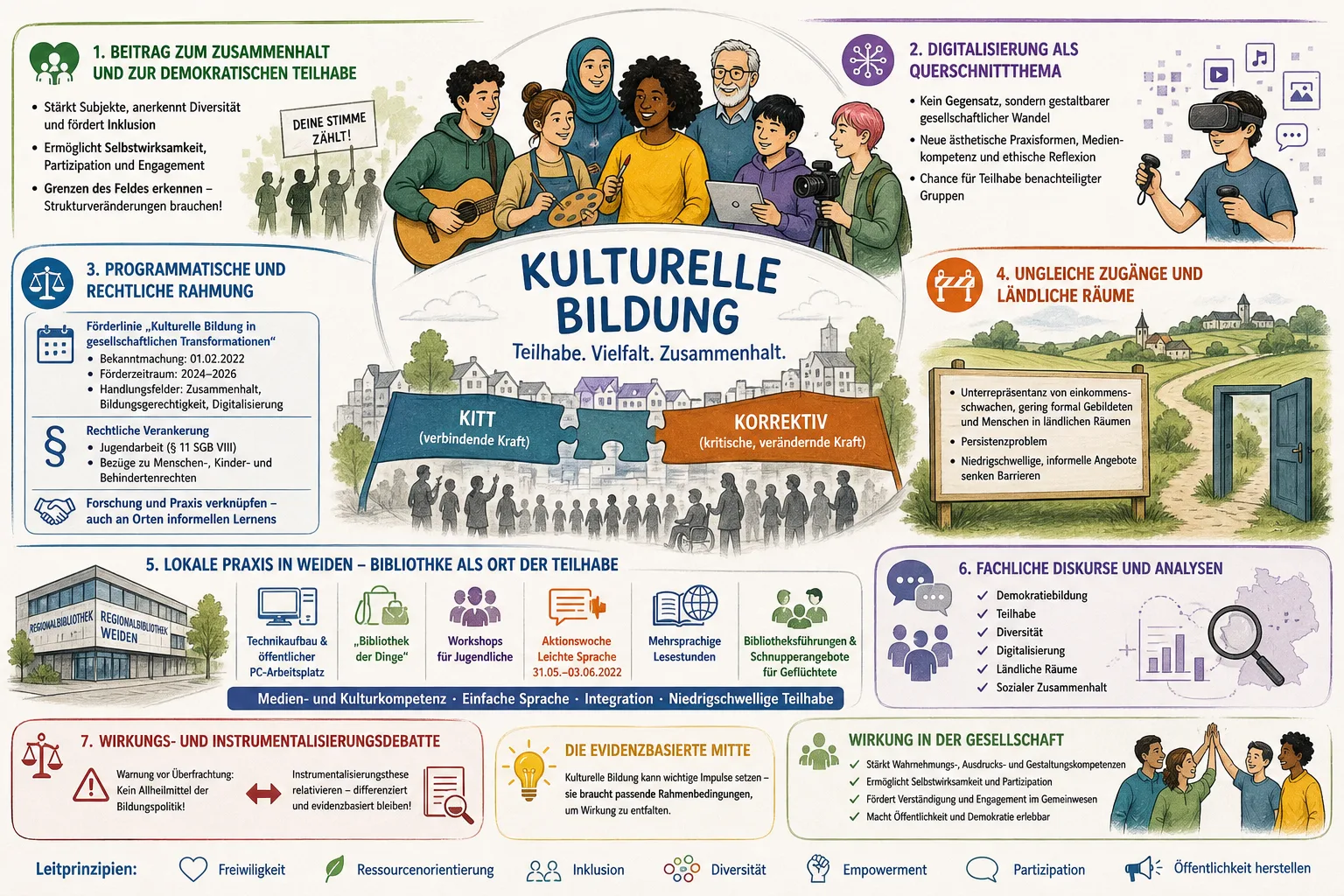
In the coming years, cultural education in Weiden will likely be able to fulfill two societal functions particularly clearly: as “glue” (cohesion) and as “corrective” (critical visibility and impulses for change).
As “Glue”: Encounters That Otherwise Would Not Happen
As “glue,” cultural education will have an effect wherever people come together who rarely meet in everyday life: in open writing workshops, inclusive theater groups, multilingual reading series, or low-threshold creative formats. Such settings will not only tolerate diversity but make it actively shapeable—a key building block for social cohesion.
As “Corrective”: Spaces Where Conflicts Become Manageable
As a “corrective,” cultural education will be relevant when it does not ignore social conflicts: Projects on democracy education, experiences of exclusion, digital public spheres, or local remembrance culture will open protected spaces where dissent, perspective shifts, and new solutions become possible.
It remains important to have a sober expectation: Cultural education will not be a substitute for social policy, infrastructure, or educational equity. Its strength will lie in preparing discourses, opening participation, and building concrete skills—provided that framework conditions such as time, spaces, qualified staff, and cooperation are reliably secured.
Rural Area: Access, Barriers, and New Solutions
Weiden, as a medium-sized center in a rural environment, will play a key role especially if cultural education is designed in such a way that it reaches people who would otherwise remain underrepresented. Research and practical debates have pointed for years to unequal opportunities for participation—among other things, along the lines of income, education, language, mobility, and disability.
Barriers That Can Be Specifically Reduced in the Future
Financial hurdles : fees, travel, materials.Information and language : lack of multilingual information, unclear access, communication that is too complex.Structural distances : long journeys from the surrounding area, unsuitable times, lack of compatibility with everyday life.
Effective will likely be especially low-threshold and informal settings: open workshops, low-cost trial formats, offers in the immediate living environment, as well as cooperation with schools, youth social work, clubs, and neighborhood initiatives. If Weiden systematically bundles and makes such formats visible, the city can take on a real bridging function for the region.
Digitalization: Post-digital Cultural Practice as the Next Step
In the future, digitalization in cultural education will not be discussed as “analog versus digital,” but as a post-digital reality: Life worlds are intertwined, media literacy becomes a cultural technique, and what matters is how tools, spaces, and rules are designed.
Opportunities That Weiden Can Specifically Use in the Future
Media literacy as a key to participation : a reflective approach to platforms, sources, and digital publics will strengthen cultural, political, and professional participation.New aesthetic forms : audio and video projects, gaming culture, maker formats, storytelling, and social media labs will offer particularly attractive entry points for young people.Expanded access : open learning and technology spaces (e.g., PC workstations, Wi-Fi, device lending) will help where equipment or quiet learning spaces are lacking.
To ensure that digitalization does not reinforce inequalities, pedagogical and ethical standards will be important in the future: data protection, copyright, youth protection, low-barrier usability, and critical source competence must be considered from the outset. The goal will be for young people not only to consume, but to act as creators—with their own projects, publications, and formats that address local topics.
The Library as a Culture Hub: Formats That Lend Themselves
In Weiden, the public library will be particularly well suited as a hub for cultural education in the future, because it is low-threshold, public, and accessible across generations. Especially when cultural venues are to enable discourse, a “safe” everyday space with clear rules and an open atmosphere will be crucial.
Building Blocks That Can Be Sensibly Combined in the Future
Open technology and learning times : freely usable workstations, introductions to basic digital skills, and support for independent learning.“Library of Things” as a participation tool : lending of items (e.g., technology or creative materials) can reduce costs and enable project work.Workshops for young people : formats on video, podcast, gaming culture, creative writing, or AI-supported work (with clear rules on sources, labeling, and data protection).Easy language & multilingualism : readings, introductions, and program information in accessible language will reduce barriers and reach new target groups.Encounter formats : moderated discussion evenings, “city stories” formats, or intergenerational storytelling cafés can strengthen local discourse.
It will be crucial that such offers do not fizzle out as one-off events, but are built as a reliable series with clear access, transparent participation conditions, and cooperation with schools, youth centers, integration work, and cultural initiatives.
When cultural education becomes public in a city, discourse does not only arise on panels, but in everyday life: while reading, listening, trying things out, and having the courage to share one's own perspective.
Guiding principle for future formats in Weiden
Outlook: What Weiden Can Specifically Continue to Develop
In the coming years, Weiden will anchor cultural education sustainably above all if goals, responsibilities, and quality criteria become clear. Several practical guidelines can be derived from nationwide debates.
1) Strengthen Structures
Reliable spaces, qualified staff, and continuous cooperation will make the difference. If the library, schools, youth centers, clubs, and initiatives plan in a coordinated way, a network can emerge that remains viable even with changing funding landscapes.
2) Broaden Access
Low-threshold, low-cost offers, understandable communication (including easy language), accessibility, and flexible times will remain central in the future to actually reach people with previously low participation opportunities.
3) Connect Digital and Analog Worlds
Hybrid projects will appeal to new target groups: for example, local podcast series, digital city stories, exhibitions with online extensions, or workshops that combine analog creation with digital publication.
4) Open Discourse Spaces—with Real Co-creation
Cultural education will credibly promote discourse in Weiden when participation is real: Young people, seniors, newcomers, and people with disabilities will not only appear as audiences, but as co-planners and contributors. Local topics such as city center development, mobility, environment, or coexistence can thus be addressed in cultural formats—constructively, controversially, and respectfully.
This way, cultural education in Weiden can be both “glue” and “corrective” in the future: connecting without suppressing conflicts—and critical without excluding people. What will be decisive is that this work is designed continuously, transparently, and accessibly.
Last reviewed: 2026-08-26
Note: This article serves to inform and provide orientation on cultural education and possible future development directions in Weiden. It does not replace legal advice and does not make binding commitments about specific programs or dates.