Open Stage & Poetry Slam in Weiden – Stage for Creatives
Open Mic & Poetry Slam in Weiden: Upcoming Stages, Participation & Preparation
Do you want to perform in Weiden or simply experience creative live formats? Here you will find only upcoming dates and permanently relevant contact points – plus concrete tips for text, technique, and your first performance.
Overview: Which formats await you in Weiden (and nearby)
- Open Stage / Open Mic: Open stage with short slots – ideal for trying things out, also with music or spoken word.
- Poetry Slam: Own texts, stage performance, usually with a time limit and audience rating (details vary by event).
- Workshops: Writing and performance training, often as a springboard to the first stage (especially for U20).
- Campus Formats: University-related slams and open-mic evenings in the region, which are also relevant for participants from Weiden.
Important: The exact rules, times, and slot allocations differ for each event. Check the official announcements from the organizers in advance.
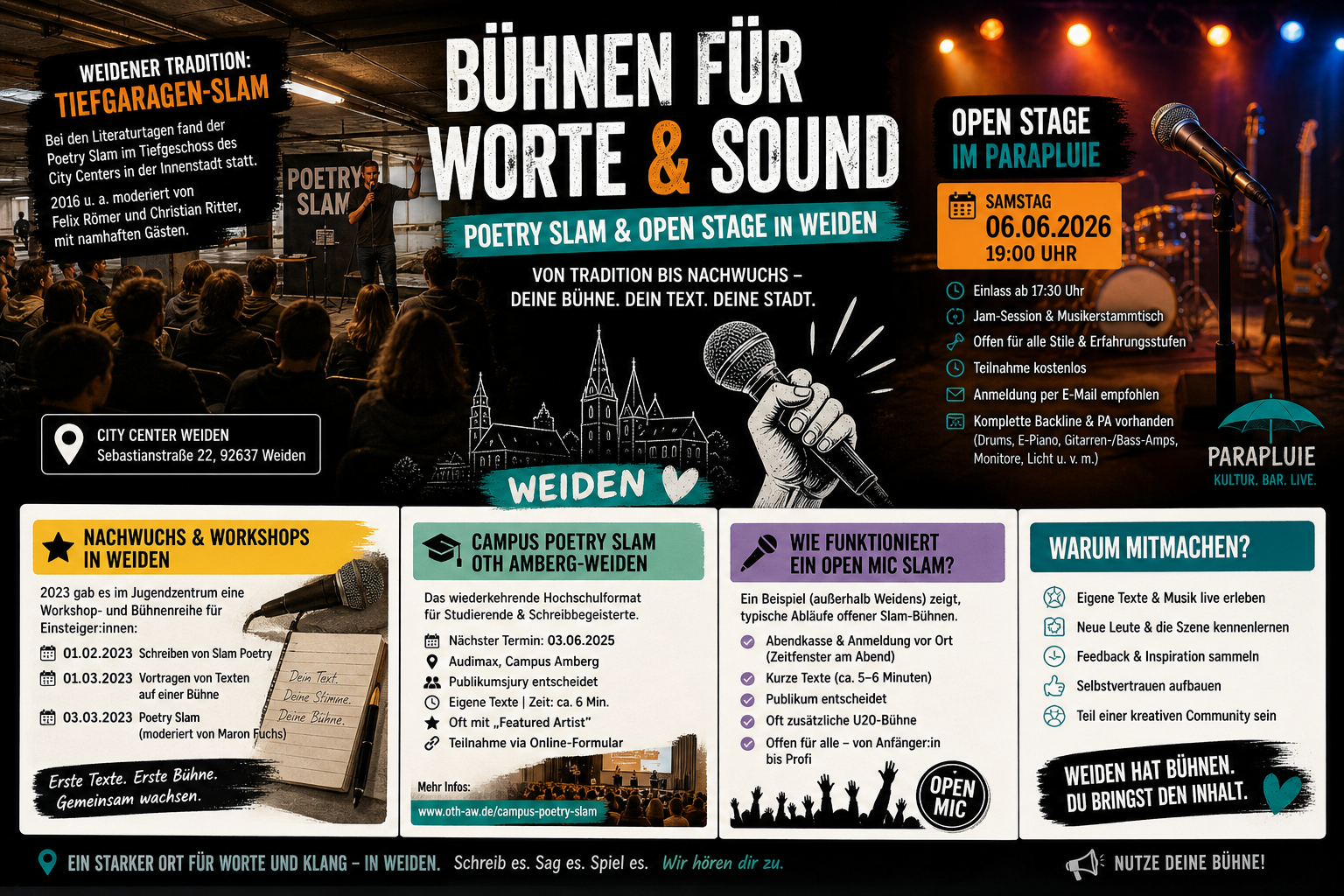
Upcoming Date: Open Stage at Parapluie (Weiden)
If you want to get on stage in Weiden at short notice and with low barriers, the Open Stage at Parapluie is a central contact point: open to all genres (music, poetry, spoken word, rap, reading) and focused on "just do it."
Date (upcoming)
- Date: Saturday, 06.06.2026
- Start: 7:00 PM
- Admission: from 5:30 PM
- Participation: free
- Secure a slot: Registration by email is recommended (depending on demand, spontaneous slots may be possible).
Technology & Backline
Crucial for many acts: The stage is typically already equipped (including PA, monitors, lighting; often also drum set, e-piano, as well as guitar and bass amps). This reduces preparation stress – especially if you are performing for the first time or working with spoken word plus instrument.
How to make the most of the evening
- Arrive early: Use admission time to understand soundcheck/slot procedures and talk to the host.
- Plan for the slot: A clear, short contribution often has more impact than "too much at once."
- Jam/Open-Mic Character: If a session develops after individual contributions, you can also join in musically or performatively – without pressure to be "perfect."
Workshops & Young Talent: Good Paths to the First Stage (U20 & Beginners)
If you don't yet feel ready to stand on an open stage "just like that," a workshop setting is often better: You develop a text, rehearse presentation, timing, and breathing – and only then go into the live situation.
What to look for in workshop offers
- Focus on "Writing": Finding topics, dramaturgy, punchlines, imagery, rhythm.
- Focus on "Performance": Microphone work, volume, pauses, eye contact, dealing with blackouts.
- Final performance: Ideally, there is a stage at the end (showcase or slam-like evening), so you can apply what you have learned directly.
If you are U20 (or support U20), it is especially worthwhile to look at programs from youth culture and educational institutions in the city: There, young talent formats are more often designed so that first performances take place in a protected environment.
Campus Poetry Slam & Regional Options (within reach of Weiden)
In addition to city stages, campus formats in the region are a practical addition: You often get a clearly structured registration, guaranteed slots, and a larger hall situation – ideal if you want to specifically prepare for "classic" slam evenings.
Typical procedure (may vary by event)
- Register in advance: Often via an online form or by email.
- Time limit: Usually a few minutes per text (exact requirements are in the announcement).
- Moderation & Voting: The host leads through the evening; often the audience decides.
- Featured Act: Sometimes a guest performs outside the competition.
For students and creatives from Weiden: If you want to become confident on a big stage, campus slams are a good training ground – you learn to deal with hall size, stage fright, and clear rules.
Preparation: How to go on stage more confidently
1) Text & Timing (Slam or Open Stage)
- Practice aloud & time yourself: Read your text with a stopwatch. Read aloud, it is almost always longer than "in your head."
- Mark breathing points: Especially in fast passages, consciously placed pauses help.
- A clear start: The first 10–20 seconds often decide whether the audience is "with you."
- Backup text: Bring a second, shorter piece in case slots change or you are asked spontaneously.
2) Technology & Procedure
- Microphone: Test the distance (usually 5–10 cm) and speak short sentences at stage volume.
- Music/Playback: If you need playback, clarify this with the tech team in advance (format, volume, start signal).
- Respect changeover time: Pack so that you are ready to go in under a minute (especially at open stages).
3) Managing stage fright in practice
- Mini-ritual: 3 deep breaths, relax your shoulders, look at the audience – then start.
- Allow yourself to be nervous: You don't have to appear "cool." Speaking clearly beats perfect attitude.
- Front rows as anchors: Pick 2–3 friendly faces and alternate eye contact between them.
If you (first) just want to watch: How you benefit as an audience member
Even without your own slot, a visit is worthwhile – especially if you want to perform later:
- You see how long contributions work in practice (not just on paper).
- You get a feel for audience reactions: What brings laughter, what brings silence, what carries in the room?
- You get to know moderation style and procedures – and thus take pressure off your own performance.