
Schumann Quartett
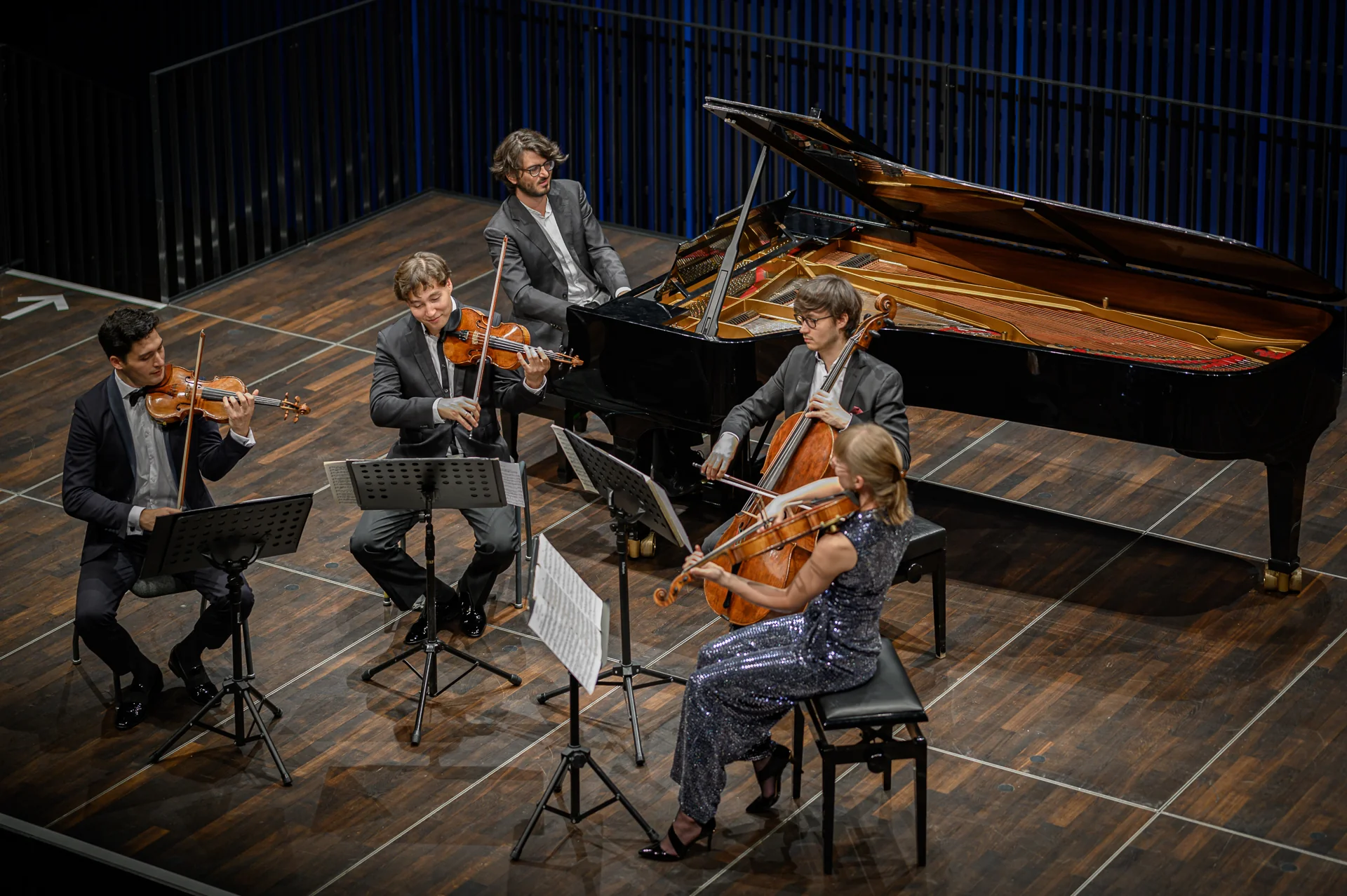
Image from Wikipedia
Image from Wikipedia
Schumann Quartet: Chamber Music with Tension, Intelligence, and Electric Stage Presence
A German String Quartet Filling the Concert Hall with Risk and Depth
The Schumann Quartet is among the most prominent string quartets of its generation. Founded in 2009 in Cologne, the ensemble brings together the three brothers Erik Schumann, Ken Schumann, and Mark Schumann with violist Matthew McDowell, creating a formation that combines technical precision, emotional alertness, and stylistic curiosity in a rare way. The name does not refer to Robert Schumann, but rather to the three Schumann brothers themselves – a clear commitment to familial roots and collective identity.
The career of the ensemble demonstrates how consistently chamber music is envisioned as a living present. The Schumann Quartet navigates confidently between canonical works, conceptually strong programs, and new perspectives on familiar repertoire. International competitions, prestigious awards, and a discography with a clear artistic signature have established the ensemble as a staple in European concert life.
Biography: From Shared Childhood to International Quartet Culture
The artistic starting point of the Schumann Quartet is unusually immediate: The three brothers have played together since early childhood. This developed familiarity continues to shape the ensemble's musical career, as the focus is not solely on the pure mastery of the repertoire but on a shared musical reflection. Matthew McDowell complements this familial structure with a tonally and musically highly sensitive viola voice, which shapes the quartet into an organic whole.
Important impulses came from influential teachers such as Eberhard Feltz and from the Alban Berg Quartet. Collaborations with notable musicians like Menahem Pressler also left significant marks on their artistic development. The ensemble describes its working method as open, curious, and focused on the tension of the moment – an approach that is particularly valuable in string quartet playing as it avoids routine and refreshes the music in every performance.
Competitions, Awards, and the Early Breakthrough
The Schumann Quartet solidified its international breakthrough with significant competition successes. These include first prizes at the International Competition "Schubert and the Music of Modernity" in Graz in 2012 and at the prestigious string quartet competition in Bordeaux in 2013. Such achievements are more than mere milestones in the field of chamber music; they mark the recognition of an artistic signature that stands out in tempo, balance, articulation, and tonal penetration compared to many other ensembles.
In 2014, the quartet was awarded the Music Prize of the Jürgen Ponto Foundation in the field of string quartet. Additionally, they have received funding from foundations such as Villa Musica Rheinland-Pfalz and other institutional supporters. In classical music, these signals are not only representative but also structurally significant: they open artistic spaces for tours, studio work, and long-term repertoire development.
The Artistic Signature: Energy, Transparency, and Emotional Intelligence
Critics repeatedly describe the Schumann Quartet as an ensemble of exceptional tension and vitality. On their own biography page, the quartet quotes comments such as "high emotional intelligence" and "dreamlike technical security." The praise from music press and feuilleton is equally poignant: Harald Eggebrecht wrote in the Süddeutsche Zeitung about "fire and energy" along with "blazing virtuosity and readiness for surprise." This captures the essence of this formation very accurately.
The special charm lies in the fact that the ensemble does not aim for smooth perfection but for tension, risk, and communicative intensity. The Schumann Quartet conceives of ensemble sound not as mere fusion but as a living dialogue of four independent voices. Particularly in the string quartet, this royal discipline of chamber music, an aesthetic quality emerges that convinces intellectually while also resonating immediately.
Discography: Concept Albums with a Clear Profile
The discography of the Schumann Quartet shows a remarkable evolution from classical core repertoire to curated concept albums. Early releases like "Beethoven Bartók Brahms" and "Mozart Ives Verdi" anchored the ensemble within the repertoire of classical modernism and the great quartet tradition. With "Landscapes," an album strategy began that not only collects works but also establishes connections between composers, epochs, and tonal colors.
"Intermezzo" placed Robert Schumann, Felix Mendelssohn Bartholdy, and Aribert Reimann in a musical context and was awarded the OPUS Klassik in the category of chamber music recording in 2019. "Chiaroscuro" marked the conclusion of a trilogy in 2019, presenting Mozart arrangements, Mendelssohn, Webern, Shostakovich, Philip Glass, and Janáček in a program full of tension. "Fragment" in 2020 devoted itself to Franz Schubert with particular intensity and deepened the profile of the quartet as an interpretatively reflective ensemble.
New Projects and Current Releases
Recent activities also demonstrate the ongoing artistic dynamism of the Schumann Quartet. In autumn 2023, a highly regarded album dedicated to the music year 1923 was released in collaboration with Bayerischer Rundfunk. The recording includes works by Alban Berg, Leoš Janáček, Paul Hindemith, and Aaron Copland, combining expressionist intensity, modernism, and tonal diversity in a historically precise concept.
For 2025, the release "Martin - Ullmann - Fauré" is scheduled with Berlin Classics. The album brings together three very different musical worlds in dialogue, showcasing once again the quartet's programmatic strength. Additionally, the dense concert activity of the 2025/2026 season with performances in renowned venues such as the Musikverein Vienna, Elbphilharmonie Hamburg, Muziekgebouw Amsterdam, Cologne Philharmonic, and Konzerthaus Dortmund emphasizes the chamber music rank of the ensemble. Projects with Kit Armstrong, Lisa Batiashvili, Sharon Kam, Andreas Ottensamer, and other partners underline the ensemble's chamber music stature.
Reception: Praise from Experts and High Repute in the Classical Scene
Critical reception paints the Schumann Quartet as an ensemble with extraordinary charisma. The British BBC Music Magazine referred to it as "personal and profound," while the Süddeutsche Zeitung counted the quartet among the best of the present day. The Fono Forum also described it as one of the most exciting string quartets on the current scene. Such assessments are not casual in the classical world, but expressions of widespread trust in interpretative substance.
It is particularly interesting that the press consistently highlights the balance of technical mastery and risk. The quartet's recordings are perceived not only as clean and stylistically controlled but also as lively, demanding, and rhetorically pointed. This mix of authority and unpredictability makes the ensemble equally exciting for audiences and critics.
Musical Development Between Tradition and Present
The musical development of the Schumann Quartet can be described as a movement from classic repertoire toward programmatically reflective overarching narratives. Haydn, Beethoven, Brahms, Schubert, and Schumann form the foundation, yet the present is always considered: Janáček, Glass, Webern, Copland, or Hindemith do not appear here as fringe repertoire but as integral parts of a vibrant quartet culture. This is precisely where the ensemble's expertise lies.
The discography also shows how skillfully the quartet draws historical lines. Works are not presented in isolation but are interpreted as parts of larger contexts: light and shadow, intermezzo and contrast, fragment and whole. This programmatic mindset grants the recordings a high recognition value and makes the ensemble attractive to listeners seeking more than mere fidelity to the work in string quartet music.
Stage Presence and Concert Culture
The Schumann Quartet perceives the stage as the place of genuine musical events. In their biography, the ensemble emphasizes that a work only truly develops live; on stage, every imitation dissolves, and one becomes honest with oneself. This attitude significantly shapes the quartet's stage presence: no academic performance, but breathing communication, immediate response, and a tension that engages the audience.
This presence is particularly evident in the 2025/2026 season, with performances at major venues and festivals confirming the quartet's status as an internationally sought-after formation. Those who experience the Schumann Quartet live receive chamber music not as a museum tradition, but as a vibrant present.
Conclusion: The Schumann Quartet combines familial intimacy, technical mastery, and intellectual curiosity into one of the most distinctive voices in contemporary chamber music. The mix of powerful stage presence, thoughtfully curated discography, and strong media perception makes this ensemble particularly intriguing. Anyone wanting to not just hear but intensely experience string quartet music should definitely see the Schumann Quartet live.
Official Channels of Schumann Quartet:
- Instagram: https://www.instagram.com/schumannstringquartet/
- Facebook: https://www.facebook.com/SchumannQuartett
- YouTube: https://www.youtube.com/SchumannQuartett
- Spotify: no official profile found
- TikTok: no official profile found
Sources:
- Schumann Quartett - Biography
- Schumann Quartett - Discography
- Schumann Quartett - Martin - Ullmann - Fauré
- Schumann Quartett - Official Website / Concerts
- Schumann Quartett - Contact / Social Media
- AllMusic - Schumann Quartett Biography
- The Strad - Schumann Quartet: 1923 – 100 Years of Radio
- BR-KLASSIK - Album of the Week: Schumann Quartett "1923 – 100 Years of Radio"
- Wikipedia: Image and text source
Upcoming Events
Castle Concert: Schumann Quartet