
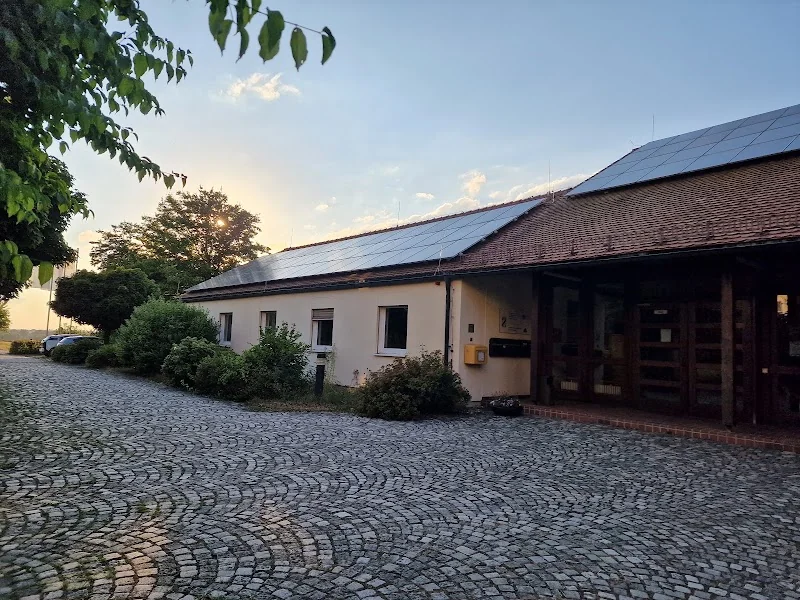
Weiden in der Oberpfalz
Almesbach 1, 92637 Weiden in der Oberpfalz, Deutschland
Bavarian State Estates Almesbach | Cattle Farming & Education
The state estate Almesbach is not a classic event venue, but an agricultural education and research facility with a clear professional focus and strong regional ties in Weiden i.d. Oberpfalz. The official site describes Almesbach as a place where modern dairy and cattle farming, sustainable feeding, animal welfare, digitalization, and renewable energies come together. Therefore, those looking for Almesbach will primarily find practical knowledge, courses, experiments, and concrete solutions for today's and tomorrow's agriculture. The location is complemented by Pfrentschweiher, where young cattle rearing, cow-calf farming, and game farming converge. This makes Almesbach a place where learning does not end in the seminar room but takes place in the barn, on the grassland, on the experimental fields, and during demonstrations directly on the farm. ([baysg.bayern.de](https://www.baysg.bayern.de/zentren/almesbach/267283/index.php?fontsize=1))
Cattle Farming, Animal Welfare, and Digital Barn Practices
The most important content focus in Almesbach is cattle farming. According to the official description, the dairy herd currently consists of around 140 animals. The farm uses the herd not only as a teaching herd for vocational training but also for specific research questions. These include various housing forms with a view to cow comfort and animal welfare, milking technology with digital animal health monitoring, breeding for genetic hornlessness, and questions of feed efficiency. Additionally, the herd is integrated into the LfL program DigiMilch, which tests digital technology in dairy farming and collects practical experiences. This is particularly exciting for visitors and learners because modern cattle farming is not only discussed but is made visible in ongoing operations. ([baysg.bayern.de](https://www.baysg.bayern.de/zentren/almesbach/247734/index.php))
The housing system is also designed for animal welfare. The dairy cows are kept in an outdoor climate barn that was built in 2006 and has been continuously modernized since then. The free-stall barn is divided into different functional areas where the animals can move freely and decide for themselves where to eat, rest, or stay. Important for practice is also the milking technology: Almesbach works with a milking parlor from the company DeLaval, and part of the herd is automatically milked so that course participants can learn about both systems. The milking process of individual animals can be monitored electronically; the milk quantities are documented in management programs and linked to herd management. This clearly shows why Almesbach is considered a research and education site: The operation combines animal observation, digital control, and practical training in a daily routine focused on profitability and animal health. ([baysg.bayern.de](https://www.baysg.bayern.de/zentren/almesbach/247734/index.php))
For feeding, the official site mentions a consciously structured ration concept consisting of grass silage, corn silage, straw, grain, mineral feed, protein mixture, and water; hay is also provided. The goal is a ruminant-appropriate, healthy, and liver-relieving diet with a balanced ruminal nitrogen balance. The ration is designed for a basic supply of about 25 kg of milk, with additional concentrates provided for higher performance. It is particularly emphasized that all feed used is free from genetic engineering and is tested in the quality program. This is ideal for the training logic because feeding, animal assessment, milking, and herd management do not occur separately but are conveyed as an interconnected system. This connection of animal welfare, technology, and economics makes the site relevant for businesses, trainees, and professionals alike. ([baysg.bayern.de](https://www.baysg.bayern.de/zentren/almesbach/247734/index.php))
Training, Courses, and Further Education
Almesbach is primarily a place of learning. In the field of agriculture, according to the official education page, four positions for vocational training are offered annually. A qualifying secondary school diploma is required; the first or second year of vocational training is possible. The focus areas are dairy farming, young cattle rearing, cow-calf farming, external economy, crop production, grassland, game farming, and alternative energy generation. Additionally, the farm offers a one-week trial internship. There are also training positions in home economics, specifically two positions per year. This shows that Almesbach not only represents animal production but functions as a holistic training facility that also includes supply, organization, and event work. ([baysg.bayern.de](https://www.baysg.bayern.de/zentren/almesbach/247736/index.php))
For agricultural trainees, the courses are particularly practice-oriented. The official education page mentions digital aids such as cow tracking, activity measurement, feeding time monitoring, rumination sensor technology, and the observation of calf drinking behavior. The focus course covers machine milking, quality milk production, milk price calculation, healthy feeding, breeding, estrus, pregnancy, obstetrics, herd management, and animal assessment. Additionally, quality assurance systems for milk and meat, feed law, and hoof care are included. For career changers, there are compact basic courses that explicitly address people who want more than just to sniff barn air. Training in Almesbach is thus not merely theoretical knowledge transfer but a structured connection of observation, craftsmanship, management, and modern measurement technology. ([baysg.bayern.de](https://www.baysg.bayern.de/zentren/almesbach/247736/index.php))
Furthermore, the continuing education offerings are particularly important. This includes the course for certified hoof trimmers, where proper and animal welfare-compliant hoof care is the focus. The hoof care course is conducted in small groups with theory and practice at several hoof care stations. For game farmers, Almesbach also offers a specialist course that is structured according to the relevant legal requirements and includes both distance learning and in-person phases. According to the official site, these courses take place in spring and autumn. In practice, this means: Almesbach is not only a training center for young farmers but also a place for further education on specialized topics where experience, law, animal welfare, and technical implementation belong together. ([baysg.bayern.de](https://www.baysg.bayern.de/zentren/almesbach/247736/index.php))
Pfrentschweiher: Young Cattle Rearing, Cow-Calf Farming, and Game
A central part of the site is Pfrentschweiher. The operation is located between the village of Pfrentsch and the Czech border directly on the Pfreimd and was annexed to the state estate Almesbach in 1969. Since then, the tasks have been clearly divided: In Almesbach, dairy farming is the focus, while in Pfrentschweiher, young cattle rearing takes place. The information pages also describe cow-calf farming in detail. Thus, Pfrentschweiher is not a side show but a specialized complement to the main site that makes the path from young animal rearing to cow-calf farming visible in a separate operational part. ([baysg.bayern.de](https://www.baysg.bayern.de/zentren/almesbach/267285/index.php))
The game enclosure Pfrentschweiher is the Bavarian teaching, research, and demonstration enclosure. Here, red deer, fallow deer, and sika deer are kept in large enclosures on 44 hectares. The enclosures are structured close to nature, with forests and hedges as wind and sight protection, as well as water areas as wallowing opportunities for the red deer. The management is divided into winter, calving, and summer enclosures, so that the animals have fresh growth throughout the vegetation period and the areas can be used extensively and promote biodiversity. The official site also mentions a herd protection demonstration facility that has become typical for the site. This is interesting for visitors and professionals because animal husbandry, nature conservation, wildlife management, and education come together here. ([baysg.bayern.de](https://www.baysg.bayern.de/zentren/almesbach/247763/index.php))
The cow-calf farming in Pfrentschweiher is also understood as a contribution to landscape maintenance. The animals keep renaturation areas along the Pfreimd clear and utilize growth from extensively managed areas. The operational description also emphasizes that the grassland is grazed by mother cows and wildlife, thus not only producing feed but also fulfilling ecological functions. This makes the operation particularly interesting for users searching for terms like young cattle rearing, cow-calf farming, or game farming: These topics are not just buzzwords in Almesbach but are directly anchored in the daily operations. ([baysg.bayern.de](https://www.baysg.bayern.de/cms16/zentren/almesbach/270444/index.php))
History: From Clearing Area to State Educational Institution
The history of Almesbach dates back a long way. The official history page suggests that a small settlement may have already existed near the present property around the year 1000. Over the centuries, the name, function, and ownership changed several times. However, Almesbach became particularly influential from the beginning of the 20th century when agricultural education and training became the actual focus. The page describes 1905 as a major premiere: At that time, for the first time in the then German Empire, a stationary livestock husbandry and milking course took place. This is a remarkable historical finding because Almesbach thus early became a place where agricultural practice was systematically taught. ([baysg.bayern.de](https://www.baysg.bayern.de/zentren/almesbach/270449/index.php))
The conditions were also very simple at first. Classes were sometimes held in the administrator's living room, accommodations were scarce, and the course participants had to live under very makeshift conditions. Nevertheless, the site quickly gained a good reputation. The official chronicle emphasizes that the response to the courses was positive from the beginning and that the site built a reputation in the field of agricultural further education. In 1949, the Free State of Bavaria acquired the association farm; in the same year, the new school building was prepared, and in 1950 the new building was inaugurated. Between 1905 and 1950, according to the chronicle, 5,700 young people were trained in the proper handling of animals. This number clearly shows the significance of Almesbach as a training location even then. ([baysg.bayern.de](https://www.baysg.bayern.de/zentren/almesbach/270449/index.php))
Later, the site developed further: In 1969, the research facility Pfrentsch was annexed to Almesbach, thereby functionally merging dairy farming and young cattle rearing. From 1992, the State Higher Agricultural School Weiden-Almesbach was established, and in 2004, Almesbach was integrated as a teaching, research, and specialist center into the Bavarian State Institute for Agriculture. Today, the tradition is continued with modern aspirations. The official announcement for the open house day in 2026 speaks of 125 years of Almesbach and invites insights into the educational and research operations. Thus, the site connects history, practice, and the present in a way that is hardly visible a second time so consistently in Bavaria. ([baysg.bayern.de](https://www.baysg.bayern.de/zentren/almesbach/247763/index.php))
Agriculture, Land, Energy, and Practical Information
Almesbach works not only with animals but also with land, crop rotation, and arable farming. The operational mirror lists a total of 265 hectares of agricultural usable area, including Pfrentschweiher, of which 96 hectares are arable land and 169 hectares are grassland. The crops include winter wheat, winter barley, winter triticale, winter rye, clover grass, and silage corn. The areas are primarily used for feed production for dairy cows, mother cows, heifers, and game, but also for biogas production. Additionally, state variety trials, fertilization trials, and other practical tests are conducted. There are also 30 hectares of forest, which provides construction timber and fuel. Agricultural work is therefore broadly positioned and ranges from forage production to research to forestry and energy issues. ([baysg.bayern.de](https://www.baysg.bayern.de/cms16/zentren/almesbach/270444/index.php))
Almesbach also demonstrates its role as a research facility in energy and climate protection. The official reports state that the large tractor Fendt 722 Vario used on the estate was converted to operate on cold-pressed rapeseed oil as part of the climate protection offensive. Additionally, the Bavarian State Estates mention public charging points at the Almesbach location, which underscores the focus on mobility and renewable energies. For practical orientation, the official contact page is helpful: Almesbach 1, 92637 Weiden i.d. Oberpfalz, with phone number and email address. Those visiting the site will find not urban logistics but an agricultural operation with clear pathways, comprehensible structure, and close ties to the land. ([baysg.bayern.de](https://www.baysg.bayern.de/))
For inquiries such as directions to Almesbach or parking at Almesbach, the events are particularly useful. At the field evening 2026, the large parking lot at the state estate was explicitly mentioned as the meeting point, and the event showcased practical solutions for reducing plant protection products on a model and demonstration area. The announcement for the open house day 2026 also mentions a program with agricultural machinery exhibitions, barn tours, technology demonstrations, culinary offerings, and children's programs. This means that those who visit Almesbach experience agriculture not abstractly but directly on-site. The location is thus equally a source of information, a learning place, and a practical operation. ([baysg.bayern.de](https://www.baysg.bayern.de/zentren/almesbach/398276/index.php))
Visits, Dates, and What Visitors Can Expect in Almesbach
Visitors should approach Almesbach with the right expectations: This is about agriculture, not classic entertainment. Nevertheless, the site has a lot to offer for interested parties because it regularly provides insights into ongoing work processes. The field evening 2026 focused on reducing plant protection products and showcased practical solutions in the crops wheat, corn, and triticale. The invitation to the open house day 2026 promises rare insights into an agricultural education and research facility. This mix of professional information, barn technology, fieldwork, and family offerings makes Almesbach a location worth visiting for both professionals and agriculturally interested laypeople. ([baysg.bayern.de](https://www.baysg.bayern.de/zentren/almesbach/398276/index.php))
The organization is also practically solved. The official page for the field evening did not require a separate registration step, and the large parking lot of the estate was mentioned as the meeting point. This facilitates planning for visitors interested in topics such as animal welfare, barn technology, digitalization, game farming, or sustainable land management. Those visiting the site for courses or tours also benefit from the fact that the Bavarian State Estates coordinate their work at several locations and clearly position Almesbach as an education and research center for cattle farming. Therefore, Almesbach is also well placed under search terms such as training farmer Almesbach, game farming Almesbach, or animal welfare cattle farming Bavaria. ([baysg.bayern.de](https://www.baysg.bayern.de/zentren/almesbach/398276/index.php))
If you need practical information, the official contact details are the best starting point: State Estate Almesbach, Almesbach 1, 92637 Weiden i.d. Oberpfalz. From there, appointments, courses, and visiting opportunities can also be directly inquired. From a professional perspective, the site is particularly strong because it not only imparts knowledge but also tests and applies this knowledge in daily operations. This creates the special character of Almesbach: An operation that shows, explains, tests, and further develops agriculture. ([baysg.bayern.de](https://www.baysg.bayern.de/zentren/almesbach/350875/index.php))
Sources:
- Official overview page of the State Estate Almesbach ([baysg.bayern.de](https://www.baysg.bayern.de/zentren/almesbach/index.php?utm_source=openai))
- Contact and location data of the State Estate Almesbach ([baysg.bayern.de](https://www.baysg.bayern.de/zentren/almesbach/350875/index.php))
- Cattle farming, education, and educational offerings ([baysg.bayern.de](https://www.baysg.bayern.de/zentren/almesbach/247734/index.php))
- Pfrentschweiher, game farming, and history ([baysg.bayern.de](https://www.baysg.bayern.de/zentren/almesbach/247763/index.php))
- History, operational overview, and current events ([baysg.bayern.de](https://www.baysg.bayern.de/zentren/almesbach/270449/index.php))
- Energy, rapeseed oil tractor, and site topics ([baysg.bayern.de](https://www.baysg.bayern.de/))
Mehr anzeigenWeniger anzeigen
Bavarian State Estates Almesbach | Cattle Farming & Education
The state estate Almesbach is not a classic event venue, but an agricultural education and research facility with a clear professional focus and strong regional ties in Weiden i.d. Oberpfalz. The official site describes Almesbach as a place where modern dairy and cattle farming, sustainable feeding, animal welfare, digitalization, and renewable energies come together. Therefore, those looking for Almesbach will primarily find practical knowledge, courses, experiments, and concrete solutions for today's and tomorrow's agriculture. The location is complemented by Pfrentschweiher, where young cattle rearing, cow-calf farming, and game farming converge. This makes Almesbach a place where learning does not end in the seminar room but takes place in the barn, on the grassland, on the experimental fields, and during demonstrations directly on the farm. ([baysg.bayern.de](https://www.baysg.bayern.de/zentren/almesbach/267283/index.php?fontsize=1))
Cattle Farming, Animal Welfare, and Digital Barn Practices
The most important content focus in Almesbach is cattle farming. According to the official description, the dairy herd currently consists of around 140 animals. The farm uses the herd not only as a teaching herd for vocational training but also for specific research questions. These include various housing forms with a view to cow comfort and animal welfare, milking technology with digital animal health monitoring, breeding for genetic hornlessness, and questions of feed efficiency. Additionally, the herd is integrated into the LfL program DigiMilch, which tests digital technology in dairy farming and collects practical experiences. This is particularly exciting for visitors and learners because modern cattle farming is not only discussed but is made visible in ongoing operations. ([baysg.bayern.de](https://www.baysg.bayern.de/zentren/almesbach/247734/index.php))
The housing system is also designed for animal welfare. The dairy cows are kept in an outdoor climate barn that was built in 2006 and has been continuously modernized since then. The free-stall barn is divided into different functional areas where the animals can move freely and decide for themselves where to eat, rest, or stay. Important for practice is also the milking technology: Almesbach works with a milking parlor from the company DeLaval, and part of the herd is automatically milked so that course participants can learn about both systems. The milking process of individual animals can be monitored electronically; the milk quantities are documented in management programs and linked to herd management. This clearly shows why Almesbach is considered a research and education site: The operation combines animal observation, digital control, and practical training in a daily routine focused on profitability and animal health. ([baysg.bayern.de](https://www.baysg.bayern.de/zentren/almesbach/247734/index.php))
For feeding, the official site mentions a consciously structured ration concept consisting of grass silage, corn silage, straw, grain, mineral feed, protein mixture, and water; hay is also provided. The goal is a ruminant-appropriate, healthy, and liver-relieving diet with a balanced ruminal nitrogen balance. The ration is designed for a basic supply of about 25 kg of milk, with additional concentrates provided for higher performance. It is particularly emphasized that all feed used is free from genetic engineering and is tested in the quality program. This is ideal for the training logic because feeding, animal assessment, milking, and herd management do not occur separately but are conveyed as an interconnected system. This connection of animal welfare, technology, and economics makes the site relevant for businesses, trainees, and professionals alike. ([baysg.bayern.de](https://www.baysg.bayern.de/zentren/almesbach/247734/index.php))
Training, Courses, and Further Education
Almesbach is primarily a place of learning. In the field of agriculture, according to the official education page, four positions for vocational training are offered annually. A qualifying secondary school diploma is required; the first or second year of vocational training is possible. The focus areas are dairy farming, young cattle rearing, cow-calf farming, external economy, crop production, grassland, game farming, and alternative energy generation. Additionally, the farm offers a one-week trial internship. There are also training positions in home economics, specifically two positions per year. This shows that Almesbach not only represents animal production but functions as a holistic training facility that also includes supply, organization, and event work. ([baysg.bayern.de](https://www.baysg.bayern.de/zentren/almesbach/247736/index.php))
For agricultural trainees, the courses are particularly practice-oriented. The official education page mentions digital aids such as cow tracking, activity measurement, feeding time monitoring, rumination sensor technology, and the observation of calf drinking behavior. The focus course covers machine milking, quality milk production, milk price calculation, healthy feeding, breeding, estrus, pregnancy, obstetrics, herd management, and animal assessment. Additionally, quality assurance systems for milk and meat, feed law, and hoof care are included. For career changers, there are compact basic courses that explicitly address people who want more than just to sniff barn air. Training in Almesbach is thus not merely theoretical knowledge transfer but a structured connection of observation, craftsmanship, management, and modern measurement technology. ([baysg.bayern.de](https://www.baysg.bayern.de/zentren/almesbach/247736/index.php))
Furthermore, the continuing education offerings are particularly important. This includes the course for certified hoof trimmers, where proper and animal welfare-compliant hoof care is the focus. The hoof care course is conducted in small groups with theory and practice at several hoof care stations. For game farmers, Almesbach also offers a specialist course that is structured according to the relevant legal requirements and includes both distance learning and in-person phases. According to the official site, these courses take place in spring and autumn. In practice, this means: Almesbach is not only a training center for young farmers but also a place for further education on specialized topics where experience, law, animal welfare, and technical implementation belong together. ([baysg.bayern.de](https://www.baysg.bayern.de/zentren/almesbach/247736/index.php))
Pfrentschweiher: Young Cattle Rearing, Cow-Calf Farming, and Game
A central part of the site is Pfrentschweiher. The operation is located between the village of Pfrentsch and the Czech border directly on the Pfreimd and was annexed to the state estate Almesbach in 1969. Since then, the tasks have been clearly divided: In Almesbach, dairy farming is the focus, while in Pfrentschweiher, young cattle rearing takes place. The information pages also describe cow-calf farming in detail. Thus, Pfrentschweiher is not a side show but a specialized complement to the main site that makes the path from young animal rearing to cow-calf farming visible in a separate operational part. ([baysg.bayern.de](https://www.baysg.bayern.de/zentren/almesbach/267285/index.php))
The game enclosure Pfrentschweiher is the Bavarian teaching, research, and demonstration enclosure. Here, red deer, fallow deer, and sika deer are kept in large enclosures on 44 hectares. The enclosures are structured close to nature, with forests and hedges as wind and sight protection, as well as water areas as wallowing opportunities for the red deer. The management is divided into winter, calving, and summer enclosures, so that the animals have fresh growth throughout the vegetation period and the areas can be used extensively and promote biodiversity. The official site also mentions a herd protection demonstration facility that has become typical for the site. This is interesting for visitors and professionals because animal husbandry, nature conservation, wildlife management, and education come together here. ([baysg.bayern.de](https://www.baysg.bayern.de/zentren/almesbach/247763/index.php))
The cow-calf farming in Pfrentschweiher is also understood as a contribution to landscape maintenance. The animals keep renaturation areas along the Pfreimd clear and utilize growth from extensively managed areas. The operational description also emphasizes that the grassland is grazed by mother cows and wildlife, thus not only producing feed but also fulfilling ecological functions. This makes the operation particularly interesting for users searching for terms like young cattle rearing, cow-calf farming, or game farming: These topics are not just buzzwords in Almesbach but are directly anchored in the daily operations. ([baysg.bayern.de](https://www.baysg.bayern.de/cms16/zentren/almesbach/270444/index.php))
History: From Clearing Area to State Educational Institution
The history of Almesbach dates back a long way. The official history page suggests that a small settlement may have already existed near the present property around the year 1000. Over the centuries, the name, function, and ownership changed several times. However, Almesbach became particularly influential from the beginning of the 20th century when agricultural education and training became the actual focus. The page describes 1905 as a major premiere: At that time, for the first time in the then German Empire, a stationary livestock husbandry and milking course took place. This is a remarkable historical finding because Almesbach thus early became a place where agricultural practice was systematically taught. ([baysg.bayern.de](https://www.baysg.bayern.de/zentren/almesbach/270449/index.php))
The conditions were also very simple at first. Classes were sometimes held in the administrator's living room, accommodations were scarce, and the course participants had to live under very makeshift conditions. Nevertheless, the site quickly gained a good reputation. The official chronicle emphasizes that the response to the courses was positive from the beginning and that the site built a reputation in the field of agricultural further education. In 1949, the Free State of Bavaria acquired the association farm; in the same year, the new school building was prepared, and in 1950 the new building was inaugurated. Between 1905 and 1950, according to the chronicle, 5,700 young people were trained in the proper handling of animals. This number clearly shows the significance of Almesbach as a training location even then. ([baysg.bayern.de](https://www.baysg.bayern.de/zentren/almesbach/270449/index.php))
Later, the site developed further: In 1969, the research facility Pfrentsch was annexed to Almesbach, thereby functionally merging dairy farming and young cattle rearing. From 1992, the State Higher Agricultural School Weiden-Almesbach was established, and in 2004, Almesbach was integrated as a teaching, research, and specialist center into the Bavarian State Institute for Agriculture. Today, the tradition is continued with modern aspirations. The official announcement for the open house day in 2026 speaks of 125 years of Almesbach and invites insights into the educational and research operations. Thus, the site connects history, practice, and the present in a way that is hardly visible a second time so consistently in Bavaria. ([baysg.bayern.de](https://www.baysg.bayern.de/zentren/almesbach/247763/index.php))
Agriculture, Land, Energy, and Practical Information
Almesbach works not only with animals but also with land, crop rotation, and arable farming. The operational mirror lists a total of 265 hectares of agricultural usable area, including Pfrentschweiher, of which 96 hectares are arable land and 169 hectares are grassland. The crops include winter wheat, winter barley, winter triticale, winter rye, clover grass, and silage corn. The areas are primarily used for feed production for dairy cows, mother cows, heifers, and game, but also for biogas production. Additionally, state variety trials, fertilization trials, and other practical tests are conducted. There are also 30 hectares of forest, which provides construction timber and fuel. Agricultural work is therefore broadly positioned and ranges from forage production to research to forestry and energy issues. ([baysg.bayern.de](https://www.baysg.bayern.de/cms16/zentren/almesbach/270444/index.php))
Almesbach also demonstrates its role as a research facility in energy and climate protection. The official reports state that the large tractor Fendt 722 Vario used on the estate was converted to operate on cold-pressed rapeseed oil as part of the climate protection offensive. Additionally, the Bavarian State Estates mention public charging points at the Almesbach location, which underscores the focus on mobility and renewable energies. For practical orientation, the official contact page is helpful: Almesbach 1, 92637 Weiden i.d. Oberpfalz, with phone number and email address. Those visiting the site will find not urban logistics but an agricultural operation with clear pathways, comprehensible structure, and close ties to the land. ([baysg.bayern.de](https://www.baysg.bayern.de/))
For inquiries such as directions to Almesbach or parking at Almesbach, the events are particularly useful. At the field evening 2026, the large parking lot at the state estate was explicitly mentioned as the meeting point, and the event showcased practical solutions for reducing plant protection products on a model and demonstration area. The announcement for the open house day 2026 also mentions a program with agricultural machinery exhibitions, barn tours, technology demonstrations, culinary offerings, and children's programs. This means that those who visit Almesbach experience agriculture not abstractly but directly on-site. The location is thus equally a source of information, a learning place, and a practical operation. ([baysg.bayern.de](https://www.baysg.bayern.de/zentren/almesbach/398276/index.php))
Visits, Dates, and What Visitors Can Expect in Almesbach
Visitors should approach Almesbach with the right expectations: This is about agriculture, not classic entertainment. Nevertheless, the site has a lot to offer for interested parties because it regularly provides insights into ongoing work processes. The field evening 2026 focused on reducing plant protection products and showcased practical solutions in the crops wheat, corn, and triticale. The invitation to the open house day 2026 promises rare insights into an agricultural education and research facility. This mix of professional information, barn technology, fieldwork, and family offerings makes Almesbach a location worth visiting for both professionals and agriculturally interested laypeople. ([baysg.bayern.de](https://www.baysg.bayern.de/zentren/almesbach/398276/index.php))
The organization is also practically solved. The official page for the field evening did not require a separate registration step, and the large parking lot of the estate was mentioned as the meeting point. This facilitates planning for visitors interested in topics such as animal welfare, barn technology, digitalization, game farming, or sustainable land management. Those visiting the site for courses or tours also benefit from the fact that the Bavarian State Estates coordinate their work at several locations and clearly position Almesbach as an education and research center for cattle farming. Therefore, Almesbach is also well placed under search terms such as training farmer Almesbach, game farming Almesbach, or animal welfare cattle farming Bavaria. ([baysg.bayern.de](https://www.baysg.bayern.de/zentren/almesbach/398276/index.php))
If you need practical information, the official contact details are the best starting point: State Estate Almesbach, Almesbach 1, 92637 Weiden i.d. Oberpfalz. From there, appointments, courses, and visiting opportunities can also be directly inquired. From a professional perspective, the site is particularly strong because it not only imparts knowledge but also tests and applies this knowledge in daily operations. This creates the special character of Almesbach: An operation that shows, explains, tests, and further develops agriculture. ([baysg.bayern.de](https://www.baysg.bayern.de/zentren/almesbach/350875/index.php))
Sources:
- Official overview page of the State Estate Almesbach ([baysg.bayern.de](https://www.baysg.bayern.de/zentren/almesbach/index.php?utm_source=openai))
- Contact and location data of the State Estate Almesbach ([baysg.bayern.de](https://www.baysg.bayern.de/zentren/almesbach/350875/index.php))
- Cattle farming, education, and educational offerings ([baysg.bayern.de](https://www.baysg.bayern.de/zentren/almesbach/247734/index.php))
- Pfrentschweiher, game farming, and history ([baysg.bayern.de](https://www.baysg.bayern.de/zentren/almesbach/247763/index.php))
- History, operational overview, and current events ([baysg.bayern.de](https://www.baysg.bayern.de/zentren/almesbach/270449/index.php))
- Energy, rapeseed oil tractor, and site topics ([baysg.bayern.de](https://www.baysg.bayern.de/))
Bavarian State Estates Almesbach | Cattle Farming & Education
The state estate Almesbach is not a classic event venue, but an agricultural education and research facility with a clear professional focus and strong regional ties in Weiden i.d. Oberpfalz. The official site describes Almesbach as a place where modern dairy and cattle farming, sustainable feeding, animal welfare, digitalization, and renewable energies come together. Therefore, those looking for Almesbach will primarily find practical knowledge, courses, experiments, and concrete solutions for today's and tomorrow's agriculture. The location is complemented by Pfrentschweiher, where young cattle rearing, cow-calf farming, and game farming converge. This makes Almesbach a place where learning does not end in the seminar room but takes place in the barn, on the grassland, on the experimental fields, and during demonstrations directly on the farm. ([baysg.bayern.de](https://www.baysg.bayern.de/zentren/almesbach/267283/index.php?fontsize=1))
Cattle Farming, Animal Welfare, and Digital Barn Practices
The most important content focus in Almesbach is cattle farming. According to the official description, the dairy herd currently consists of around 140 animals. The farm uses the herd not only as a teaching herd for vocational training but also for specific research questions. These include various housing forms with a view to cow comfort and animal welfare, milking technology with digital animal health monitoring, breeding for genetic hornlessness, and questions of feed efficiency. Additionally, the herd is integrated into the LfL program DigiMilch, which tests digital technology in dairy farming and collects practical experiences. This is particularly exciting for visitors and learners because modern cattle farming is not only discussed but is made visible in ongoing operations. ([baysg.bayern.de](https://www.baysg.bayern.de/zentren/almesbach/247734/index.php))
The housing system is also designed for animal welfare. The dairy cows are kept in an outdoor climate barn that was built in 2006 and has been continuously modernized since then. The free-stall barn is divided into different functional areas where the animals can move freely and decide for themselves where to eat, rest, or stay. Important for practice is also the milking technology: Almesbach works with a milking parlor from the company DeLaval, and part of the herd is automatically milked so that course participants can learn about both systems. The milking process of individual animals can be monitored electronically; the milk quantities are documented in management programs and linked to herd management. This clearly shows why Almesbach is considered a research and education site: The operation combines animal observation, digital control, and practical training in a daily routine focused on profitability and animal health. ([baysg.bayern.de](https://www.baysg.bayern.de/zentren/almesbach/247734/index.php))
For feeding, the official site mentions a consciously structured ration concept consisting of grass silage, corn silage, straw, grain, mineral feed, protein mixture, and water; hay is also provided. The goal is a ruminant-appropriate, healthy, and liver-relieving diet with a balanced ruminal nitrogen balance. The ration is designed for a basic supply of about 25 kg of milk, with additional concentrates provided for higher performance. It is particularly emphasized that all feed used is free from genetic engineering and is tested in the quality program. This is ideal for the training logic because feeding, animal assessment, milking, and herd management do not occur separately but are conveyed as an interconnected system. This connection of animal welfare, technology, and economics makes the site relevant for businesses, trainees, and professionals alike. ([baysg.bayern.de](https://www.baysg.bayern.de/zentren/almesbach/247734/index.php))
Training, Courses, and Further Education
Almesbach is primarily a place of learning. In the field of agriculture, according to the official education page, four positions for vocational training are offered annually. A qualifying secondary school diploma is required; the first or second year of vocational training is possible. The focus areas are dairy farming, young cattle rearing, cow-calf farming, external economy, crop production, grassland, game farming, and alternative energy generation. Additionally, the farm offers a one-week trial internship. There are also training positions in home economics, specifically two positions per year. This shows that Almesbach not only represents animal production but functions as a holistic training facility that also includes supply, organization, and event work. ([baysg.bayern.de](https://www.baysg.bayern.de/zentren/almesbach/247736/index.php))
For agricultural trainees, the courses are particularly practice-oriented. The official education page mentions digital aids such as cow tracking, activity measurement, feeding time monitoring, rumination sensor technology, and the observation of calf drinking behavior. The focus course covers machine milking, quality milk production, milk price calculation, healthy feeding, breeding, estrus, pregnancy, obstetrics, herd management, and animal assessment. Additionally, quality assurance systems for milk and meat, feed law, and hoof care are included. For career changers, there are compact basic courses that explicitly address people who want more than just to sniff barn air. Training in Almesbach is thus not merely theoretical knowledge transfer but a structured connection of observation, craftsmanship, management, and modern measurement technology. ([baysg.bayern.de](https://www.baysg.bayern.de/zentren/almesbach/247736/index.php))
Furthermore, the continuing education offerings are particularly important. This includes the course for certified hoof trimmers, where proper and animal welfare-compliant hoof care is the focus. The hoof care course is conducted in small groups with theory and practice at several hoof care stations. For game farmers, Almesbach also offers a specialist course that is structured according to the relevant legal requirements and includes both distance learning and in-person phases. According to the official site, these courses take place in spring and autumn. In practice, this means: Almesbach is not only a training center for young farmers but also a place for further education on specialized topics where experience, law, animal welfare, and technical implementation belong together. ([baysg.bayern.de](https://www.baysg.bayern.de/zentren/almesbach/247736/index.php))
Pfrentschweiher: Young Cattle Rearing, Cow-Calf Farming, and Game
A central part of the site is Pfrentschweiher. The operation is located between the village of Pfrentsch and the Czech border directly on the Pfreimd and was annexed to the state estate Almesbach in 1969. Since then, the tasks have been clearly divided: In Almesbach, dairy farming is the focus, while in Pfrentschweiher, young cattle rearing takes place. The information pages also describe cow-calf farming in detail. Thus, Pfrentschweiher is not a side show but a specialized complement to the main site that makes the path from young animal rearing to cow-calf farming visible in a separate operational part. ([baysg.bayern.de](https://www.baysg.bayern.de/zentren/almesbach/267285/index.php))
The game enclosure Pfrentschweiher is the Bavarian teaching, research, and demonstration enclosure. Here, red deer, fallow deer, and sika deer are kept in large enclosures on 44 hectares. The enclosures are structured close to nature, with forests and hedges as wind and sight protection, as well as water areas as wallowing opportunities for the red deer. The management is divided into winter, calving, and summer enclosures, so that the animals have fresh growth throughout the vegetation period and the areas can be used extensively and promote biodiversity. The official site also mentions a herd protection demonstration facility that has become typical for the site. This is interesting for visitors and professionals because animal husbandry, nature conservation, wildlife management, and education come together here. ([baysg.bayern.de](https://www.baysg.bayern.de/zentren/almesbach/247763/index.php))
The cow-calf farming in Pfrentschweiher is also understood as a contribution to landscape maintenance. The animals keep renaturation areas along the Pfreimd clear and utilize growth from extensively managed areas. The operational description also emphasizes that the grassland is grazed by mother cows and wildlife, thus not only producing feed but also fulfilling ecological functions. This makes the operation particularly interesting for users searching for terms like young cattle rearing, cow-calf farming, or game farming: These topics are not just buzzwords in Almesbach but are directly anchored in the daily operations. ([baysg.bayern.de](https://www.baysg.bayern.de/cms16/zentren/almesbach/270444/index.php))
History: From Clearing Area to State Educational Institution
The history of Almesbach dates back a long way. The official history page suggests that a small settlement may have already existed near the present property around the year 1000. Over the centuries, the name, function, and ownership changed several times. However, Almesbach became particularly influential from the beginning of the 20th century when agricultural education and training became the actual focus. The page describes 1905 as a major premiere: At that time, for the first time in the then German Empire, a stationary livestock husbandry and milking course took place. This is a remarkable historical finding because Almesbach thus early became a place where agricultural practice was systematically taught. ([baysg.bayern.de](https://www.baysg.bayern.de/zentren/almesbach/270449/index.php))
The conditions were also very simple at first. Classes were sometimes held in the administrator's living room, accommodations were scarce, and the course participants had to live under very makeshift conditions. Nevertheless, the site quickly gained a good reputation. The official chronicle emphasizes that the response to the courses was positive from the beginning and that the site built a reputation in the field of agricultural further education. In 1949, the Free State of Bavaria acquired the association farm; in the same year, the new school building was prepared, and in 1950 the new building was inaugurated. Between 1905 and 1950, according to the chronicle, 5,700 young people were trained in the proper handling of animals. This number clearly shows the significance of Almesbach as a training location even then. ([baysg.bayern.de](https://www.baysg.bayern.de/zentren/almesbach/270449/index.php))
Later, the site developed further: In 1969, the research facility Pfrentsch was annexed to Almesbach, thereby functionally merging dairy farming and young cattle rearing. From 1992, the State Higher Agricultural School Weiden-Almesbach was established, and in 2004, Almesbach was integrated as a teaching, research, and specialist center into the Bavarian State Institute for Agriculture. Today, the tradition is continued with modern aspirations. The official announcement for the open house day in 2026 speaks of 125 years of Almesbach and invites insights into the educational and research operations. Thus, the site connects history, practice, and the present in a way that is hardly visible a second time so consistently in Bavaria. ([baysg.bayern.de](https://www.baysg.bayern.de/zentren/almesbach/247763/index.php))
Agriculture, Land, Energy, and Practical Information
Almesbach works not only with animals but also with land, crop rotation, and arable farming. The operational mirror lists a total of 265 hectares of agricultural usable area, including Pfrentschweiher, of which 96 hectares are arable land and 169 hectares are grassland. The crops include winter wheat, winter barley, winter triticale, winter rye, clover grass, and silage corn. The areas are primarily used for feed production for dairy cows, mother cows, heifers, and game, but also for biogas production. Additionally, state variety trials, fertilization trials, and other practical tests are conducted. There are also 30 hectares of forest, which provides construction timber and fuel. Agricultural work is therefore broadly positioned and ranges from forage production to research to forestry and energy issues. ([baysg.bayern.de](https://www.baysg.bayern.de/cms16/zentren/almesbach/270444/index.php))
Almesbach also demonstrates its role as a research facility in energy and climate protection. The official reports state that the large tractor Fendt 722 Vario used on the estate was converted to operate on cold-pressed rapeseed oil as part of the climate protection offensive. Additionally, the Bavarian State Estates mention public charging points at the Almesbach location, which underscores the focus on mobility and renewable energies. For practical orientation, the official contact page is helpful: Almesbach 1, 92637 Weiden i.d. Oberpfalz, with phone number and email address. Those visiting the site will find not urban logistics but an agricultural operation with clear pathways, comprehensible structure, and close ties to the land. ([baysg.bayern.de](https://www.baysg.bayern.de/))
For inquiries such as directions to Almesbach or parking at Almesbach, the events are particularly useful. At the field evening 2026, the large parking lot at the state estate was explicitly mentioned as the meeting point, and the event showcased practical solutions for reducing plant protection products on a model and demonstration area. The announcement for the open house day 2026 also mentions a program with agricultural machinery exhibitions, barn tours, technology demonstrations, culinary offerings, and children's programs. This means that those who visit Almesbach experience agriculture not abstractly but directly on-site. The location is thus equally a source of information, a learning place, and a practical operation. ([baysg.bayern.de](https://www.baysg.bayern.de/zentren/almesbach/398276/index.php))
Visits, Dates, and What Visitors Can Expect in Almesbach
Visitors should approach Almesbach with the right expectations: This is about agriculture, not classic entertainment. Nevertheless, the site has a lot to offer for interested parties because it regularly provides insights into ongoing work processes. The field evening 2026 focused on reducing plant protection products and showcased practical solutions in the crops wheat, corn, and triticale. The invitation to the open house day 2026 promises rare insights into an agricultural education and research facility. This mix of professional information, barn technology, fieldwork, and family offerings makes Almesbach a location worth visiting for both professionals and agriculturally interested laypeople. ([baysg.bayern.de](https://www.baysg.bayern.de/zentren/almesbach/398276/index.php))
The organization is also practically solved. The official page for the field evening did not require a separate registration step, and the large parking lot of the estate was mentioned as the meeting point. This facilitates planning for visitors interested in topics such as animal welfare, barn technology, digitalization, game farming, or sustainable land management. Those visiting the site for courses or tours also benefit from the fact that the Bavarian State Estates coordinate their work at several locations and clearly position Almesbach as an education and research center for cattle farming. Therefore, Almesbach is also well placed under search terms such as training farmer Almesbach, game farming Almesbach, or animal welfare cattle farming Bavaria. ([baysg.bayern.de](https://www.baysg.bayern.de/zentren/almesbach/398276/index.php))
If you need practical information, the official contact details are the best starting point: State Estate Almesbach, Almesbach 1, 92637 Weiden i.d. Oberpfalz. From there, appointments, courses, and visiting opportunities can also be directly inquired. From a professional perspective, the site is particularly strong because it not only imparts knowledge but also tests and applies this knowledge in daily operations. This creates the special character of Almesbach: An operation that shows, explains, tests, and further develops agriculture. ([baysg.bayern.de](https://www.baysg.bayern.de/zentren/almesbach/350875/index.php))
Sources:
- Official overview page of the State Estate Almesbach ([baysg.bayern.de](https://www.baysg.bayern.de/zentren/almesbach/index.php?utm_source=openai))
- Contact and location data of the State Estate Almesbach ([baysg.bayern.de](https://www.baysg.bayern.de/zentren/almesbach/350875/index.php))
- Cattle farming, education, and educational offerings ([baysg.bayern.de](https://www.baysg.bayern.de/zentren/almesbach/247734/index.php))
- Pfrentschweiher, game farming, and history ([baysg.bayern.de](https://www.baysg.bayern.de/zentren/almesbach/247763/index.php))
- History, operational overview, and current events ([baysg.bayern.de](https://www.baysg.bayern.de/zentren/almesbach/270449/index.php))
- Energy, rapeseed oil tractor, and site topics ([baysg.bayern.de](https://www.baysg.bayern.de/))

Frequently Asked Questions
Reviews
No reviews found