
Weiden in der Oberpfalz
Schulgasse 3a, 92637 Weiden in der Oberpfalz, Deutschland
City Museum Weiden | Opening Hours & History
The City Museum Weiden in the Upper Palatinate invites you to understand the development of the city not only through dates but through concrete things, spaces, and personal life worlds. The collection is located in the Cultural Center Hans Bauer, a historic building at Schulgasse 3a, traditionally referred to as the Old School House in Weiden. The location itself makes the museum visit special: the building was completed in 1566 and has been associated with the German and Latin schools since the 16th century. Today, city history, everyday culture, craftsmanship, and music history come together there.
Those looking for City Museum Weiden opening hours, admission, exhibitions, or photos will find a manageable and content-rich tour in the museum. Topics include craftsmanship, living culture, religious expressions, and the development of Weiden. Staged historical rooms convey a vivid impression of earlier living conditions. A special focus is on two memory rooms for Max Reger, who is closely associated with Weiden as a composer. Admission to the City Museum is free. Due to its location in the historic city center, the visit can be easily combined with a tour of the old town.
City Museum Weiden Opening Hours, Admission, and Important Visitor Information
The opening hours are among the most important search queries related to the City Museum Weiden. The museum is open Monday to Friday from 09:00 to 12:00 and from 14:00 to 16:30. The lunch break should be taken into account when planning the day, as visits in the morning and afternoon are divided into two time slots. The City Museum remains closed from December 23 to January 6, as well as on Shrove Tuesday and public holidays. Those combining their visit with a trip, shopping, or a tour of the old town should check the current information from the city of Weiden before heading out.
Admission to the City Museum Weiden is free. This makes the museum particularly suitable for spontaneous visits, short cultural breaks, and family outings where multiple destinations in the city center can be connected. The address is Schulgasse 3a, 92637 Weiden in the Upper Palatinate. The museum is housed in the Cultural Center Hans Bauer and is organizationally part of the historical museum and archive area of the city. For telephone inquiries, the city of Weiden provides the number 0961 / 81-4102. The contact address is stadtmuseum@weiden.de.
The City Museum is not a venue with a running stage program and is also not a large exhibition hall with fixed seating capacities. The focus is on the collections and the historical presentation. Therefore, terms like hall plan, seating plan, or event capacity are not applicable here. Visitors come primarily for the exhibitions, the historical rooms, and the Max Reger collection. For current information on special openings, changes, and other offers, the official page of the city of Weiden is the most reliable point of contact.
The search query City Museum Weiden photos can also be meaningfully categorized. The city museum's website shows images of the building and individual areas. They provide an initial impression of the historic surroundings but do not replace the on-site tour. The staged rooms, in particular, are particularly vivid in the interplay of architecture, furniture, objects, and spatial arrangement. The museum is therefore a destination for anyone wanting to get to know Weiden in the Upper Palatinate compactly, free of charge, and with a clear connection to local history.
City Museum Weiden in the Upper Palatinate: History of the Museum and the Old School House
The history of the City Museum Weiden began in 1896. It was founded as a trade sample collection by Chief Land Court Councilor Albert Vierling. The original focus was on examples from trade and craftsmanship. In 1902, the collection was expanded into a local museum by city archivist Hans Wagner and magistrate councilor Christian Aichinger. Thus, a museum developed from a more commercially oriented collection that could comprehensively document the history and life world of the city.
In its early days, the museum was initially housed in the old meat bank. From 1915, it was located in the former hospital building at Unterer Markt 23. Since 1979, the City Museum has been located in the current Cultural Center Hans Bauer. The building is a distinctive box construction of the Altalmosen Foundation of the Clothmakers' Guild. Its construction was completed in 1566. The designation Old School House reminds us that both the German school and the Latin school were housed in the building since the 16th century.
The historic building is therefore more than a neutral shell for exhibits. It is part of the city's history itself and creates the framework for the exhibition. Walking through the rooms, one moves in a building that has been connected to education, administration, craftsmanship, and urban life for centuries. This connection between exhibition objects and architecture makes the visit particularly comprehensible. City history is not told exclusively in showcases but also through the place where the presentation takes place.
In addition to the City Museum, the Cultural Center Hans Bauer includes the Max Reger Collection, the Gallery in the Old School House, and the City Archive. The gallery features changing exhibitions of local artists. This creates a connection between historical collection, regional art, and communal memory culture. Depending on the time of visit, various cultural impressions can thus be combined. The City Museum remains the area where the development of Weiden and the lives of earlier generations are the focus.
For the search terms City Museum Weiden history and Old School House Weiden, it is particularly important that several layers of time overlap here. The founding of the museum in the late 19th century, its expansion into a local museum, the changing locations, and the current place in the historic school house together tell how the understanding of city history has changed. From the collection of individual trade objects, a museum emerged that makes visible the social, economic, religious, and cultural aspects of life in Weiden.
Exhibitions in the Museum Weiden: Craftsmanship, Living Culture, and Earlier Life Worlds
The City Museum Weiden showcases various themes of city history. Central areas include craftsmanship, living culture, and popular piety. These themes provide insight into the everyday lives of earlier generations and complement the classic political city history with concrete experiences. Tools, furnishings, religious objects, and historical rooms make it understandable how people worked, lived, believed, and shaped their environment.
The staged rooms are particularly vivid. These include the living spaces of a craftsman family, including a Black Kitchen. Such a kitchen conveys how strongly everyday life was shaped by dealing with fire, smoke, supplies, and craftsmanship. The presentation focuses not only on individual valuable objects but on the connection of many things within a household. Furniture, spatial arrangement, and everyday objects reveal how living and working were interconnected in historical urban life.
Furthermore, the museum showcases Biedermeier and Rococo rooms. These rooms represent different historical living and design concepts. They make it clear that interiors were not only used practically but also made societal ideas, prosperity, and taste visible. In comparing the types of rooms, visitors can trace changes in furnishings, decoration, and lifestyle. The rooms function like three-dimensional sources: they tell history not only through texts but through atmosphere, scale, and the arrangement of objects.
Another focus is on objects from churches and chapels. This incorporates the religious history of the city into the collection. Popular piety is often reflected in things that were used, revered, or passed on in everyday life. Such objects document personal and communal forms of faith and complement the representation of craftsmanship and living culture. Together, a picture of the city emerges that does not isolate economic, social, and religious areas.
The Museum Weiden in the Upper Palatinate is therefore particularly suitable for people who want to learn about regional history through tangible examples. Students can develop questions about work, living, and education based on the rooms and objects. Families gain uncomplicated access to the past because the exhibition does not consist solely of abstract data. Locals may discover references to well-known buildings, professions, or traditions. Visitors to the city receive a concentrated overview of Weiden before exploring the historic city center themselves.
City Museum Weiden Max Reger: Music History in the Old School House
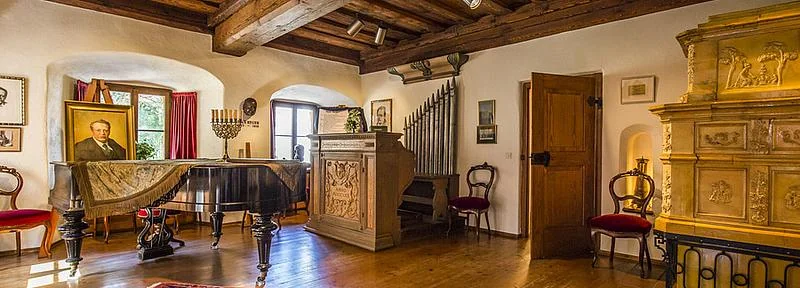
A prominent part of the City Museum is the Max Reger Collection. The composer Max Reger, who lived from 1873 to 1916, has two memory rooms dedicated to him. Reger spent his childhood in Weiden and is thus closely connected to the city. The collection expands the museum's perspective from general city history to a personality whose musical work gained significance far beyond the Upper Palatinate.
The memorabilia include a square piano and a death mask of the musician. Such objects make the person behind the historical and musical legacy immediately tangible. A square piano refers to the musical education and practice of past times, while a death mask represents an unusually personal form of remembrance. Together with the rooms, they create an area that not only conveys biographical information but also makes the city's memory culture visible.
Particularly noteworthy is the Max Reger Room, where the composer received music lessons during his school years. Thus, the place is not merely an exhibition space but a concrete part of the transmitted biography. Visitors can imagine how learning and musical education took place in the historic building. The connection of the original room, memorabilia, and local history gives the Max Reger Collection a special authenticity.
The Max Reger Rooms complement the other exhibition areas meaningfully. While the craftsmanship and living spaces represent the everyday life of many Weiden citizens, the collection focuses on a single personality. Both perspectives are part of city history: the broad development of the population and the memory of a well-known son of the city. The visit thus shows how a city museum can connect different scales.
Those searching for City Museum Weiden Max Reger often expect information about the memory rooms and the exhibited memorabilia. The collection is an important reason to understand the museum not just as a general local museum. It makes Weiden's musical heritage visible and connects local educational and life history with music history. This part of the museum also offers an independent attraction for guests interested in composers, historical classrooms, or regional cultural figures.
City Museum Weiden Address, Directions, and Parking in the City Center
The address of the City Museum is Schulgasse 3a, 92637 Weiden in the Upper Palatinate. The museum is located in the historic city center in the Cultural Center Hans Bauer. Schulgasse is part of the largely car-free areas of the Weiden old town. This also includes, among others, the Upper and Lower Market, Türlgasse, Wörthstraße, and Max-Reger-Straße. Therefore, those arriving by car should not expect to drive directly to the museum entrance. The last meters will be covered on foot.
For parking, numerous public parking spaces and garages are available around the old town. According to the city and local tourism offerings, there are approximately 2,000 parking spaces in the city center. This number includes parking garages and public parking spaces; parking spaces on public streets are not fully included in the city's representation. The specific availability, fees, and allowable maximum parking duration may vary depending on the location. Therefore, it is advisable to check the current overview plan of the city before departure.
The city of Weiden also offers digital options for parking. In managed public parking lots, parking tickets can be purchased via SMS or app, depending on the location. The city points out that when using the app for parking, a service fee may be charged in addition to the parking fee. For visitors to the City Museum, it is especially important to pay attention to the signage at the respective parking lot and to adhere to the allowed maximum parking duration.
Traveling by public transport can also be sensible for a visit to the old town. The Weiden train station is located in the city and has its own parking facilities. From there, the way to the city center can be planned with other means of transport or on foot. Since exact travel times depend on the chosen route and starting point, travelers should use the current city or line plan. The museum itself is located in a central area where several destinations can be connected.
The central location is an advantage for a combined visit. After the museum tour, guests can stroll through the historic city center, visit the Upper or Lower Market, or head to other cultural institutions in Weiden. Those arriving by bicycle should also use the designated parking facilities in the city and observe the pedestrian zone. Specific regulations apply to travel groups and buses; a concrete parking option should be coordinated in advance with the city or the respective parking operator.
City Museum Weiden Photos, Visitor Experience, and Connection with Other Museums
Photos from the City Museum Weiden provide an initial impression of the building and individual areas of the collection. Particularly the historic Old School House shapes the external and internal impact of the museum. The architecture already tells of the long history of the place before individual exhibits are considered. Images can also make the Max Reger Rooms, historical rooms, or selected museum objects visible. For planning, photos are helpful, but the actual visitor experience arises from the connection of space, object, and explanation.
The museum is suitable for various visit occasions. Those with little time can focus on the most important areas, such as the rooms related to city history, the craftsman's apartment, and the Max Reger collection. Those who want to engage more deeply with Weiden can plan the tour in more detail and then visit further destinations in the old town. Since admission is free and the museum is open on weekdays, the visit can be flexibly integrated into a stay in the city.
In the Cultural Center Hans Bauer, in addition to the City Museum, there is also the Gallery in the Old School House and the City Archive. The gallery presents changing exhibitions of local artists. Thus, the offerings can change depending on the exhibition period. The combination of historical collection and contemporary regional art makes the building a cultural place with multiple perspectives. Those interested in local identity can connect past, present, and artistic engagement here.
Another museum in the city is the Tachau Local Museum, which is also located at Schulgasse 3a. It is dedicated to the social, religious, and economic conditions of the former political district of Tachau-Pfraumberg in southern Egerland. Topics also include life until the expulsion in 1945 and 1946, as well as the integration of the population in Bavaria and Weiden. The opening hours and admission regulations of this museum may differ from those of the City Museum and should be checked separately.
Another well-known museum in Weiden is the International Ceramic Museum at Luitpoldstraße 25. It has its own opening hours and admission prices and is not identical to the City Museum. For visitors comparing multiple museums, this distinction is important. The City Museum focuses on city history, everyday culture, and Max Reger, while the International Ceramic Museum has a different collection focus. Together, the institutions showcase the cultural diversity of Weiden.
The City Museum Weiden is thus a suitable starting point for getting to know the city with its historical, social, and cultural layers. It connects the historic site of the Old School House with a collection that ranges from craftsmanship to living spaces and religious objects to music history. The free opening on weekdays, the central location, and the proximity to other attractions make the visit uncomplicated. Those who check opening hours and directions in advance can easily incorporate the museum visit into a full day in Weiden in the Upper Palatinate.
Sources:
- City Museum Weiden - Official Website of the City of Weiden
- Museums in Weiden - Opening Hours and Contact Information
- Parking in Weiden - Official Information from the City
- Parking in the City of Weiden - Tourism Weiden
- City Museum Weiden with Max Reger Collection - Museums in Bavaria
- Old School House - Cultural Center Hans Bauer - East Bavaria Tourism
Mehr anzeigenWeniger anzeigen
City Museum Weiden | Opening Hours & History
The City Museum Weiden in the Upper Palatinate invites you to understand the development of the city not only through dates but through concrete things, spaces, and personal life worlds. The collection is located in the Cultural Center Hans Bauer, a historic building at Schulgasse 3a, traditionally referred to as the Old School House in Weiden. The location itself makes the museum visit special: the building was completed in 1566 and has been associated with the German and Latin schools since the 16th century. Today, city history, everyday culture, craftsmanship, and music history come together there.
Those looking for City Museum Weiden opening hours, admission, exhibitions, or photos will find a manageable and content-rich tour in the museum. Topics include craftsmanship, living culture, religious expressions, and the development of Weiden. Staged historical rooms convey a vivid impression of earlier living conditions. A special focus is on two memory rooms for Max Reger, who is closely associated with Weiden as a composer. Admission to the City Museum is free. Due to its location in the historic city center, the visit can be easily combined with a tour of the old town.
City Museum Weiden Opening Hours, Admission, and Important Visitor Information
The opening hours are among the most important search queries related to the City Museum Weiden. The museum is open Monday to Friday from 09:00 to 12:00 and from 14:00 to 16:30. The lunch break should be taken into account when planning the day, as visits in the morning and afternoon are divided into two time slots. The City Museum remains closed from December 23 to January 6, as well as on Shrove Tuesday and public holidays. Those combining their visit with a trip, shopping, or a tour of the old town should check the current information from the city of Weiden before heading out.
Admission to the City Museum Weiden is free. This makes the museum particularly suitable for spontaneous visits, short cultural breaks, and family outings where multiple destinations in the city center can be connected. The address is Schulgasse 3a, 92637 Weiden in the Upper Palatinate. The museum is housed in the Cultural Center Hans Bauer and is organizationally part of the historical museum and archive area of the city. For telephone inquiries, the city of Weiden provides the number 0961 / 81-4102. The contact address is stadtmuseum@weiden.de.
The City Museum is not a venue with a running stage program and is also not a large exhibition hall with fixed seating capacities. The focus is on the collections and the historical presentation. Therefore, terms like hall plan, seating plan, or event capacity are not applicable here. Visitors come primarily for the exhibitions, the historical rooms, and the Max Reger collection. For current information on special openings, changes, and other offers, the official page of the city of Weiden is the most reliable point of contact.
The search query City Museum Weiden photos can also be meaningfully categorized. The city museum's website shows images of the building and individual areas. They provide an initial impression of the historic surroundings but do not replace the on-site tour. The staged rooms, in particular, are particularly vivid in the interplay of architecture, furniture, objects, and spatial arrangement. The museum is therefore a destination for anyone wanting to get to know Weiden in the Upper Palatinate compactly, free of charge, and with a clear connection to local history.
City Museum Weiden in the Upper Palatinate: History of the Museum and the Old School House
The history of the City Museum Weiden began in 1896. It was founded as a trade sample collection by Chief Land Court Councilor Albert Vierling. The original focus was on examples from trade and craftsmanship. In 1902, the collection was expanded into a local museum by city archivist Hans Wagner and magistrate councilor Christian Aichinger. Thus, a museum developed from a more commercially oriented collection that could comprehensively document the history and life world of the city.
In its early days, the museum was initially housed in the old meat bank. From 1915, it was located in the former hospital building at Unterer Markt 23. Since 1979, the City Museum has been located in the current Cultural Center Hans Bauer. The building is a distinctive box construction of the Altalmosen Foundation of the Clothmakers' Guild. Its construction was completed in 1566. The designation Old School House reminds us that both the German school and the Latin school were housed in the building since the 16th century.
The historic building is therefore more than a neutral shell for exhibits. It is part of the city's history itself and creates the framework for the exhibition. Walking through the rooms, one moves in a building that has been connected to education, administration, craftsmanship, and urban life for centuries. This connection between exhibition objects and architecture makes the visit particularly comprehensible. City history is not told exclusively in showcases but also through the place where the presentation takes place.
In addition to the City Museum, the Cultural Center Hans Bauer includes the Max Reger Collection, the Gallery in the Old School House, and the City Archive. The gallery features changing exhibitions of local artists. This creates a connection between historical collection, regional art, and communal memory culture. Depending on the time of visit, various cultural impressions can thus be combined. The City Museum remains the area where the development of Weiden and the lives of earlier generations are the focus.
For the search terms City Museum Weiden history and Old School House Weiden, it is particularly important that several layers of time overlap here. The founding of the museum in the late 19th century, its expansion into a local museum, the changing locations, and the current place in the historic school house together tell how the understanding of city history has changed. From the collection of individual trade objects, a museum emerged that makes visible the social, economic, religious, and cultural aspects of life in Weiden.
Exhibitions in the Museum Weiden: Craftsmanship, Living Culture, and Earlier Life Worlds
The City Museum Weiden showcases various themes of city history. Central areas include craftsmanship, living culture, and popular piety. These themes provide insight into the everyday lives of earlier generations and complement the classic political city history with concrete experiences. Tools, furnishings, religious objects, and historical rooms make it understandable how people worked, lived, believed, and shaped their environment.
The staged rooms are particularly vivid. These include the living spaces of a craftsman family, including a Black Kitchen. Such a kitchen conveys how strongly everyday life was shaped by dealing with fire, smoke, supplies, and craftsmanship. The presentation focuses not only on individual valuable objects but on the connection of many things within a household. Furniture, spatial arrangement, and everyday objects reveal how living and working were interconnected in historical urban life.
Furthermore, the museum showcases Biedermeier and Rococo rooms. These rooms represent different historical living and design concepts. They make it clear that interiors were not only used practically but also made societal ideas, prosperity, and taste visible. In comparing the types of rooms, visitors can trace changes in furnishings, decoration, and lifestyle. The rooms function like three-dimensional sources: they tell history not only through texts but through atmosphere, scale, and the arrangement of objects.
Another focus is on objects from churches and chapels. This incorporates the religious history of the city into the collection. Popular piety is often reflected in things that were used, revered, or passed on in everyday life. Such objects document personal and communal forms of faith and complement the representation of craftsmanship and living culture. Together, a picture of the city emerges that does not isolate economic, social, and religious areas.
The Museum Weiden in the Upper Palatinate is therefore particularly suitable for people who want to learn about regional history through tangible examples. Students can develop questions about work, living, and education based on the rooms and objects. Families gain uncomplicated access to the past because the exhibition does not consist solely of abstract data. Locals may discover references to well-known buildings, professions, or traditions. Visitors to the city receive a concentrated overview of Weiden before exploring the historic city center themselves.
City Museum Weiden Max Reger: Music History in the Old School House
A prominent part of the City Museum is the Max Reger Collection. The composer Max Reger, who lived from 1873 to 1916, has two memory rooms dedicated to him. Reger spent his childhood in Weiden and is thus closely connected to the city. The collection expands the museum's perspective from general city history to a personality whose musical work gained significance far beyond the Upper Palatinate.
The memorabilia include a square piano and a death mask of the musician. Such objects make the person behind the historical and musical legacy immediately tangible. A square piano refers to the musical education and practice of past times, while a death mask represents an unusually personal form of remembrance. Together with the rooms, they create an area that not only conveys biographical information but also makes the city's memory culture visible.
Particularly noteworthy is the Max Reger Room, where the composer received music lessons during his school years. Thus, the place is not merely an exhibition space but a concrete part of the transmitted biography. Visitors can imagine how learning and musical education took place in the historic building. The connection of the original room, memorabilia, and local history gives the Max Reger Collection a special authenticity.
The Max Reger Rooms complement the other exhibition areas meaningfully. While the craftsmanship and living spaces represent the everyday life of many Weiden citizens, the collection focuses on a single personality. Both perspectives are part of city history: the broad development of the population and the memory of a well-known son of the city. The visit thus shows how a city museum can connect different scales.
Those searching for City Museum Weiden Max Reger often expect information about the memory rooms and the exhibited memorabilia. The collection is an important reason to understand the museum not just as a general local museum. It makes Weiden's musical heritage visible and connects local educational and life history with music history. This part of the museum also offers an independent attraction for guests interested in composers, historical classrooms, or regional cultural figures.
City Museum Weiden Address, Directions, and Parking in the City Center
The address of the City Museum is Schulgasse 3a, 92637 Weiden in the Upper Palatinate. The museum is located in the historic city center in the Cultural Center Hans Bauer. Schulgasse is part of the largely car-free areas of the Weiden old town. This also includes, among others, the Upper and Lower Market, Türlgasse, Wörthstraße, and Max-Reger-Straße. Therefore, those arriving by car should not expect to drive directly to the museum entrance. The last meters will be covered on foot.
For parking, numerous public parking spaces and garages are available around the old town. According to the city and local tourism offerings, there are approximately 2,000 parking spaces in the city center. This number includes parking garages and public parking spaces; parking spaces on public streets are not fully included in the city's representation. The specific availability, fees, and allowable maximum parking duration may vary depending on the location. Therefore, it is advisable to check the current overview plan of the city before departure.
The city of Weiden also offers digital options for parking. In managed public parking lots, parking tickets can be purchased via SMS or app, depending on the location. The city points out that when using the app for parking, a service fee may be charged in addition to the parking fee. For visitors to the City Museum, it is especially important to pay attention to the signage at the respective parking lot and to adhere to the allowed maximum parking duration.
Traveling by public transport can also be sensible for a visit to the old town. The Weiden train station is located in the city and has its own parking facilities. From there, the way to the city center can be planned with other means of transport or on foot. Since exact travel times depend on the chosen route and starting point, travelers should use the current city or line plan. The museum itself is located in a central area where several destinations can be connected.
The central location is an advantage for a combined visit. After the museum tour, guests can stroll through the historic city center, visit the Upper or Lower Market, or head to other cultural institutions in Weiden. Those arriving by bicycle should also use the designated parking facilities in the city and observe the pedestrian zone. Specific regulations apply to travel groups and buses; a concrete parking option should be coordinated in advance with the city or the respective parking operator.
City Museum Weiden Photos, Visitor Experience, and Connection with Other Museums
Photos from the City Museum Weiden provide an initial impression of the building and individual areas of the collection. Particularly the historic Old School House shapes the external and internal impact of the museum. The architecture already tells of the long history of the place before individual exhibits are considered. Images can also make the Max Reger Rooms, historical rooms, or selected museum objects visible. For planning, photos are helpful, but the actual visitor experience arises from the connection of space, object, and explanation.
The museum is suitable for various visit occasions. Those with little time can focus on the most important areas, such as the rooms related to city history, the craftsman's apartment, and the Max Reger collection. Those who want to engage more deeply with Weiden can plan the tour in more detail and then visit further destinations in the old town. Since admission is free and the museum is open on weekdays, the visit can be flexibly integrated into a stay in the city.
In the Cultural Center Hans Bauer, in addition to the City Museum, there is also the Gallery in the Old School House and the City Archive. The gallery presents changing exhibitions of local artists. Thus, the offerings can change depending on the exhibition period. The combination of historical collection and contemporary regional art makes the building a cultural place with multiple perspectives. Those interested in local identity can connect past, present, and artistic engagement here.
Another museum in the city is the Tachau Local Museum, which is also located at Schulgasse 3a. It is dedicated to the social, religious, and economic conditions of the former political district of Tachau-Pfraumberg in southern Egerland. Topics also include life until the expulsion in 1945 and 1946, as well as the integration of the population in Bavaria and Weiden. The opening hours and admission regulations of this museum may differ from those of the City Museum and should be checked separately.
Another well-known museum in Weiden is the International Ceramic Museum at Luitpoldstraße 25. It has its own opening hours and admission prices and is not identical to the City Museum. For visitors comparing multiple museums, this distinction is important. The City Museum focuses on city history, everyday culture, and Max Reger, while the International Ceramic Museum has a different collection focus. Together, the institutions showcase the cultural diversity of Weiden.
The City Museum Weiden is thus a suitable starting point for getting to know the city with its historical, social, and cultural layers. It connects the historic site of the Old School House with a collection that ranges from craftsmanship to living spaces and religious objects to music history. The free opening on weekdays, the central location, and the proximity to other attractions make the visit uncomplicated. Those who check opening hours and directions in advance can easily incorporate the museum visit into a full day in Weiden in the Upper Palatinate.
Sources:
- City Museum Weiden - Official Website of the City of Weiden
- Museums in Weiden - Opening Hours and Contact Information
- Parking in Weiden - Official Information from the City
- Parking in the City of Weiden - Tourism Weiden
- City Museum Weiden with Max Reger Collection - Museums in Bavaria
- Old School House - Cultural Center Hans Bauer - East Bavaria Tourism
Frequently Asked Questions
Reviews
S MB
3. August 2026
I rushed like mad to reach this museum around 12:00, before they close it at 13:00, I followed their official website: Opening hours of the city administration Mon, Tue, Wed, and Fri: 08:00 - 13:00 ... But they put a paper notice on the door that they close at 12, so I could not visit it. Such misinformation is very disrespectful to visitors who pass through Weiden and want to visit it, without staying here for a full day or overnight.
André KH Korndörfer
15. April 2026
Weiden in der Oberpfalz is worth a visit, the closed townscape, the market, the churches - one should definitely also see the city museum in a nearly half-millennium-old building that was once used as a grain store and later as a school. The museum is very multifaceted and is dedicated to the composer Max Reger, who spent his childhood and youth here, as well as significant personalities for the development of the city. You can find historical furniture as well as old tin toys, an old model pharmacy, and a black kitchen. The local porcelain manufacturers Bauscher, Seltmann, and Bavaria are also not forgotten. The signage is sparse but concise, mostly the exhibits speak for themselves - the visit was worth it, even though it was free, there is a donation box where you can drop something in, which was by no means difficult after the interesting visit.
caliban lemarchand
18. September 2025
Very interesting exhibition with really great pieces. Fun museum, it's free and the staff go about their work on the floor... They don't disturb you though 😀
Monika Tusch
13. September 2019
Highly interesting! Changing thematic focuses, lovingly put together and presented.
Thomas Roth
4. December 2017
A really nice museum