
Sergei Sergejewitsch Prokofjew
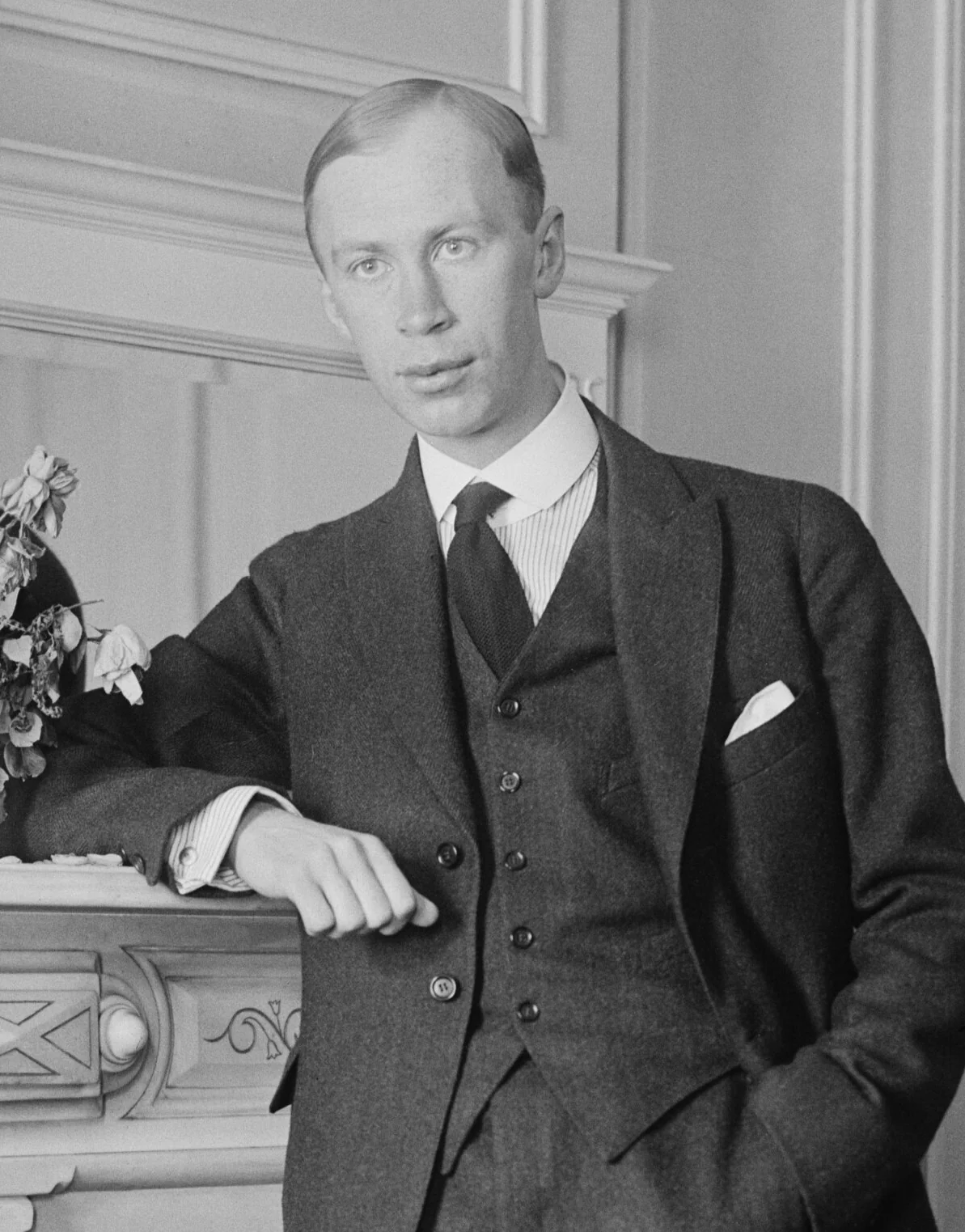
Image from Wikipedia
Image from Wikipedia
Sergei Sergeyevich Prokofiev – The Radical Melodist Between Avant-Garde, Ballet, and Soviet Tragedy
A Composer Who Shaped the 20th Century with a Distinctive Hand
Sergei Sergeyevich Prokofiev is one of the most prominent composers of the 20th century: a pianist, musical innovator, provocateur, and master of large form all at once. Born in 1891 in what was then the Russian Empire and who died in Moscow in 1953, his journey took him from early training in St. Petersburg to years of exile in the USA and Paris, before returning to the Soviet Union where he continued to work under difficult political conditions. His work combines sharp rhythmicity, incisive melody, sarcastic energy, and an often surprisingly lyrical intimacy. Above all, Peter and the Wolf, Romeo and Juliet, Alexander Nevsky, and the Classical Symphony have permanently inscribed his name in the canon of classical music. ([deutschegrammophon.com](https://www.deutschegrammophon.com/en/composers/sergei-prokofiev/biography))
Biography: From Prodigy to International Trendsetter
Prokofiev's artistic development began early and with remarkable consistency. Already as a child, he composed small piano pieces, and at the age of 13, he entered the St. Petersburg Conservatory, where early miniatures evolved into first published compositions. His first opera was even composed at the age of ten; it remained a youthful work but already displayed the urge for dramatic intensification that would characterize his entire oeuvre. Later, he shaped himself at the conservatory into a composer who did not imitate tradition but energetically reinterpreted it. ([deutschegrammophon.com](https://www.deutschegrammophon.com/en/composers/sergei-prokofiev/biography))
Even his early performances as a pianist made waves. Prokofiev viewed the piano not just as an instrument but as a stage for attack, virtuosity, and irony. His first piano concerto was mocked by conservative critics, while the second was regarded as a monumental challenge with an extremely difficult cadenza. At the same time, in works such as the Classical Symphony and the First Violin Concerto, he demonstrated that behind the provocation lay a highly disciplined compositional architecture. This combination of wit, sharpness, and formal control made him an early singular voice of modernity. ([deutschegrammophon.com](https://www.deutschegrammophon.com/en/composers/sergei-prokofiev/biography))
Between Revolution, Exile, and Return
The political upheavals following the October Revolution fundamentally altered Prokofiev's life path. In 1918, he left Russia, traveling via Japan to the USA, and lived in Paris from 1923 until 1936. During these years, he wrote commissioned works for America as well as more complex, modernist scores for the Parisian music scene. Works such as The Love for Three Oranges, the Third Symphony, and The Fiery Angel reflect this transatlantic phase, in which Prokofiev balanced audience expectations, avant-garde tendencies, and personal independence. ([deutschegrammophon.com](https://www.deutschegrammophon.com/en/composers/sergei-prokofiev/biography))
From the early 1930s, the focus of his work increasingly shifted back toward the Soviet Union. Prokofiev oscillated between Western concert life and Soviet residencies for a time before definitively returning in 1936. This return brought new opportunities but also new restrictions. The famous ballet Romeo and Juliet was created during this transitional period and demonstrates how Prokofiev combined melodic directness with dramatic compression. His music became more accessible without losing its compositional sophistication. ([deutschegrammophon.com](https://www.deutschegrammophone.com/en/composers/sergei-prokofiev/biography))
Film, Theater, and Grand Symphonic Thinking
Prokofiev's work for film and stage lies at the core of his reputation as a sound dramaturge. With Lieutenant Kijé, which began in 1933, one of the most elegant partnerships between music and film in Soviet cinema commenced, followed by Alexander Nevsky, whose wide-reaching, post-romantic melodies remain a model case of compelling film music. Ivan the Terrible also demonstrates how precisely Prokofiev translated dramatic tension into musical form. His collaboration with Sergei Eisenstein became famous precisely because of this fine timing. ([deutschegrammophon.com](https://www.deutschegrammophon.com/en/composers/sergei-prokofiev/biography))
His symphonic and chamber music displays the same dual strategy: clear gestures, immediately recognizable motifs, and at the same time unexpected harmonic shifts. Late works such as the Sixth, Seventh, and Eighth Piano Sonatas or the First Violin Sonata carry a darker, more serious handwriting. Deutsche Grammophon describes this development as a journey from the "cheeky" young modernist to a deeper, more emotional composer who transformed the tensions of the Soviet art system into sound. ([deutschegrammophon.com](https://www.deutschegrammophon.com/en/composers/sergei-prokofiev/biography))
Discography and Reception: A World-Class Repertoire
Prokofiev's discography is not only extensive but also exceptionally broad in style. AllMusic documents recordings and performances ranging from early piano rolls and historical documents to modern interpretations. In terms of reception, the ballet suites, piano concertos, symphonies, operas The Love for Three Oranges and War and Peace, as well as the children's pieces are among the most frequently cherished pillars of his oeuvre. In particular, Peter and the Wolf has established itself as a global entry point into classical music. ([allmusic.com](https://www.allmusic.com/artist/sergey-prokofiev-mn0000596899))
The critical reception of Prokofiev often followed the pattern of late recognition. Early premieres sometimes caused irritation because his music seemed too biting, dissonant, or idiosyncratic. However, over time, the insight emerged that Prokofiev was not merely a modernist but a composer with a tremendous sense of audience, theater, and form. His works were performed internationally, anchored in the Soviet repertoire, and later confirmed by music critics and scholars as an indispensable part of modernity. ([deutschegrammophon.com](https://www.deutschegrammophon.com/en/composers/sergei-prokofiev/biography))
Musical Language: Sharpness, Melody, and Rhythmic Restlessness
Prokofiev’s style thrives on contrasts. He worked with distinctive rhythms, motoric energy, sharply defined themes, and a harmony that fluctuated between clarity and tension. At the same time, he had an exceptional sensibility for songful lines, which makes his music accessible despite its modernity. This connection of brutality and cantabile, irony and emphasis, is part of the reasons why his works resonate permanently in the concert hall. ([deutschegrammophon.com](https://www.deutschegrammophon.com/en/composers/sergei-prokofiev/biography))
His gift for characterization is particularly strong. In Peter and the Wolf, instruments become characters, in the ballet scores dramatic movement images arise, and in the symphonies, he develops a nearly theatrical sense of tension. Prokofiev did not compose abstractly but plastically; even in pure instrumental music, he thinks in scenes, gestures, and sound colors. This is where his historical uniqueness lies: he combines analytical construction with immediate engagement. ([deutschegrammophon.com](https://www.deutschegrammophon.com/en/composers/sergei-prokofiev/biography))
Cultural Influence: Between Soviet History and Global Repertoire
Prokofiev's cultural influence extends far beyond the classical music scene. His music has been repeatedly rediscovered in concert halls, films, ballets, and educational formats because it is both accessible and complex. The Peter and the Wolf principle of merging music with clear figures and narrative conciseness continues to resonate in music education today. His film scores also set standards for how symphonic scores can work with visual dramaturgy. ([deutschegrammophon.com](https://www.deutschegrammophon.com/en/composers/sergei-prokofiev/biography))
At the same time, Prokofiev exemplifies the tension between individual art and political system. The years under Stalin brought control, pressure, and health strains; in 1945, he suffered an aneurysm that significantly limited his ability to work. Nevertheless, in his final years, works of remarkable intellectual tension emerged. His death on March 5, 1953, ironically coincided with Stalin's death, a historical coincidence that adds almost symbolic weight to his posthumous reputation. ([deutschegrammophon.com](https://www.deutschegrammophon.com/en/composers/sergei-prokofiev/biography))
Current Releases and Today’s Presence
As a deceased composer, Prokofiev has no current projects or new releases in the contemporary sense. However, his music remains highly active in the repertoire, present on recordings and in concert programs. Current recordings and re-releases, for instance in significant label catalogs, demonstrate how lively his work continues to be in 2026. The present does not merely manage a legacy but a continued tradition of performance. ([deutschegrammophon.com](https://www.deutschegrammophon.com/en/catalogue/products/prokofiev-peter-and-the-wolf-gustavo-dudamel-14406?utm_source=openai))
Conclusion: Why Sergei Prokofiev Continues to Fascinate Today
Sergei Prokofiev remains intriguing because he did not smooth over contrasts but made them productive: avant-garde and melody, virtuosity and closeness to the folk, irony and pathos, formal rigor and emotional directness. His music possesses the rare ability to challenge intellectually while also touching directly. Anyone who experiences Prokofiev live in the concert hall encounters a sound cosmos that still feels fresh, risky, and surprising today. ([deutschegrammophon.com](https://www.deutschegrammophon.com/en/composers/sergei-prokofiev/biography))
Official Channels of Sergei Sergeyevich Prokofiev:
- Instagram: No official profile found
- Facebook: No official profile found
- YouTube: No official profile found
- Spotify: No official profile found
- TikTok: No official profile found